Home
Class 12
PHYSICS
In a car race, car A takes a time t less...

In a car race, car A takes a time t less than car B at the finish and passes the finishing point with speed v more than that of the car B. Assuming that both the cars start from rest and travel with constant acceleration `a_1 and a_2` respectively. Show that `v=sqrt (a_1 a_2) t.`

A

`v_(0) = sqrt((alpha^(2)-beta^(2))/(2)t_(0)`

B

`v_(0) = ((alpha+beta)/(2))t_(0)`

C

`v_(0) = sqrt(alpha beta)t_(0)`

D

`v_(0) = sqrt((alpha^(2)+beta^(2))/(2)t_(0)`

Text Solution

Verified by Experts

The correct Answer is:
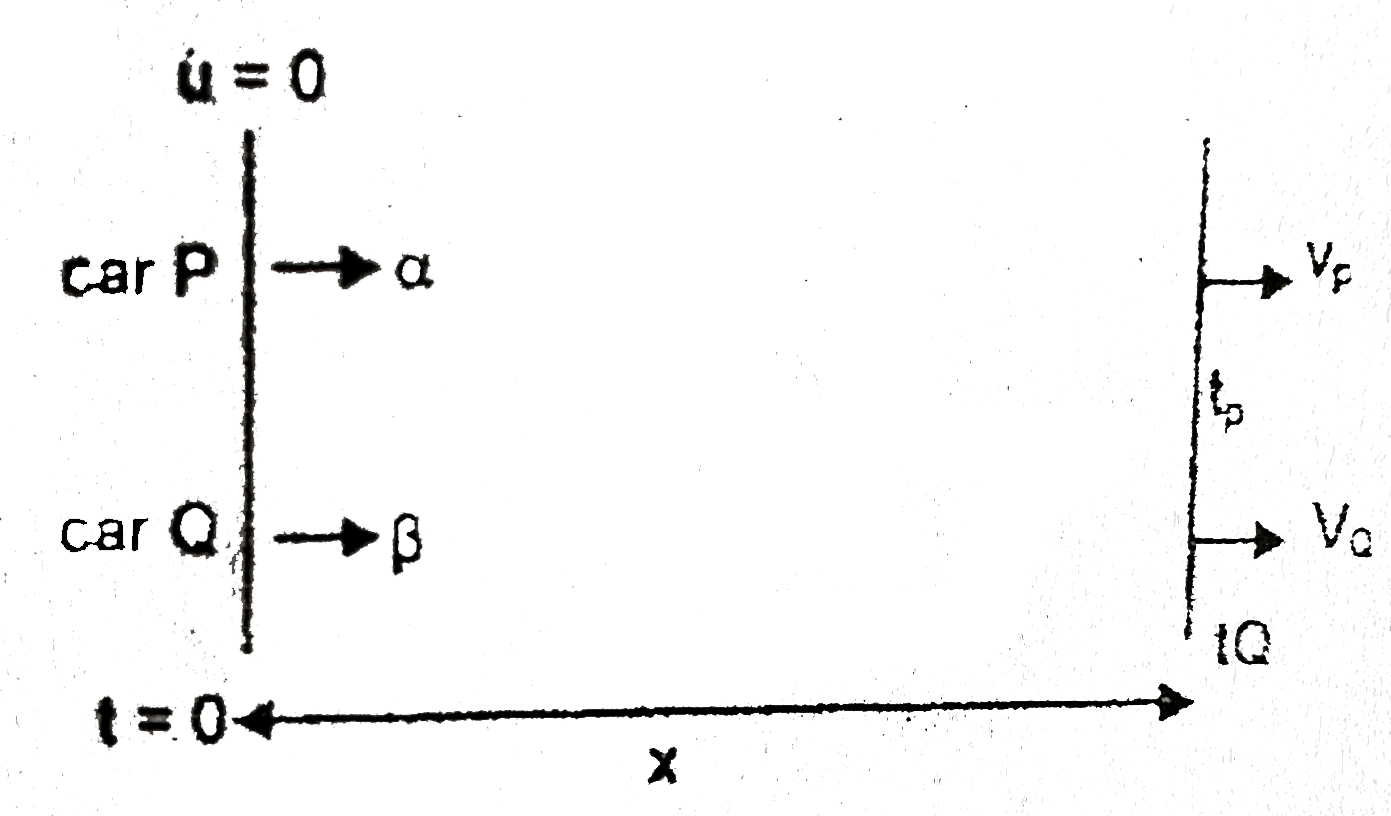
C

In a car race ……….

P.given `t_(Q) - t_(p) = t_(0) - 0 V_(p) - V_(Q) = V_(0)` ………(2)
`x =0 xxt_(p) + (1)/(2)alpha t_(p)^(2) implies t_(p) = sqrt((2x)/(alpha))`
`v_(p)^(2) = 0^(2) + 2alpha x implies V_(p) = sqrt(2alpha x)`
`Q. x = 0 xxt_(Q) + (1)/(2)beta t_(Q)^(2)`
`t_(Q) = sqrt((2x)/(beta))`
now ` (V_(p) - V_(Q))/(t_(Q) - t_(p)) = (v_(0))/(t_(0)) implies (sqrt(2alpha x)-sqrt(2beta x))/(sqrt((2x)/(beta))-sqrt((2x)/(alpha))) = (v_(0))/(t_(0))`
`implies v_(0) = sqrt(alpha beta n t_(0))`
Promotional Banner

Topper's Solved these Questions

  • TEST PAPERS

    RESONANCE ENGLISH|Exercise PART - II PHYSICS|106 Videos
  • SIMPLE HARMONIC MOTION

    RESONANCE ENGLISH|Exercise Advanced Level Problems|13 Videos
  • TEST SERIES

    RESONANCE ENGLISH|Exercise PHYSICS|130 Videos

Similar Questions

Explore conceptually related problems

In a car race, car A takes time t less than car B and passes the finishing point with a velocity v more than the velocity with which car B passes the point. Assuming that the cars start from rest and travel with constant accelerations a_1 and a_2 show that v/t=sqrt(a_1a_2) .

In a car race, car A takes 4 s less than can B at the finish and passes the finishing point with a velcity v more than the car B . Assumung that the cars start form restand travel with constant accleration a_(1)=4 m s^(-2) and a_(2) =1 m s^(-2) respectively, find the velocity of v in m s^(-1) .

In a car race car A takes t_(0) time less to finish than car B and pases the finishing point with a velocity v_(0) more than car B . The cars start from rest and travel with constant accelerations a_(1) and a_(2) . Then the ratio (v_(0))/(t_(0)) is equal to

In a car race, car A takes time t less than car B and passes the finishing point with a velocity of 12m//s more than the velocity with which car B passes the finishing point. Assume that the cars A and B start from rest and travel with constant acceleration of 9 m//s^(2) and 4 m//s^(2) , respectively. If v_(A) and v_(B) be the velocities of cars A and B, respectively, then

Starting from rest a particle is first accelerated for time t_1 with constant acceleration a_1 and then stops in time t_2 with constant retardation a_2. Let v_1 be the average velocity in this case and s_1 the total displacement. In the second case it is accelerating for the same time t_1 with constant acceleration 2a_1 and come to rest with constant retardation a_2 in time t_3. If v_2 is the average velocity in this case and s_2 the total displacement, then

Starting from rest a particle is first accelerated for time t_1 with constant acceleration a_1 and then stops in time t_2 with constant retardation a_2. Let v_1 be the average velocity in this case and s_1 the total displacement. In the second case it is accelerating for the same time t_1 with constant acceleration 2a_1 and come to rest with constant retardation a_2 in time t_3. If v_2 is the average velocity in this case and s_2 the total displacement, then

A particle starts with an initial velocity and passes successively over the two halves of a given distance with constant accelerations a_1 and a_2 respectively. Show that the final velocity is the same as if the whole distance is covered with a uniform acceleration (a_1 + a_2)/2 .

A car, starting from rest, accelerates at the rate f through a distance s, then continues at constant speed for time t and then decelerates at the rate f/ 2 to come to rest. If the total distance travelled is 15 s, then

A car, starting from rest, accelerates at the rate f through a distance s, then continues at constant speed for time t and then decelerates at the rate f/ 2 to come to rest. If the total distance travelled is 15 s, then

Engine of a car supplies constant power to the car which accelerates from rest. Car moves along a straight road. If velocity and displacement of car at any time t be v and s respectively then

RESONANCE ENGLISH-TEST PAPERS-PHYSICS
  1. Two vectors vecA and vecB have magnitude in the ratio 1:2 respectivel...

    Text Solution

    |

  2. For an object, graph of (1)/(v) and x is as shown in figure, where v i...

    Text Solution

    |

  3. In a car race, car A takes a time t less than car B at the finish and ...

    Text Solution

    |

  4. The displacement of a particle a duntion of time is showm in figure. I...

    Text Solution

    |

  5. A bal is thrown vertically upwards from the ground. It crosses a point...

    Text Solution

    |

  6. int(0)^(pi//4) e^(x) (tan x+ sec^(2)x) dx

    Text Solution

    |

  7. A particle starts to move along a straight line. The acceleration vers...

    Text Solution

    |

  8. A semicircle of radius R = 5m with diameter AD as shown in figure. Two...

    Text Solution

    |

  9. A balloon is moving along with constant upward acceleration of 1 m//s^...

    Text Solution

    |

  10. If vecAxxvecB=vecC, then choose the incorrect option : [vecA and vecB ...

    Text Solution

    |

  11. A particle has an initial velocity of 9 m//s^(2) due east and a cons...

    Text Solution

    |

  12. An ant starts from point 'O' moving 50m due east, then 50m 30^(@) sout...

    Text Solution

    |

  13. A particle is projected in a smooth fixed square tube from point A. Th...

    Text Solution

    |

  14. The acceleration time graph of the motion of a particle from A to B is...

    Text Solution

    |

  15. If a stone is relased from a balloon moving upwards with certain veloc...

    Text Solution

    |

  16. The acceleration versus time graph for a particle moving along a strai...

    Text Solution

    |

  17. A particle can travel point A to B from two different path 1 and 2, as...

    Text Solution

    |

  18. Velocity of a particle moving along a straight line at any time 't' is...

    Text Solution

    |

  19. A particle moves with an initial velocity V(0) and retardation alpha v...

    Text Solution

    |

  20. A particle moves with an initial velocity V(0) and retardation alpha v...

    Text Solution

    |

