Home
Class 12
PHYSICS
A particle is projected in a smooth fixe...

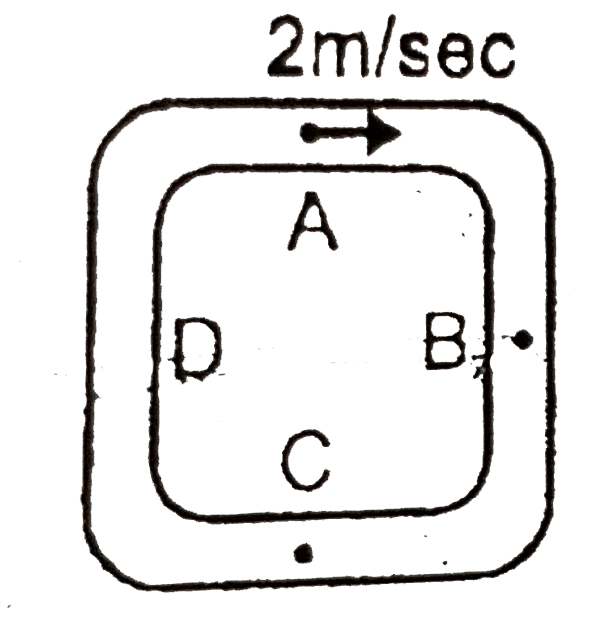
A particle is projected in a smooth fixed square tube from point A. The tube is in vertical plane and D and B are at same horizontal level as shown in figure. Then : (Assume velocity of particle changes smoothly at corners)

A

velocity at A is equal to velocity at C

B

velocity at B is equal to velocity at D

C

velocity at A is equal to negative of velocity at C

D

speed ast B is equal to speed at D

Text Solution

Verified by Experts

The correct Answer is:

D

A particle is ………..
At B and D magnitude of velocity are same but direactions are different.
Promotional Banner

Topper's Solved these Questions

  • TEST PAPERS

    RESONANCE ENGLISH|Exercise PART - II PHYSICS|106 Videos
  • SIMPLE HARMONIC MOTION

    RESONANCE ENGLISH|Exercise Advanced Level Problems|13 Videos
  • TEST SERIES

    RESONANCE ENGLISH|Exercise PHYSICS|130 Videos

Similar Questions

Explore conceptually related problems

A particles is projected horizontally with a speed v from the top of a plane inclined at an angle tehta to the horizontal as shown in the figure. (a) Hwo far from the point of projection will the particle strike the plane ? (b) Find the time taken by the particel to hit the plane. (c) What is the velocity of particle just before it hits the plane ?

A particle is projected from a point A with velocity sqrt(2)u an angle of 45^(@) with horizontal as shown in figure. It strikes the plane BC at right angles. The velocity of the particle at the time of collision is

Two particles A and B moving in a plane have velocities as shown in figure .Relative velocity of A w.r.t B

A particle in projected with velocity sqrt(3gL) at point A (lowest point of the circle) in the vertical plane. Find the maximum height about horizontal level of point A if the string slacks at the point B as shown in figure.

A particle is projected vertically upward with velocity u from a point A , when it returns to the point of projection .

A particle of mass 0.1kg is launched at an angle of 53^(@) with the horizontal . The particle enters a fixed rough hollow tube whose length is slightly less than 12.5m and which is inclined at an angle of 37^(@) with the horizontal as shown in figure. It is known that the velocity of ball when it enters the tube is parallel to the axis of the tube. The coefficient of friction betweent the particle and tube inside the tube is mu=(3)/(8)[ Take g=10m//g^(2)] The distance from the point of projection where the particle will land on the horizontal plane after coming out from the tube is approximately equal to :

A particle of mass 0.1kg is launched at an angle of 53^(@) with the horizontal . The particle enters a fixed rough hollow tube whose length is slightly less than 12.5m and which is inclined at an angle of 37^(@) with the horizontal as shown in figure. It is known that the velocity of ball when it enters the tube is parallel to the axis of the tube. The coefficient of friction betweent the particle and tube inside the tube is mu=(3)/(8)[ Take g=10m//g^(2)] The velocity of the particle as it enters the tube is :

A particle of mass 0.1kg is launched at an angle of 53^(@) with the horizontal . The particle enters a fixed rough hollow tube whose length is slightly less than 12.5m and which is inclined at an angle of 37^(@) with the horizontal as shown in figure. It is known that the velocity of ball when it enters the tube is parallel to the axis of the tube. The coefficient of friction betweent the particle and tube inside the tube is mu=(3)/(8)[ Take g=10m//g^(2)] The kinetic energy of the particle when it comes out of the tube is approximately equal to :

Two particles are projected simultaneously from the same point, with the same speed, in the same vertical plane, and at different angles with the horizontal in a uniform gravitational field acting vertically downwards. A frame of reference is fixed to one particle. The position vector of the other particle , as observed from this frame, is vecr . Which of the following statement is correct?

A particle is projected horizontally with a speed u from the top of plane inclined at an angle theta with the horizontal. How far from the point of projection will the particle strike the plane ?

RESONANCE ENGLISH-TEST PAPERS-PHYSICS
  1. A particle has an initial velocity of 9 m//s^(2) due east and a cons...

    Text Solution

    |

  2. An ant starts from point 'O' moving 50m due east, then 50m 30^(@) sout...

    Text Solution

    |

  3. A particle is projected in a smooth fixed square tube from point A. Th...

    Text Solution

    |

  4. The acceleration time graph of the motion of a particle from A to B is...

    Text Solution

    |

  5. If a stone is relased from a balloon moving upwards with certain veloc...

    Text Solution

    |

  6. The acceleration versus time graph for a particle moving along a strai...

    Text Solution

    |

  7. A particle can travel point A to B from two different path 1 and 2, as...

    Text Solution

    |

  8. Velocity of a particle moving along a straight line at any time 't' is...

    Text Solution

    |

  9. A particle moves with an initial velocity V(0) and retardation alpha v...

    Text Solution

    |

  10. A particle moves with an initial velocity V(0) and retardation alpha v...

    Text Solution

    |

  11. A particle moves with an initial velocity and retardation , where v i...

    Text Solution

    |

  12. If |vecA| = 4 and is constant. The value of vec, (dvecA)/(dt) can be ...

    Text Solution

    |

  13. A vector of magnitude sqrt2 coplanar with the vectors veca=hati+hatj+2...

    Text Solution

    |

  14. The resultant of vecA and vecB makes an angle alpha with vecA and beta...

    Text Solution

    |

  15. The value of cos0 cos1^(@)cos2^(@) ……………. cos179^(@) cos180^(@) is :

    Text Solution

    |

  16. Select the correct statement

    Text Solution

    |

  17. If veca = hati+hatj-2hatk, vecb=2hati-3hatj+hatk the value of (2veca+3...

    Text Solution

    |

  18. A vector may change when we :

    Text Solution

    |

  19. Select the statement about two vector vecA and vecB .

    Text Solution

    |

  20. A copper sphere is being heated. Its volume as a result of increasing ...

    Text Solution

    |
