Home
Class 12
PHYSICS
A body which was released from rest, sli...

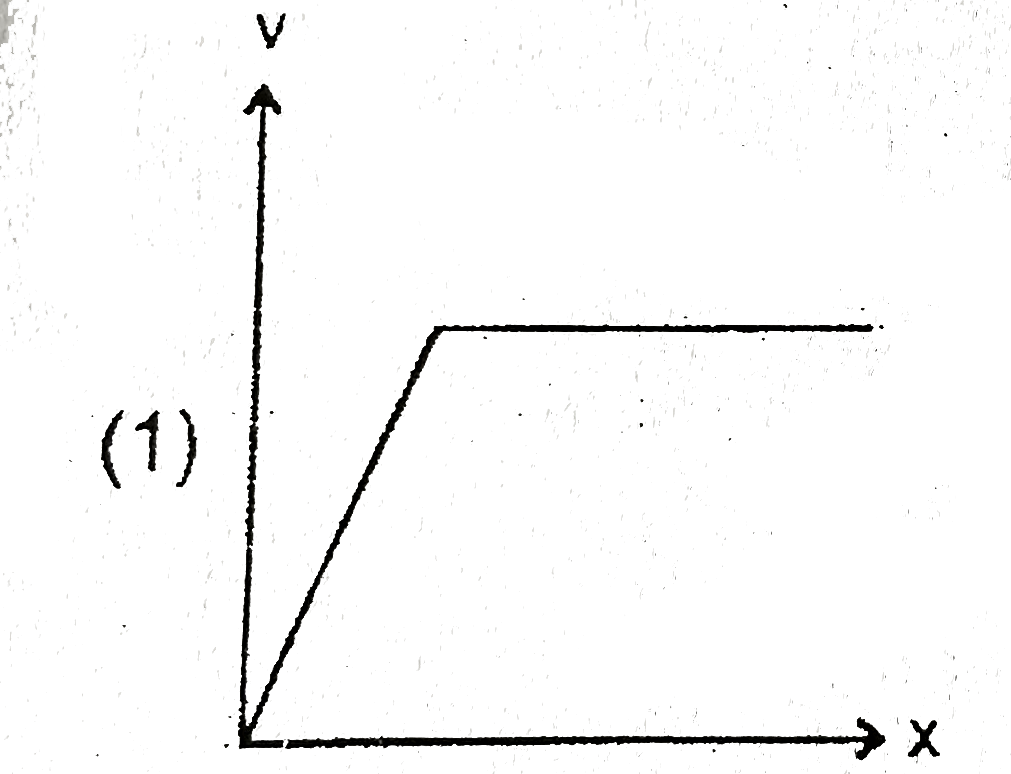
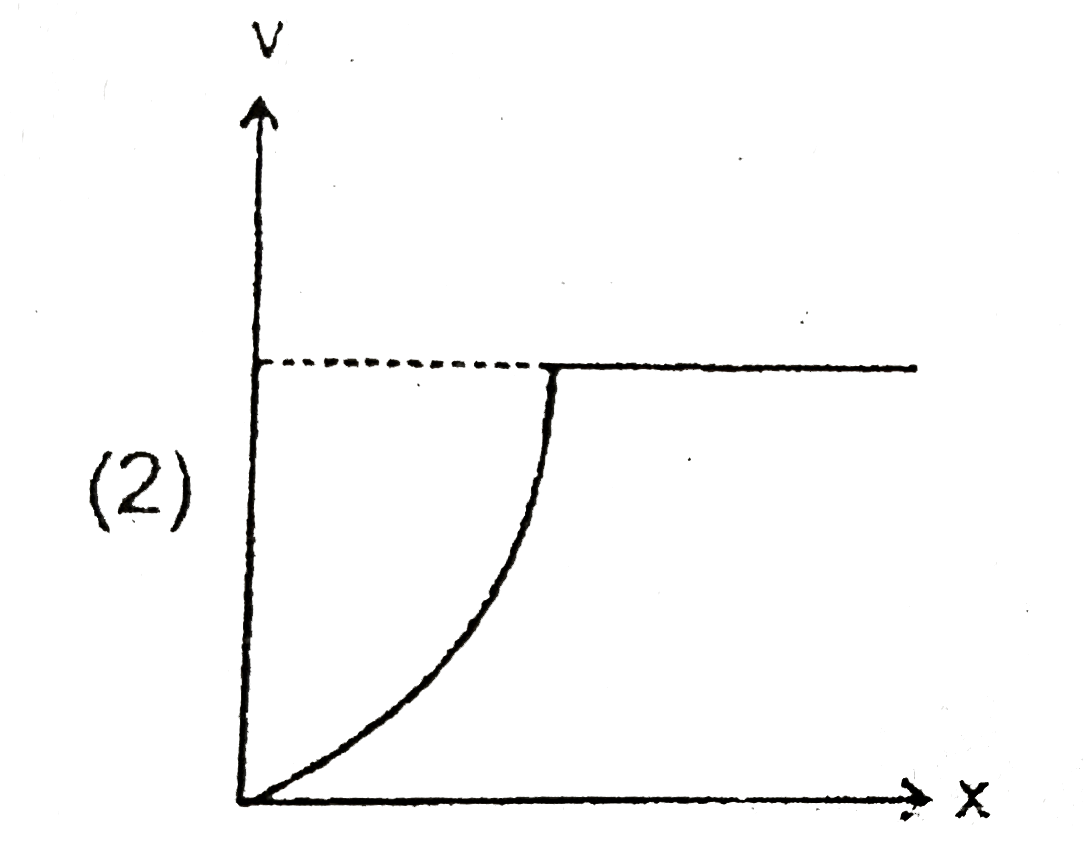
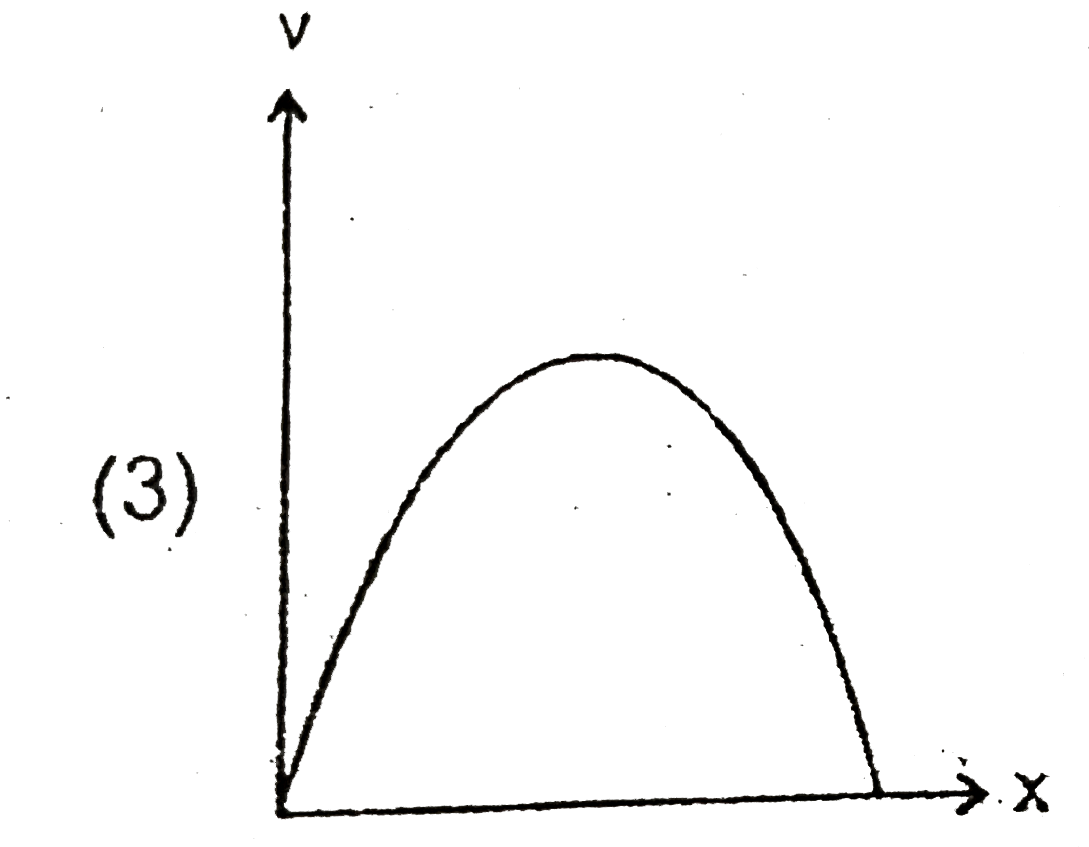
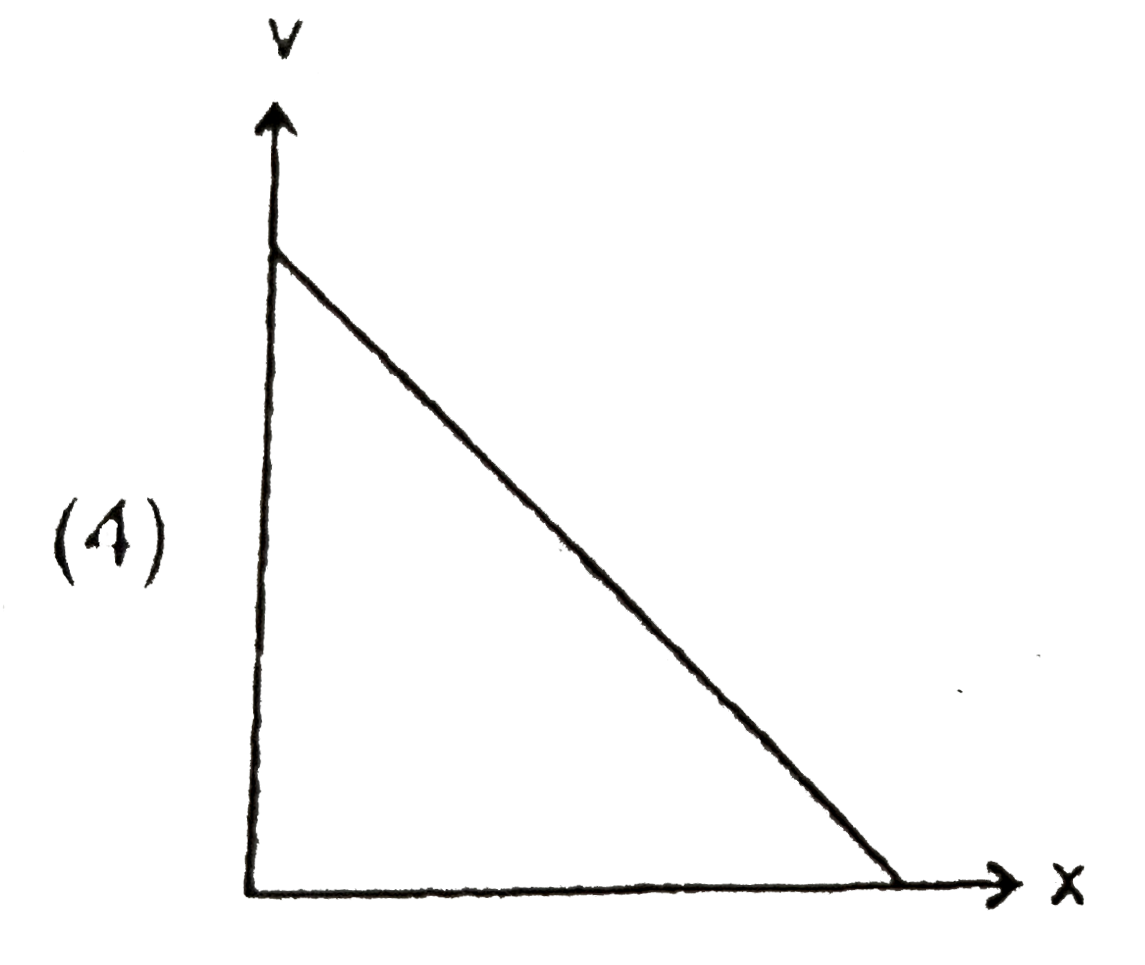
A body which was released from rest, slides down on an inclined plane of inclination `theta`. The coefficient of friction dowh the plane varies as `mu = kx` where k is a spositive constant and x is the distance moved by the body down the plane. The speed of the body 'v' versus distance 'x' graph will be as :

A

B

C

D

Text Solution

AI Generated Solution

The correct Answer is:

To solve the problem, we need to analyze the motion of a body sliding down an inclined plane with a varying coefficient of friction. Let's break it down step by step. ### Step 1: Identify the forces acting on the body When the body is on the inclined plane, the following forces act on it: - Gravitational force (weight) \( mg \) - Normal force \( N \) - Frictional force \( f \) The gravitational force can be resolved into two components: - Perpendicular to the incline: \( mg \cos \theta \) - Parallel to the incline: \( mg \sin \theta \) The frictional force, which opposes the motion, is given by: \[ f = \mu N \] Given that \( \mu = kx \), where \( k \) is a positive constant and \( x \) is the distance moved down the plane, we have: \[ f = kx N \] ### Step 2: Determine the normal force The normal force \( N \) acting on the body is equal to the perpendicular component of the gravitational force: \[ N = mg \cos \theta \] ### Step 3: Write the expression for frictional force Substituting the expression for \( N \) into the frictional force equation: \[ f = kx (mg \cos \theta) \] ### Step 4: Apply Newton's second law The net force acting on the body along the incline is: \[ F_{\text{net}} = mg \sin \theta - f \] Substituting the expression for \( f \): \[ F_{\text{net}} = mg \sin \theta - kx (mg \cos \theta) \] Using Newton's second law \( F = ma \), we can write: \[ ma = mg \sin \theta - kx (mg \cos \theta) \] Dividing through by \( m \): \[ a = g \sin \theta - kx (g \cos \theta) \] ### Step 5: Relate acceleration to velocity and distance Acceleration \( a \) can also be expressed as: \[ a = \frac{dv}{dt} = \frac{dv}{dx} \cdot \frac{dx}{dt} = v \frac{dv}{dx} \] Substituting this into our equation gives: \[ v \frac{dv}{dx} = g \sin \theta - kx (g \cos \theta) \] ### Step 6: Integrate to find the relationship between \( v \) and \( x \) Rearranging the equation: \[ v dv = \left( g \sin \theta - kx g \cos \theta \right) dx \] Integrating both sides: \[ \int v \, dv = \int \left( g \sin \theta - kx g \cos \theta \right) dx \] This results in: \[ \frac{v^2}{2} = g \sin \theta \cdot x - \frac{k g \cos \theta}{2} x^2 + C \] ### Step 7: Determine the constant of integration Since the body is released from rest at \( x = 0 \) (where \( v = 0 \)): \[ 0 = g \sin \theta \cdot 0 - \frac{k g \cos \theta}{2} \cdot 0^2 + C \implies C = 0 \] ### Step 8: Final expression for velocity Thus, we have: \[ v^2 = 2g \sin \theta \cdot x - k g \cos \theta \cdot x^2 \] ### Step 9: Analyze the velocity versus distance graph The equation \( v^2 = 2g \sin \theta \cdot x - k g \cos \theta \cdot x^2 \) is a quadratic equation in terms of \( x \). The graph of \( v \) versus \( x \) will be a parabola that opens downwards (since the coefficient of \( x^2 \) is negative). ### Conclusion The speed \( v \) versus distance \( x \) graph will be a downward-opening parabola, indicating that the speed increases to a maximum value and then decreases as the distance \( x \) increases.

To solve the problem, we need to analyze the motion of a body sliding down an inclined plane with a varying coefficient of friction. Let's break it down step by step. ### Step 1: Identify the forces acting on the body When the body is on the inclined plane, the following forces act on it: - Gravitational force (weight) \( mg \) - Normal force \( N \) - Frictional force \( f \) ...
Promotional Banner

Topper's Solved these Questions

  • TEST PAPERS

    RESONANCE ENGLISH|Exercise PART - II PHYSICS|106 Videos
  • SIMPLE HARMONIC MOTION

    RESONANCE ENGLISH|Exercise Advanced Level Problems|13 Videos
  • TEST SERIES

    RESONANCE ENGLISH|Exercise PHYSICS|130 Videos
RESONANCE ENGLISH-TEST PAPERS-PHYSICS
  1. A particle is moving on a straight line with velocity (v) as a functio...

    Text Solution

    |

  2. A particle is moving on a straight line with velocity (v) as a functio...

    Text Solution

    |

  3. A body which was released from rest, slides down on an inclined plane ...

    Text Solution

    |

  4. Two particles A and B are located at point (0m, 50m) at t = 0. The par...

    Text Solution

    |

  5. A particle is projected at t = 0 with velocity u at angle theta with t...

    Text Solution

    |

  6. System shown in figure is released from rest. Pulley and spring is mas...

    Text Solution

    |

  7. A stone is projected at angle 45^(@) with the horizontal (x- axis) as ...

    Text Solution

    |

  8. A particle is moving with a constant acceleration veca = hati-2hatj+2h...

    Text Solution

    |

  9. A block of mass 10kg is placed on rough inclined plane of variable ang...

    Text Solution

    |

  10. A roller coaster car travels down the helical path at constant speed s...

    Text Solution

    |

  11. For ground to ground projectile, time take by a particle to ge point ...

    Text Solution

    |

  12. A box of mass 10 kg is lowered with a downward acceleration 4 m//s^(2)...

    Text Solution

    |

  13. Rain is falling with constant and uniform velocity v at angle 37^(@) v...

    Text Solution

    |

  14. A particle of mass m is moving with constant velocity v parallel to th...

    Text Solution

    |

  15. A particle is ejected from the tube at A with a velocity V at an angle...

    Text Solution

    |

  16. A small block of mass m os takes slowly up a fixed hemisphere from P t...

    Text Solution

    |

  17. The acceleration of block 'C' is equal to (g)/(12)m//s^(2) where g is ...

    Text Solution

    |

  18. A slab of 40 kg lying on a frictionales floor and a block of 10 kg res...

    Text Solution

    |

  19. The acceleration of a particle moving in straight line is defined by t...

    Text Solution

    |

  20. If XYZ is an equilateral triangle. Then the resultant of the three for...

    Text Solution

    |
