Home
Class 12
PHYSICS
Initialy spring is in the natural length...

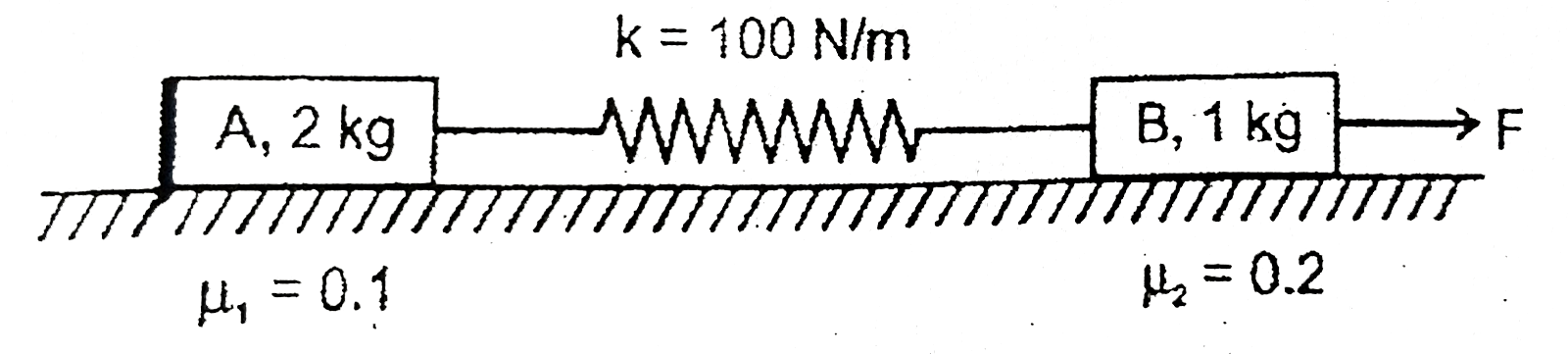
Initialy spring is in the natural length and blocks `A & B` are at rest. Find maximum value of constant force `F` that can be applied on `B` such that block `A` remains at rest. `(g = 10 m//s^(2))` (given answer in Newton)

Text Solution

Verified by Experts

The correct Answer is:

3

Initially spring ……………..
Values of `mu mg` for A and B are `2N & 2N` Worck energy theorm on `B` gives
`Fx-2x-(K//2)x^(2)=0`
`F=2+kx//2` ……(i)
For equilibrium of `A kx = mu mg = 2`
so `F = 2+1=3N`
Promotional Banner

Topper's Solved these Questions

  • TEST PAPERS

    RESONANCE ENGLISH|Exercise PART - II PHYSICS|106 Videos
  • SIMPLE HARMONIC MOTION

    RESONANCE ENGLISH|Exercise Advanced Level Problems|13 Videos
  • TEST SERIES

    RESONANCE ENGLISH|Exercise PHYSICS|130 Videos

Similar Questions

Explore conceptually related problems

Initialy spring in its natural length now a block at mass 0.25 kg is released then find out maximum force by system on floor ?

Initially spring is in natural length and both blocks are in rest condition. Then deter mine maximum extension in spring . K = 20 N/M

The block is always at rest, the maximum force which can be applied for this is 24x. Find the value of x. Take g = 10 m//s^(2) {coefficient of friction = 0.3}

A block is placed on a smooth inclined plane as shown . For what value of horizontal force F, the block will remain at rest ?

A spring is attached with a block of mass m and a fixed horizontal roof as shown. The block is lying on a smooth horizontal table and initially the spring is vertical and unstretched. Natural length of spring is 3l_(0) . A constant horizontal force F is applied on the block so that block moves in the direction of force. When length of the spring becomes 5l_(0) , block leaves contact with the table. Find the constant force F, if initial and final velocity of block is zero.

A block A of mass 4 kg is placed on another block B of mass 5 kg and the block rests on a smooth horizontal table. For sliding the block A on B, a horizontal force of 12 N is required to be applied on it. The maximum horizontal force that can be applied on B so that both A and B move together and the acceleration produced by this force is

A block of mass m is attached to a spring of force constant k whose other end is fixed to a horizontal surface. Initially the spring is in its natural length and the block is released from rest. The average force acting on the surface by the spring till the instant when the block has zero acceleration for the first time is

A block of mass m is connected to a spring (spring constant k ). Initially the block is at rest and the spring is in its natural length. Now the system is released in gravitational field and a variable force F is applied on the upper end of the spring such that the downward acceleration of the block is given as a=g-alphat , where t is time elapses and alpha=1m//s^(2) , the velocity of the point of application of the force is:

As shown in figure, if we apply a horizontal force F on the block, find the maximum force F (in N ) that can be applied so that block does not slide up. ( "Given" theta=45^(@),g=10m//sec^(2), m=1/5kg,mu=1/2)

A block of mass 1kg is placed on a rough horizontal surface. A spring is attached to the block whose other end is joined to a rigid wall, as shown in the figure. A horizontal force is applied on the block so that it remains at rest while the spring is elongated by x(xge(mumg)/(k)) . Let F_(max) and F_(mi n) be the maximum and minimum values of force F for which the block remains in equilibrium. For a particular x, F_(max)-F_(mi n)=2N . Also shown is the variation of F_(max)+F_(mi n) versus x , the elongation of the spring. The spring constant of the spring is :

RESONANCE ENGLISH-TEST PAPERS-PHYSICS
  1. Force acting on a pasrticle is vecF = (alpha y hati +beta xy hatj). Fi...

    Text Solution

    |

  2. A block of weight W is dragged across the horizontal floor from A to B...

    Text Solution

    |

  3. Initialy spring is in the natural length and blocks A & B are at rest....

    Text Solution

    |

  4. The potential energy of a 4kg particle free to move along the x-axis v...

    Text Solution

    |

  5. Taking horizontal ground as xz- plane and y-axis vertically upwards. A...

    Text Solution

    |

  6. The three flat blacks in the figure are positioned on the 37 degree i...

    Text Solution

    |

  7. A person in an elevator accelerating upwards with an acceleration of ...

    Text Solution

    |

  8. A body of mass m is released from a height h on a smooth inclined plan...

    Text Solution

    |

  9. A transerse sinusodial wave of amplitude 2 mm is setup in a long unifo...

    Text Solution

    |

  10. One end of a string of length L is tied to the ceiling of a lift accel...

    Text Solution

    |

  11. Consider a spring that exerts the following restoring force : F = -k...

    Text Solution

    |

  12. A particle performing simple harmonic motion undergoes unitial displac...

    Text Solution

    |

  13. In a standing wave on a string.

    Text Solution

    |

  14. A uniform disc of mass m and radius R is released gentiy on a horizont...

    Text Solution

    |

  15. One end of an unstretched vertical spring is attached to the ceiling a...

    Text Solution

    |

  16. In the situation as shown in figure time period of small vertical osci...

    Text Solution

    |

  17. A sphere of mass m and radius r is released from a wedge of mass 2m as...

    Text Solution

    |

  18. A uniform disc of mass m and radius r rolls without slipping along a h...

    Text Solution

    |

  19. A block of mass M and cylindrical tank which contains water having sma...

    Text Solution

    |

  20. Block A of mass m is placed on a plank B. A light support S is fixed o...

    Text Solution

    |
