Home
Class 12
PHYSICS
An ideal gas may expands from V(0) to 2V...

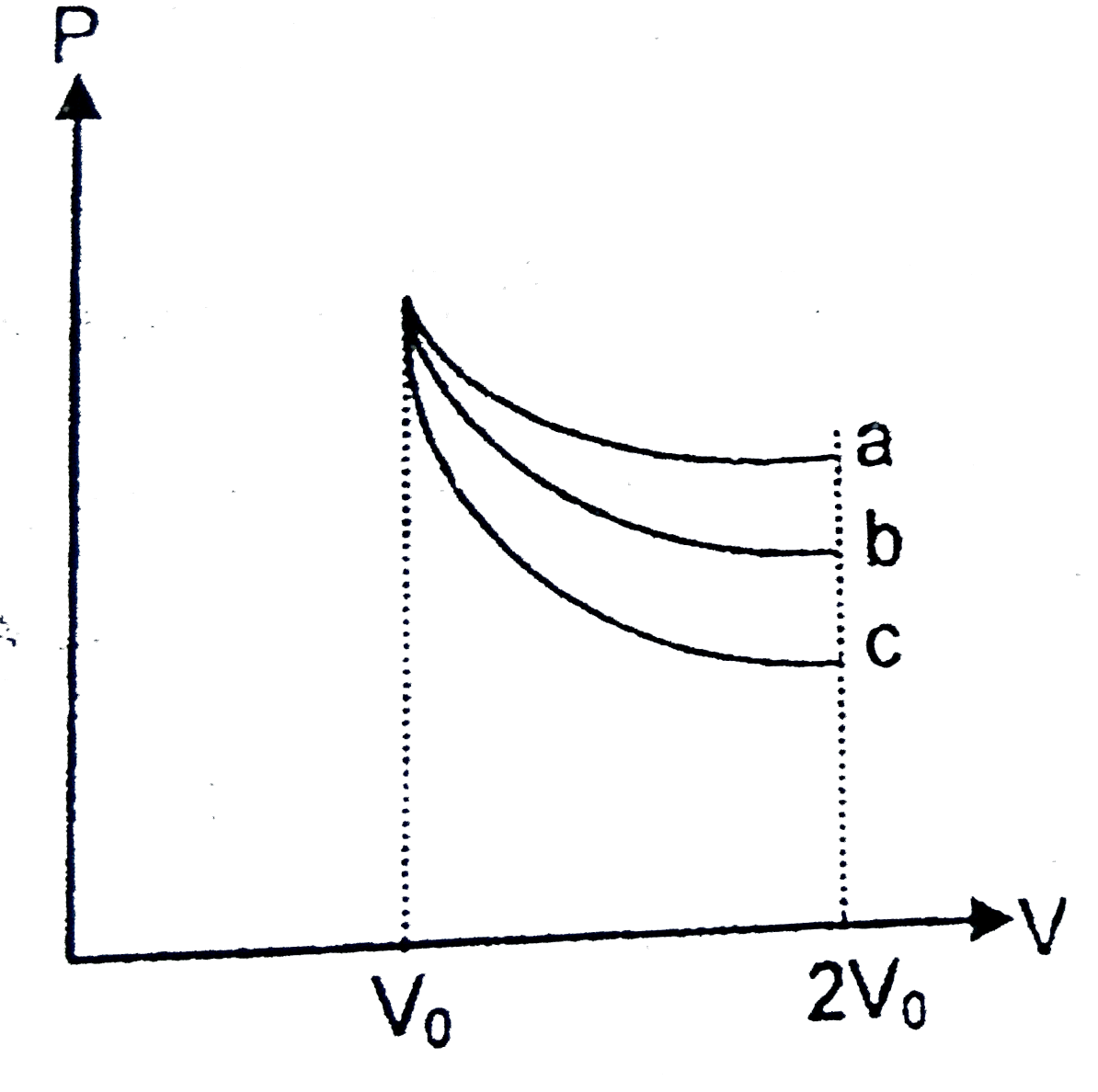
An ideal gas may expands from `V_(0)` to `2V_(0)` according to following three processes. Molar specific heat for processes `b` will be

A

positive if `a` is isothermal and `c` is adiabatic processes

B

negative if `a` is isothermal and `c` is adiabatic processes

C

positive if `c` is isothermal and `c` is adiabatic processes

D

negative if `c` is isothermal and `a` is adiabatic processes

Text Solution

Verified by Experts

The correct Answer is:

B

If a is isothermal and `c` is adiabatic processes then for `b DeltaU` will be negative and `Q` be positive so specific heat will be negative.
Promotional Banner

Topper's Solved these Questions

  • TEST PAPERS

    RESONANCE ENGLISH|Exercise PART - II PHYSICS|106 Videos
  • SIMPLE HARMONIC MOTION

    RESONANCE ENGLISH|Exercise Advanced Level Problems|13 Videos
  • TEST SERIES

    RESONANCE ENGLISH|Exercise PHYSICS|130 Videos

Similar Questions

Explore conceptually related problems

A gas is expanded form volume V_(0) to 2V_(0) under three different processes as shown in the figure . Process 1 is isobaric process process 2 is isothermal and and process 3 is adiabatic . Let DeltaU_(1),DeltaU_(2) and DeltaU_(3) be the change in internal energy of the gas in these three processes then

For a process, relation between temperature and volume is TV^(3) =constant. If a monoatomic gas follows this process, find molar specific heat for this process

A gas is expanded from volume V_(0) = 2V_(0) under three different processes. Process 1 is isobaric process, process 2 is isothermal and process 3 is adiabatic. Let DeltaU_(1), DeltaU_(2) and DeltaU_(3) be the change in internal energy of the gas in these three processes. then

A mono-atomic ideal gas is compressed form volume V to V//2 through various process. For which of the following processes final pressure will be maximum:

Starting from the same initial conditions, an ideal gas expands from volume V_(1) to V_(2) in three different ways. The work done by the gas is W_(1) if he process is purely isothermal, W_(2) if purely isobaric and W_(3) if purely adiabatic. Then

The internal energy of a gas is given by U= 5 + 2PV . It expands from V_(0) to 2V_(0) against a constant pressure P_(0) . The heat absorbed by the gas in the process is :-

The internal energy of a gas is given by U = 3 pV. It expands from V_(0) to 2V_(0) against a constant pressure p_(0) . The heat absorbed by the gas in the process is

A certain amount of ideal monoatomic gas undergoes a process given by TV^(1//2) = constant. The molar specific heat of the gas for the process will be given by

The internal energy of a gas is given by U=2pV . It expands from V_0 to 2V_0 against a constant pressure p_0 . The heat absorbed by the gas in the process is

The internal energy of a gas is given by U=2pV . It expands from V_0 to 2V_0 against a constant pressure p_0 . The heat absorbed by the gas in the process is

RESONANCE ENGLISH-TEST PAPERS-PHYSICS
  1. A hypothetical gas sample has its molecular speed distribution graph a...

    Text Solution

    |

  2. The average rotational kinetic energy of hydrogen molecule at a temper...

    Text Solution

    |

  3. An ideal gas may expands from V(0) to 2V(0) according to following thr...

    Text Solution

    |

  4. A rectangular bar is uniformly loaded axially with force per unit area...

    Text Solution

    |

  5. A flywheel can rotate in order to store kinetic energy. The flywheel i...

    Text Solution

    |

  6. A ray is incident on interface of two media at critical angle as shown...

    Text Solution

    |

  7. For two different gases x and y have degree of freedon f(1) and f(2) a...

    Text Solution

    |

  8. An ideal gas takes part in two thermal process in which it is heated f...

    Text Solution

    |

  9. On the P-T graph of an ideal gas, choose the correct option(s):

    Text Solution

    |

  10. In Figure, light is incident at an angle theta which is slightly great...

    Text Solution

    |

  11. The variation of internal energy U and density d of one mole of an ide...

    Text Solution

    |

  12. It is desired to make an achromatic combination of two lenses, (L(1)& ...

    Text Solution

    |

  13. Two identical glass slabs of same thickness are joined to form an L sh...

    Text Solution

    |

  14. An ideal monatomic gas expands in such a way that TV^((1)/(2))= consta...

    Text Solution

    |

  15. A Hydrogen gas and a helium gas each having volume 100cm^(3) at NTP ar...

    Text Solution

    |

  16. Consider one mole of an ideal gas whose volume changes with temeperatu...

    Text Solution

    |

  17. An ideal gas expands from V to 2V in 4 separate processes. Where proce...

    Text Solution

    |

  18. An object kept near a convex lens of focal length f, executes SHM betw...

    Text Solution

    |

  19. Monoatomic , diatomic and triatomic gases whose initial volume and pre...

    Text Solution

    |

  20. n moles of a monoatomic gas undergoes a cyclic process ABCDA as shown....

    Text Solution

    |
