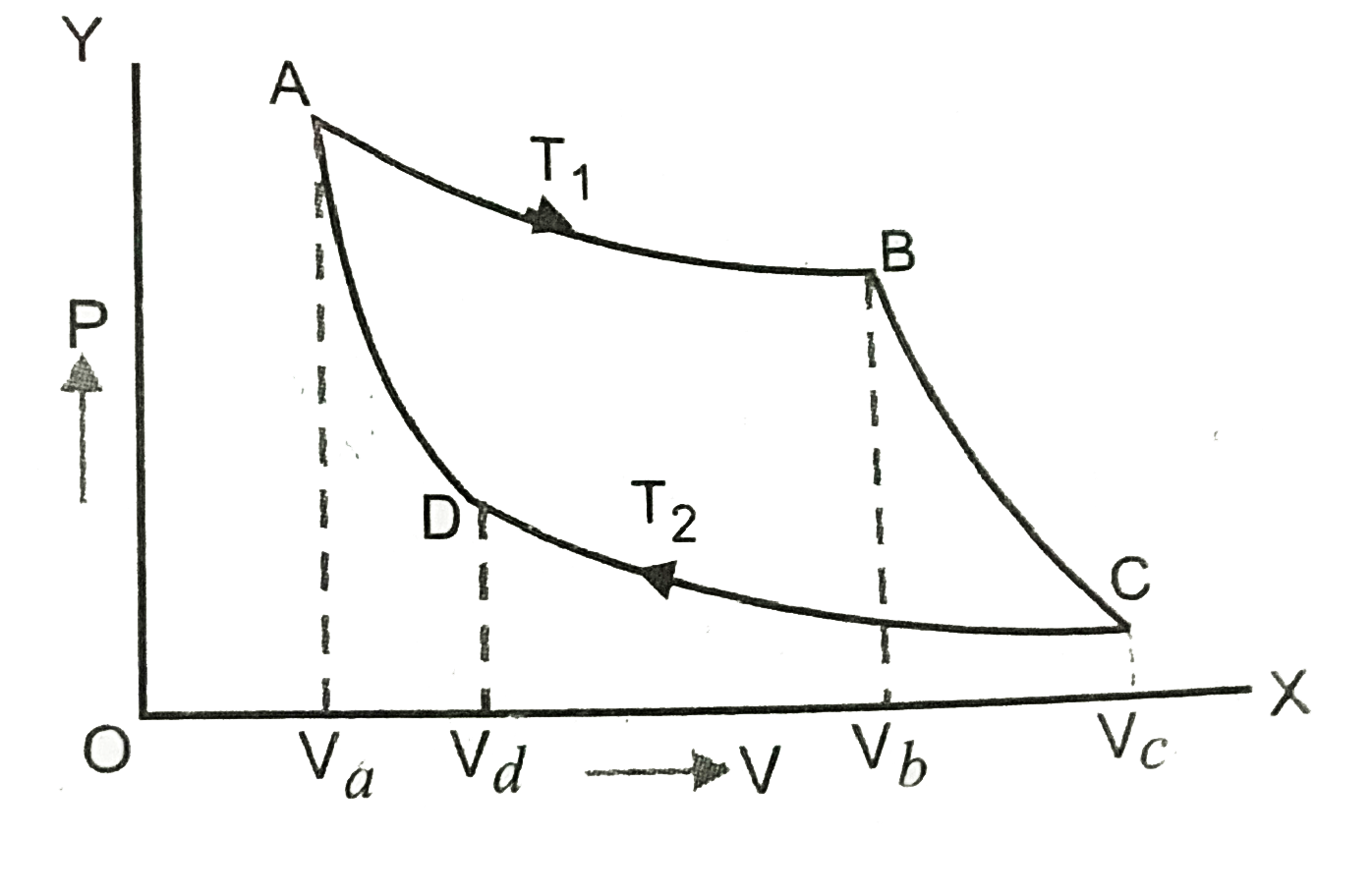
A
B
C
D
Text Solution
Verified by Experts
The correct Answer is:



Topper's Solved these Questions
KTG & THERMODYNAMICS
RESONANCE ENGLISH|Exercise Exercise-2|1 VideosKTG & THERMODYNAMICS
RESONANCE ENGLISH|Exercise PART -I|15 VideosKTG & THERMODYNAMICS
RESONANCE ENGLISH|Exercise PART -II|17 VideosKINETIC THEORY OF GASES AND THERMODYNAMICS
RESONANCE ENGLISH|Exercise Exercise|64 VideosMAGNETIC FIELD AND FORCES
RESONANCE ENGLISH|Exercise Exercise|64 Videos
Similar Questions
Explore conceptually related problems
RESONANCE ENGLISH-KTG & THERMODYNAMICS-SECTION
- If molar heat capacity of the given process (as shown in figure) is C,...
Text Solution
|
- For a solid with a small expansion coefficient,
Text Solution
|
- Two different adiabatic curves for the same gas intersect two isotherm...
Text Solution
|
- Two samples 1 and 2 are initially kept in the same state. The sample 1...
Text Solution
|
- two samples 1 and 2 are initially kept in the same state. the sample 1...
Text Solution
|
- Let (Delta Wa) and (Delta Wb) be the work done by the system A and B r...
Text Solution
|
- When an ideal gas undergoes an adiabatic change causing a temperature ...
Text Solution
|
- A given quantity of a ideal gas is at pressure P and absolute tempera...
Text Solution
|
- In figure, A and B are two adiabatic curves for two different gases. T...
Text Solution
|
- In a cyclic process shown in the figure an ideal gas is adiabatically...
Text Solution
|
- In given figure, a fixed mass of an ideal gas undergoes the change rep...
Text Solution
|
- A certain mass of an ideal gas is at pressure P(1) and volume V(1). If...
Text Solution
|
- During an adiabatic process, the pressure of a gas is found to be prop...
Text Solution
|
- A gas undergoes a process in which its pressure P and volume V are rel...
Text Solution
|
- V = k((P)/(T))^(0.33) where k is constant. It is an,
Text Solution
|
- One mole of a gas is subjected to two process AB and BC, one after the...
Text Solution
|
- An ideal gas has an adiabatic exponent gamma. In some process its mola...
Text Solution
|
- One mole of an ideal gas undergoes a process in which T = T(0) + aV^(3...
Text Solution
|
- In the above question, maximum pressure attainable is
Text Solution
|
- In a certain gas, the ratio of the velocity of sound and root mean squ...
Text Solution
|