Home
Class 11
PHYSICS
A wire is bent in a parabolic shape foll...


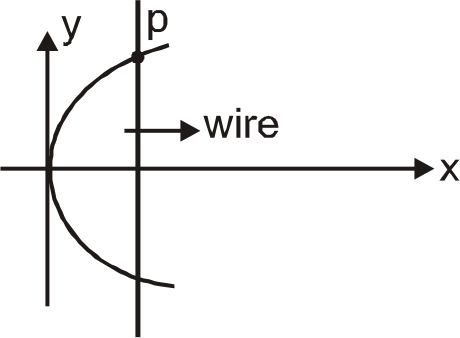
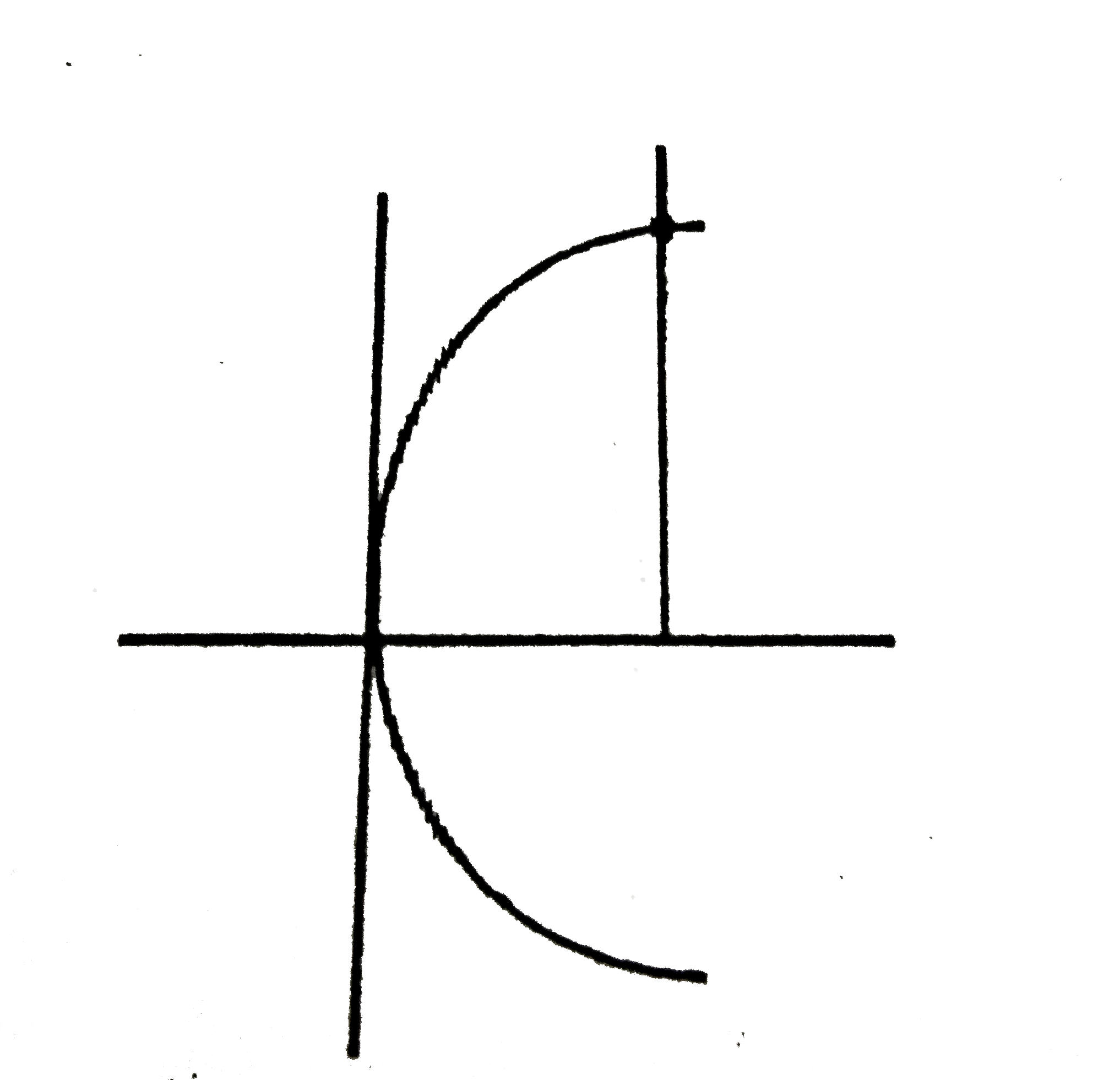
A wire is bent in a parabolic shape followed by equation `x=4y^(2)` consider origin as vertex of parabola a wire parallel toy axis moves with constant speed 4m/s along x-axis in the plane of bent wire. Then the acceleration of touching point of straight wire and parabolic wire is (when straight wire has x coordinates `=4m`)

A

`(1)/(2)hat(i)`

B

`-(1)/(4)hat(j)`

C

`2hat(j)`

D

`4hat(i)`

Text Solution

Verified by Experts

The correct Answer is:
B

`x=4y^(2)`
`(dx)/(dt)=8y(dy)/(dt)`
`V_(x)=8yV_(y)`
`V_(x)=4`
`a_(x)=0`
`0=a_(x)=8[y,a_(y)+V_(y)^(2)]-ya_(y)=V_(y)^(2)`

`|a_(y)|=(v_(y)^(2))/(y)`
`|a_(y)|=(v_(x)^(2))/(64y^(3))=(16)/(64xxy^(3))`
at `y=1rArr|a_(y)|=(1)/(4)`
`y=1rArr|a_(y)|=(1)/(4)`
Promotional Banner

Topper's Solved these Questions

  • DAILY PRACTICE PROBLEMS

    RESONANCE ENGLISH|Exercise TRUE/FALSE|2 Videos
  • DAILY PRACTICE PROBLEMS

    RESONANCE ENGLISH|Exercise dpp 25|5 Videos
  • DAILY PRACTICE PROBLEMS

    RESONANCE ENGLISH|Exercise dpp23|8 Videos
  • CURRENT ELECTRICITY

    RESONANCE ENGLISH|Exercise Exercise|53 Videos
  • ELASTICITY AND VISCOCITY

    RESONANCE ENGLISH|Exercise Advanced Level Problems|9 Videos

Similar Questions

Explore conceptually related problems

The equation of the parabola whose vertex is origin axis along x-axis and which passes through the point (-2,4) is

A thin uniform wire of mass m and length l is bent into to shape of a semicircle. The moment of inertia of that wire about an axis passing through its free ends is

A rod of length l is kept parallel to a long wire carrying constant current i . It is moving away from the wire with a velocity v . Find the emf induced in the wire when its distance from the long wire is x .

A rod of length l is kept parallel to a long wire carrying constant current i . It is moving away from the wire with a velocity v. Find the emf induced in the wire when its distance in the wire when its distance from the long wire is x .

A piece of wire is bent in the shape of a parabola y=kx^(2) (y-axis vertical) with a bead of mass m on it. The bead can slide on the wire without friction. It stays at the lowest point of the parabola when the wire is at rest. The wire is now accelerated parallel to the x-axis with a constant acceleration a. The distance of the new equilibrium position of the bead, where the bead can stay at rest with respect to the wire, from the y-axis is:

A piece of wire is bent in the shape of a parabola y=kx^(2) (y-axis vertical) with a bead of mass m on it. The bead can slide on the wire without friction. It stays at the lowest point of the parabola when the wire is at rest. The wire is now accelerated parallel to the x-axis with a constant acceleration a. The distance of the new equilibrium position of the bead, where the bead can stay at rest with respect to the wire, from the y-axis is:

A piece of wire is bent in the shape of a parabola y=kx^(2) (y-axis vertical) with a bead of mass m on it. The bead can slide on the wire without friction. It stays at the lowest point of the parabola when the wire is at rest. The wire is now accelerated parallel to the x-axis with a constant acceleration a. The distance of the new equilibrium position of the bead, where the bead can stay at rest with respect to the wire, from the y-axis is:

A piece of wire is bent in the shape of a parabola y = kx^2 (y axis vertical) with a bead of mass mon it. The bead can slide on the wire without friction. It stays at the lowest point of the parabola when the wire is at rest. The wire is now accelerated paralle to the x-axis with a constant acceleration a. The distance of the the new equilibrium position of the bead. Find the x-coordinate where the bead can stay at rest with respect to the wire ?

A long, straight wire carries a current along the z-axis. One can find two points in the x-y plane such that

Two long, straight wires, one above the other, are separated by a distance 2a and are parallel to the x-axis. Let the y-axis be in the plane of the wires in the direction form the lower wire to the upper wire. Each wire carries current I in the +x-direction. What are the magnitude and direction of the net magnetic field of the two wires at a point in the plane of wires: (a) midway between them? (b) at a distance a above the upper wire? (c) at a distance a below the lower wire?

