Home
Class 11
PHYSICS
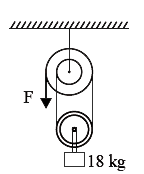
In the figure at the free end a force F ...

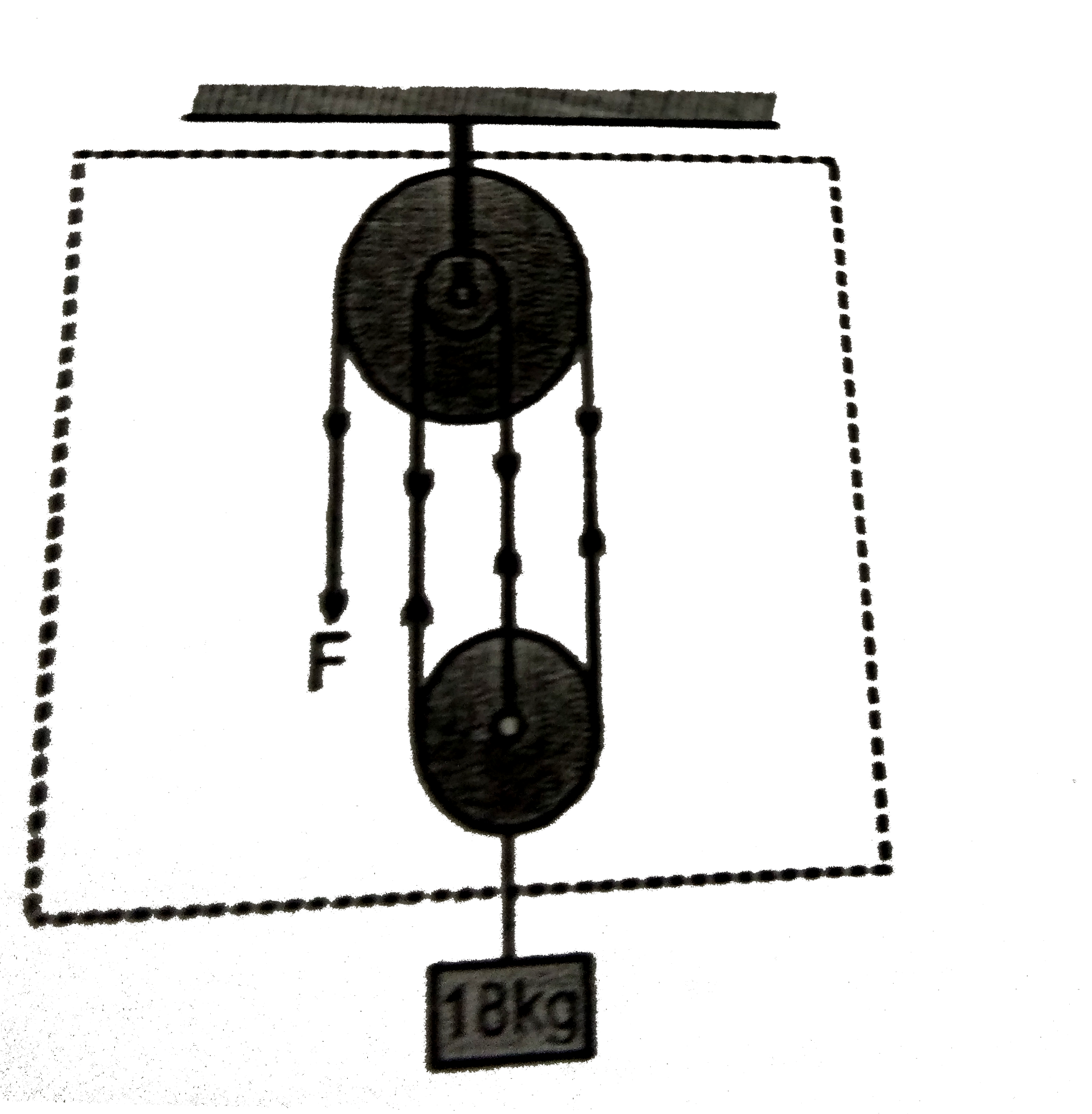
In the figure at the free end a force F is applied to keep the suspended mass of 18 kg at rest. The value of F is `:`

A

`60N`

B

`120N`

C

`180N`

D

`240N`

Text Solution

Verified by Experts

The correct Answer is:
D


`3F=180`
`F=60N`
`T=4F=210N`
Force balance on system
`T=F+180`
`T=60+18=240N`.
Promotional Banner

Topper's Solved these Questions

  • DAILY PRACTICE PROBLEMS

    RESONANCE ENGLISH|Exercise TRUE/FALSE|2 Videos
  • DAILY PRACTICE PROBLEMS

    RESONANCE ENGLISH|Exercise dpp 25|5 Videos
  • DAILY PRACTICE PROBLEMS

    RESONANCE ENGLISH|Exercise dpp23|8 Videos
  • CURRENT ELECTRICITY

    RESONANCE ENGLISH|Exercise Exercise|53 Videos
  • ELASTICITY AND VISCOCITY

    RESONANCE ENGLISH|Exercise Advanced Level Problems|9 Videos

Similar Questions

Explore conceptually related problems

In the figure, at the free end of the light string, a force F is supplied to keep the suspended mass of 18 kg at rest. Then the force exerted by the ceiling on the system (assume that the string segments are vertical and the pulleys are light and smooth) is:( g=10(m)/(s^2) )

In the figure shown, a force F is applied at the top of a disc of mass 4 kg and radius 0.25 m. find maximum velue of F for no slipping.

A force F= 2t^2 is applied to the cart of mass 10 Kg, initially at rest. The speed of the cart at t = 5 s is -

A wheel of radius R has an axle of radius R//5 . A force F is applied tangentially to the wheel. To keep the system in a state of "rotational" rest, a force F' is applied tangentially to the axle. The value of F' is

A block of mass 10 kg is placed on a horizontal surface as shown in the figure and a force F = 100 N is applied on the block as shown, in the figure. The block is at rest with respect to ground. If the contact force between block and ground is 25n (in Newton) then value of n is : (Take g = 10 m//s^(2))

A rod of mass m and length L is hinged at its top end. If the rod is in equilibrium making an angle of 30^(@) with the vertical when a horizontal force F is applied as shown in figure, then the value of F is:

A block of mass 1kg is placed on a rough horizontal surface. A spring is attached to the block whose other end is joined to a rigid wall, as shown in the figure. A horizontal force is applied on the block so that it remains at rest while the spring is elongated by x(x ge (mumg)/(k)) . Let F_(max) and F_(mi n) be the maximum and minimum values of force F for which the block remains in equilibrium. For a particular x, F_(max)-F_(mi n)=2N . Also shown is the variation of F_(max)+F_(mi n) versus x , the elongation of the spring. The value of F_(mi n) , if x=3cm is :

A block of mass 1kg is placed on a rough horizontal surface. A spring is attached to the block whose other end is joined to a rigid wall, as shown in the figure. A horizontal force is applied on the block so that it remains at rest while the spring is elongated by x(xge(mumg)/(k)) . Let F_(max) and F_(mi n) be the maximum and minimum values of force F for which the block remains in equilibrium. For a particular x, F_(max)-F_(mi n)=2N . Also shown is the variation of F_(max)+F_(mi n) versus x , the elongation of the spring. The spring constant of the spring is :

A block of mass 1kg is placed on a rough horizontal surface. A spring is attached to the block whose other end is joined to a rigid wall, as shown in the figure. A horizontal force is applied on the block so that it remains at rest while the spring is elongated by x(x ge (mumg)/(k)) . Let F_(max) and F_(mi n) be the maximum and minimum values of force F for which the block remains in equilibrium. For a particular x, F_(max)-F_(mi n)=2N . Also shown is the variation of F_(max)+F_(mi n) versus x , the elongation of the spring. The coefficient of friction between the block and the horizontal surface is :

There is a trolley in which there is a fixed inclined surface on which a smooth block of mass 5kg is placed. Two horizontal forces of magnitude F_(1) and F_(2) are applied on the trolley as shown to keep the trolley at rest. The value of F_(1)-F_(2) is : (Assume there is no friction between the trolley and horizontal ground and g=10ms^(-2) )

