Home
Class 11
PHYSICS
A force F is applied on block A of mass ...


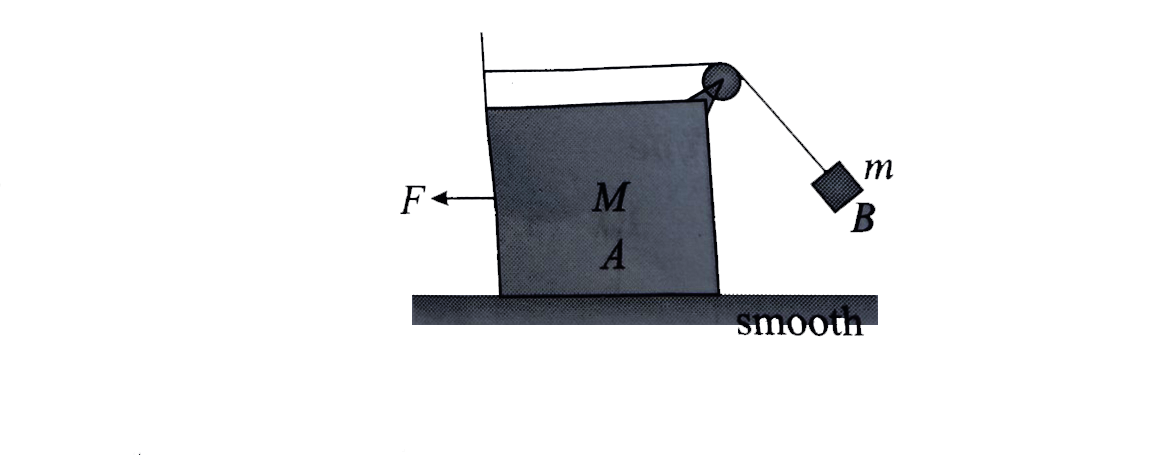
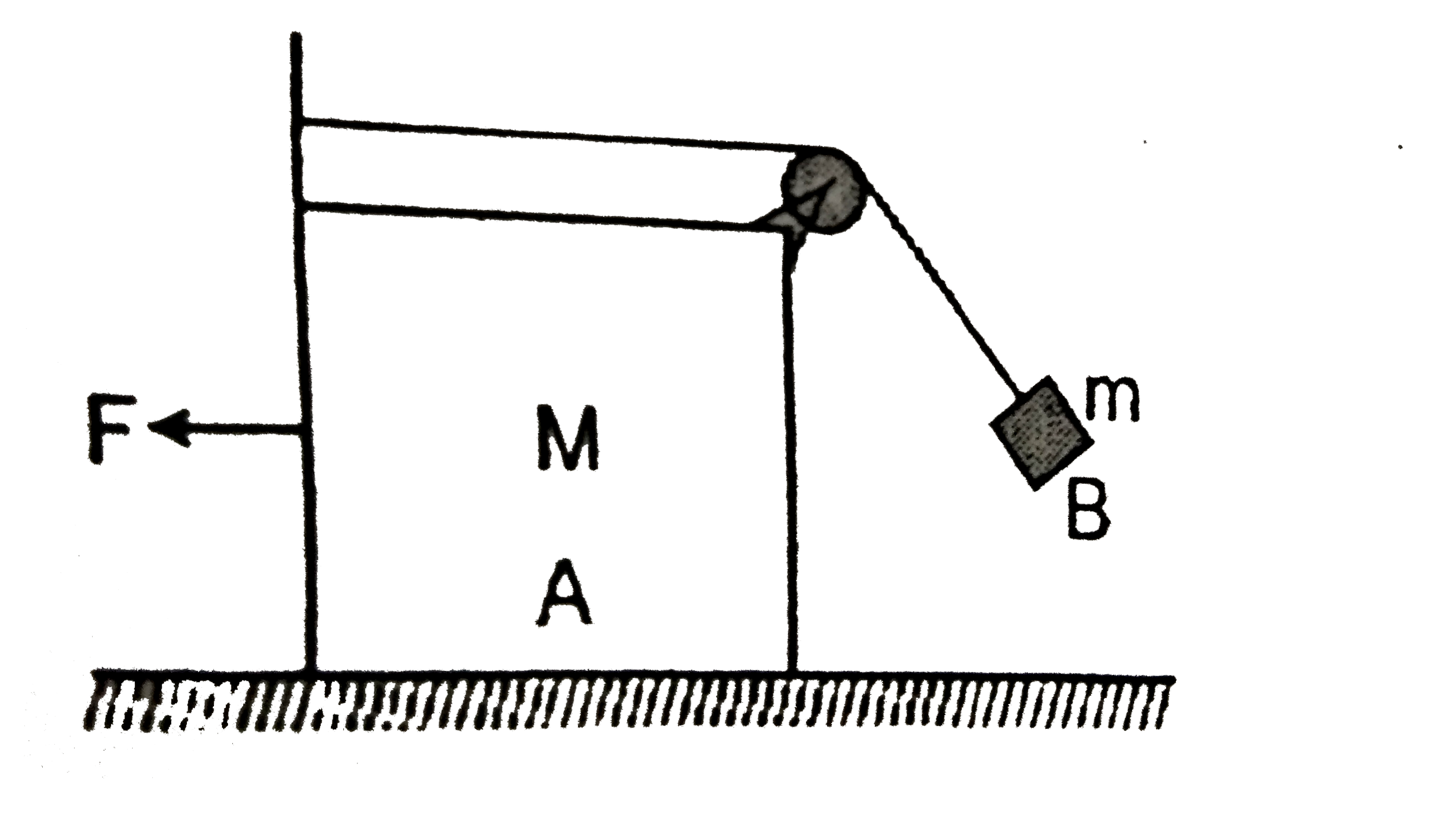
A force F is applied on block A of mass M so that the tension in light string also becomes F when block B of mass m acquires an equilibrium state with respect to block A. find the force F. Give your answer in terms of m, M and g.

Text Solution

Verified by Experts

The correct Answer is:
A, B

A force `F` is applied on block `A` of mass `M` so that the tension in light string also becomes `F` when block `B` of mass
Applying Newton's law on the system in horizontal direction `F=(M+m)a`.
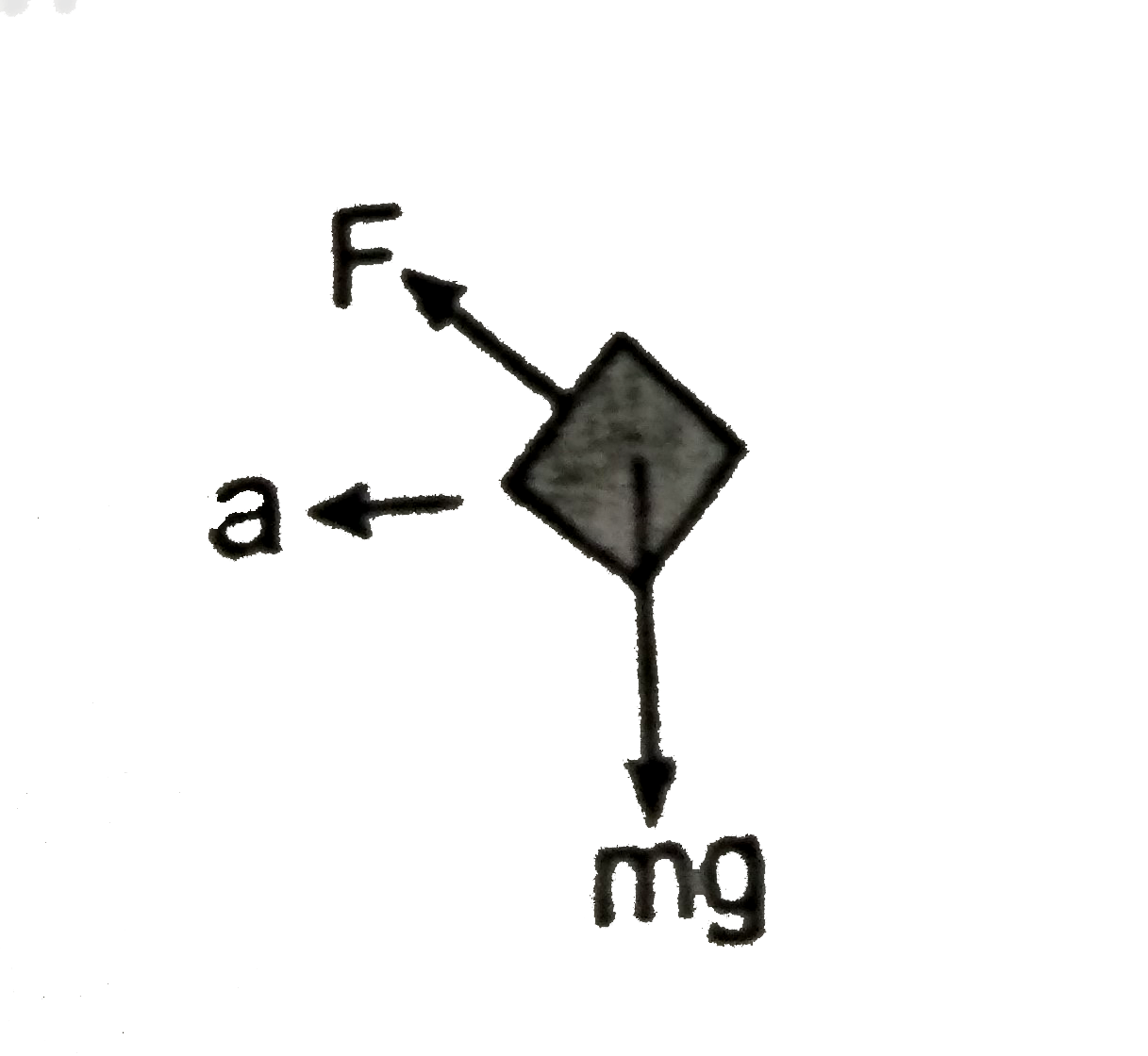
Now consider the equlibrium of block `B w.r.t.` block `M`

`F^(2)=(mg)^(2)+(ma)^(2)+(m(F)/(m+M))^(2)`
`:. F^(2)=(m^(2)g^(2))/(1-(m^(2))/((m+M)^(2))),`
`F=(mg)/(sqrt(1-((m)/(m+M))^(2)))`
Promotional Banner

Topper's Solved these Questions

  • DAILY PRACTICE PROBLEMS

    RESONANCE ENGLISH|Exercise dpp 27|3 Videos
  • DAILY PRACTICE PROBLEMS

    RESONANCE ENGLISH|Exercise dpp 28|7 Videos
  • DAILY PRACTICE PROBLEMS

    RESONANCE ENGLISH|Exercise dpp 25|5 Videos
  • CURRENT ELECTRICITY

    RESONANCE ENGLISH|Exercise Exercise|53 Videos
  • ELASTICITY AND VISCOCITY

    RESONANCE ENGLISH|Exercise Advanced Level Problems|9 Videos

Similar Questions

Explore conceptually related problems

The block of mass m is at rest. Find the tension in the string A .

A block of mass m is taken from A to B under the action of a constant force F. Work done by this force is

Two blocks of equal mass m are tied to each other through light string. One of the blocks is pulled along the line joining them with a constant force F. Find the tension in the string joining the blocks.

A horizontal force F pushes wedge of mass M on a smooth horizontal surface. A block of mass m is stationary to the wedge, then:

A block of mass m at rest is acted upon by a force F for a time t. The kinetic energy of block after time t is

A force F is applied on a block of mass M . The block is displaced through a distance d in the direction of the force. What is the work done by the force on the block? Does the internal energy change because of this work?

A constant force F = m_(2)g//2 is applied on the block of mass m_(1) as shown in fig. The string and the pulley are light and the surface of the table is smooth. The acceleration of m_(1) is :

force F is applied at the topmost point of block of mass M. The force required to topple the block before sliding is (µ = coefficient of friction)

Two blocks of masses m and M are connected by an inextensible light string as shown in the figure. When a constant horizontal force F acts on the block of the mass M , then tension in the string is : (Assume that constact between the ground and the two blocks are frictionless) and blocks will not topple. (Given: m = 1 kg, M = 4 kg, F = 10 N, theta = 60^(@) )

A force of F=0.5 N is applied on lower block as shown in figure. The work done by lower block on upper block for a displacement of 3 m of the upper block with respect to ground is (Take, g=10 ms^(-2) )