Home
Class 11
PHYSICS
A block B of mass 0.6kg slides down the ...

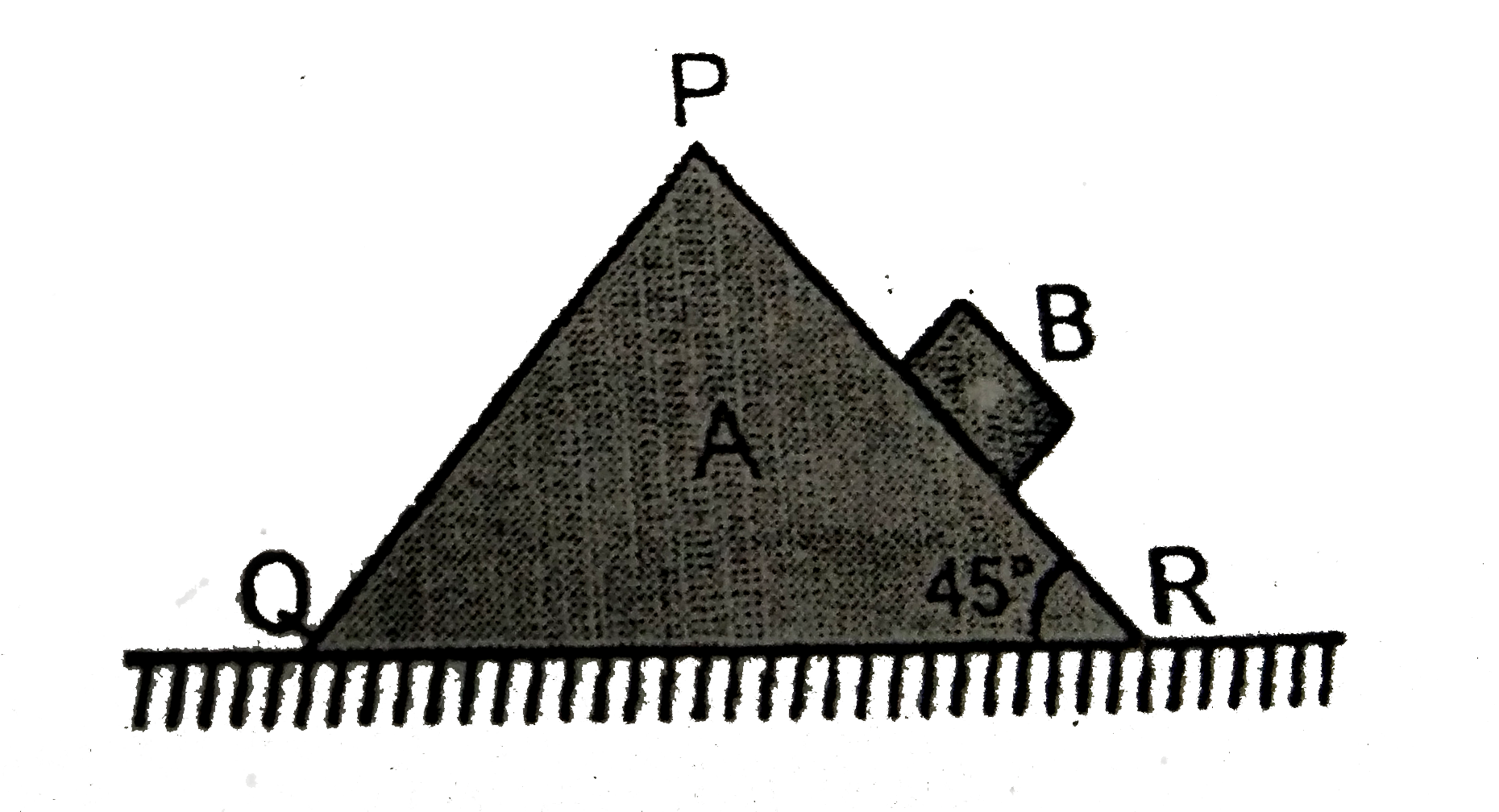
A block `B` of mass `0.6kg` slides down the smooth face `PR` of a wedge `A` of mass `1.7kg` which can move freely on a smooth horizontal surface.
The inclination of the face `PR` to the horizontal is `45^(@)` . Then `:`

A

the acceleration of `A` is `3g//20`

B

the vertical component of the acceleration of `B` is `23g//40`

C

the horizontal component of the acceleration of `B` is `17g//40`

D

none of these

Text Solution

Verified by Experts

The correct Answer is:
A, B, C

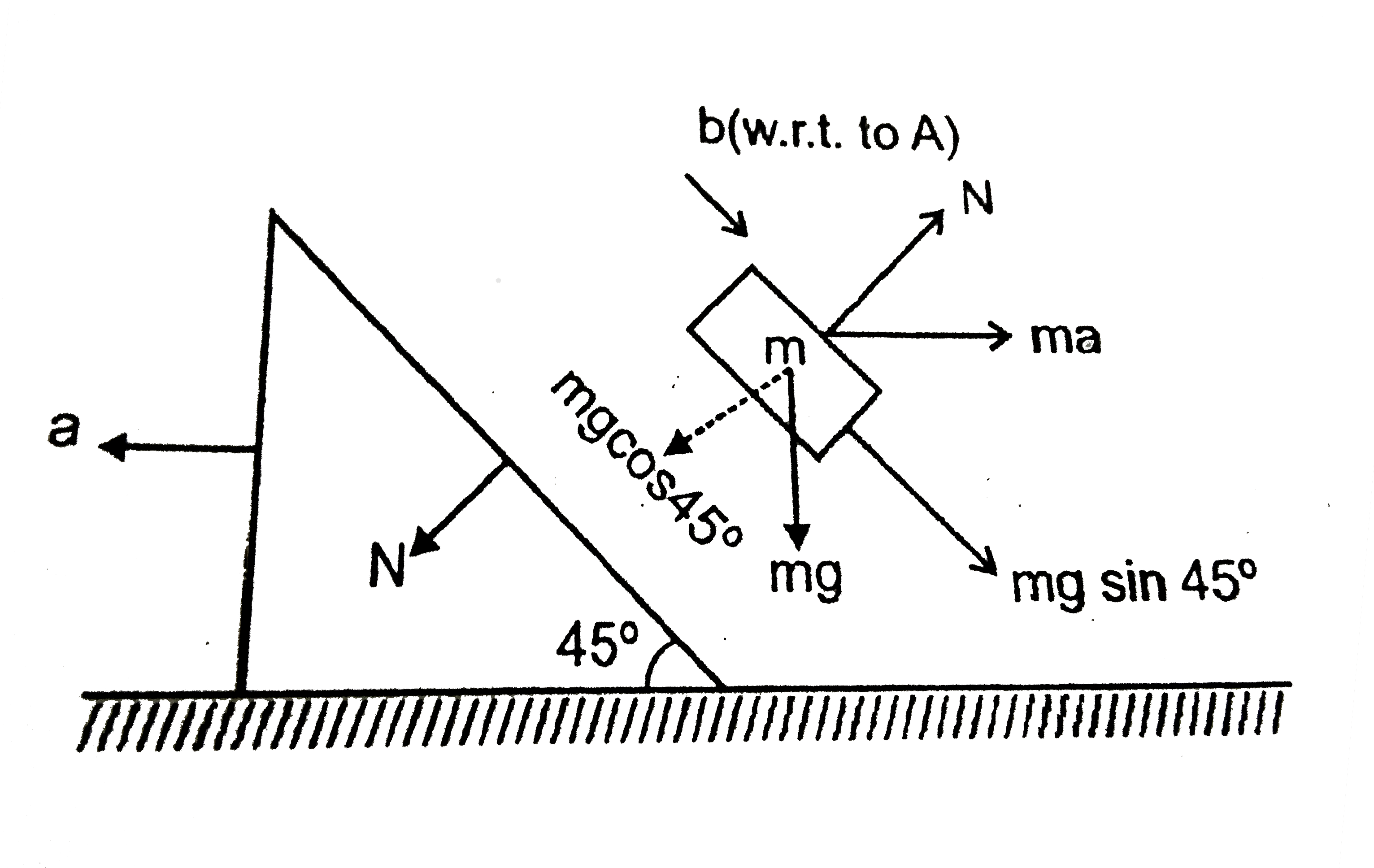
`F.B.D.` of block `B w.r.t.` wedge

for block `A` ltbr. `N cos 45^(@)=1.7a ….(1)`
for block `B` ,br. `0.6g sin 45^(@)=0.6a cos 45^(@)=0.6b …..(b)`
`N+0.6a cos 45^(@)=0.6g cos 45^(@) ….(ii)`
by solving `(i), (ii) & (iii)`
`a=(3g)/(20) ` and `b=(23g)/(20sqrt(2))`
Now vertical component acceleration of
`B=b cos 45^(@)=(23g)/(40)`
and horizontal component of acceleration of
`B=b sin 45^(@)-a=(17g)/(40)`
Promotional Banner

Topper's Solved these Questions

  • DAILY PRACTICE PROBLEMS

    RESONANCE ENGLISH|Exercise dpp29|5 Videos
  • DAILY PRACTICE PROBLEMS

    RESONANCE ENGLISH|Exercise dpp 30|4 Videos
  • DAILY PRACTICE PROBLEMS

    RESONANCE ENGLISH|Exercise dpp 27|3 Videos
  • CURRENT ELECTRICITY

    RESONANCE ENGLISH|Exercise Exercise|53 Videos
  • ELASTICITY AND VISCOCITY

    RESONANCE ENGLISH|Exercise Advanced Level Problems|9 Videos

Similar Questions

Explore conceptually related problems

A block of mass m rests on a stationary wedge of mass M. The wedge can slide freely on a smooth horizontal surface as shown in figure. If the block starts from rest

A block of mass 2kg slides down the face of a smooth 45^@ wedge of mass 9 kg as shown in the figure. The wedge is placed on a frictionless horizontal surface. Determine the acceleration of the wedge.

A block of mass m is placed at rest on a smooth wedge of mass M placed at rest on a smooth horizontal surface. As the system is released

A small block of mass m is placed at rest on the top of a smooth wedge of mass M, which in turn is placed at rest on a smooth horizontal surface as shown in figure. If h be the height of wedge and theta is the inclination, then the distance moved by the wedge as the block reaches the foot of the wedge is

Two blocks of masses m_(1) and m_(2) are connected by a massless pulley A, slides along th esmooth sides of a rectangular wedge of mass m, which rests on a smooth horizontal plane. Find the distance covered by the wedge on the horizontal plane till the mass m_(1) is lowered by the vertical distance h.

Two blocks of masses 4 kg and 6 kg are kept on a rough horizontal surface as shown. If the acceleration of 6 kg block is 5n , then n is :

A horizontal force F pushes wedge of mass M on a smooth horizontal surface. A block of mass m is stationary to the wedge, then:

A block of mass m slides over a smooth wedge of mass M which is placed over a rough horizontal surface . The centre of mass of the system will move towards left Here mu = coefficient of friction between the wedge and the ground .

A block A of mass 2 kg is placed over smooth block B of mass 4 kg which is placed over a smooth horizontal floor The coefficient of friction between A and B is 0.4 when a horizontal forces of magnitude 10 N is applied on A the acceleration of block of A and B are

A trolley containing a liquid slides down a smooth inclined plane of angle alpha with the horizontal. Find the angle of inclination theta of the free surface with the horizontal.

