Home
Class 11
PHYSICS
The square of the angular velcoity omega...

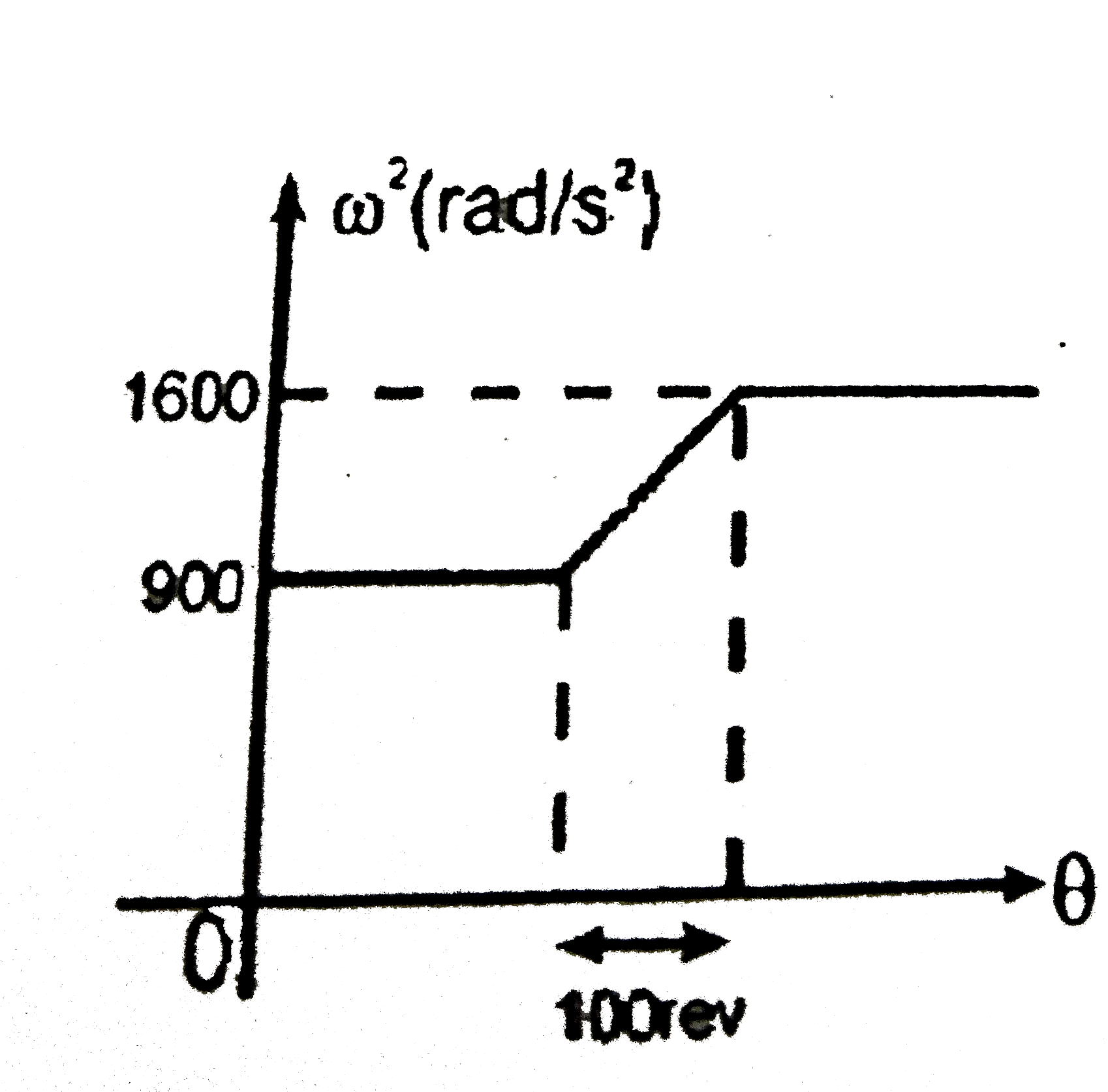
The square of the angular velcoity `omega` of a certain wheel increases linearly with the angular displacement during `100 rev` of the wheel's motion as shown. Compute the time `t` required for the increase.

Text Solution

Verified by Experts

The correct Answer is:

`(40pi)/(7)sec.`

We have `Delta theta =2pi xx (100 rev)=200pi rad`
So `omega ^(2)=omega _(0)^(2)+2 alpha Delta theta`
`rArr 1600=900+2alphaxx200pi`
`rArr alpha=(700)/(400pi)=(7)/(4pi)`
Also `omega=omega_(0)+alphat`
`rArr 40=30+(7)/(4pi)t`
`rArr t=(40pi)/(7)`
Promotional Banner

Topper's Solved these Questions

  • DAILY PRACTICE PROBLEMS

    RESONANCE ENGLISH|Exercise dpp 48|4 Videos
  • DAILY PRACTICE PROBLEMS

    RESONANCE ENGLISH|Exercise dpp 49|6 Videos
  • DAILY PRACTICE PROBLEMS

    RESONANCE ENGLISH|Exercise dpp 46|6 Videos
  • CURRENT ELECTRICITY

    RESONANCE ENGLISH|Exercise Exercise|53 Videos
  • ELASTICITY AND VISCOCITY

    RESONANCE ENGLISH|Exercise Advanced Level Problems|9 Videos

Similar Questions

Explore conceptually related problems

The angular velocity of a wheel increases from 100 to 300 in 10 s. The number of revolutions made during that time is

A wheel is a rest. Its angular velocity increases uniformly and becomes 80 rad s^(-1) after 5 s. The total angular displacement is

A wheel is at rest. Its angular velocity increases uniformly and becomes 80 radian per second after 5 second. The total angular displacement is :-

The angular velocity of a gar is controlled according to omega=12-3t^(2) where omega in radian per second, is positive in the clockwise sense and t is the time in seconds. Find the net angular displacement triangletheta from the time t=0 to t=3 s. Also, find the number of revolutions N through which the gear turns during the 3s.

A wheel having moment of inertia 2/π^2 kgm^2 is at rest. It is rotated by a 60 W ideal motor for one minute. The angular displacement traversed by the wheel in one minute is

The assembly of two discs as shown in figure is placed on a rough horizontal surface and the front disc is given an initial angular velocity omega_(0) . Determine the final linear and angular velocity when both the discs start rolling. it is given that friction is sufficient to sustain rolling the rear wheel from the starting of motion.

A ring of radius R is made of a thin wire of material of density rho having cross section area a. The ring rotates with angular velocity omega about an axis passing through its centre and perpendicular to the plane. If we consider a small element of the ring,it rotates in a circle. The required centripetal force is provided by the component of tensions on the element towards the centre. A small element of length dl of angular width d theta is shown in the figure. If for a given mass of the ring and angular velocity, the radius R of the ring is increased to 2R , the new tension will be

A ring of radius R is made of a thin wire of material of density rho having cross section area a. The ring rotates with angular velocity omega about an axis passing through its centre and perpendicular to the plane. If we consider a small element of the ring,it rotates in a circle. The required centripetal force is provided by the component of tensions on the element towards the centre. A small element of length dl of angular width d theta is shown in the figure. If T is the tension in the ring, then

The magnitude of displacement of a particle moving in a circle of radius a with constant angular speed omega varries with time t is

The side of a square is increasing at the rate of 0.2 cm/s. The rate of increase of perimeter w.r.t time is :
