Home
Class 11
PHYSICS
Two blocks, of masses M and 2M are conne...

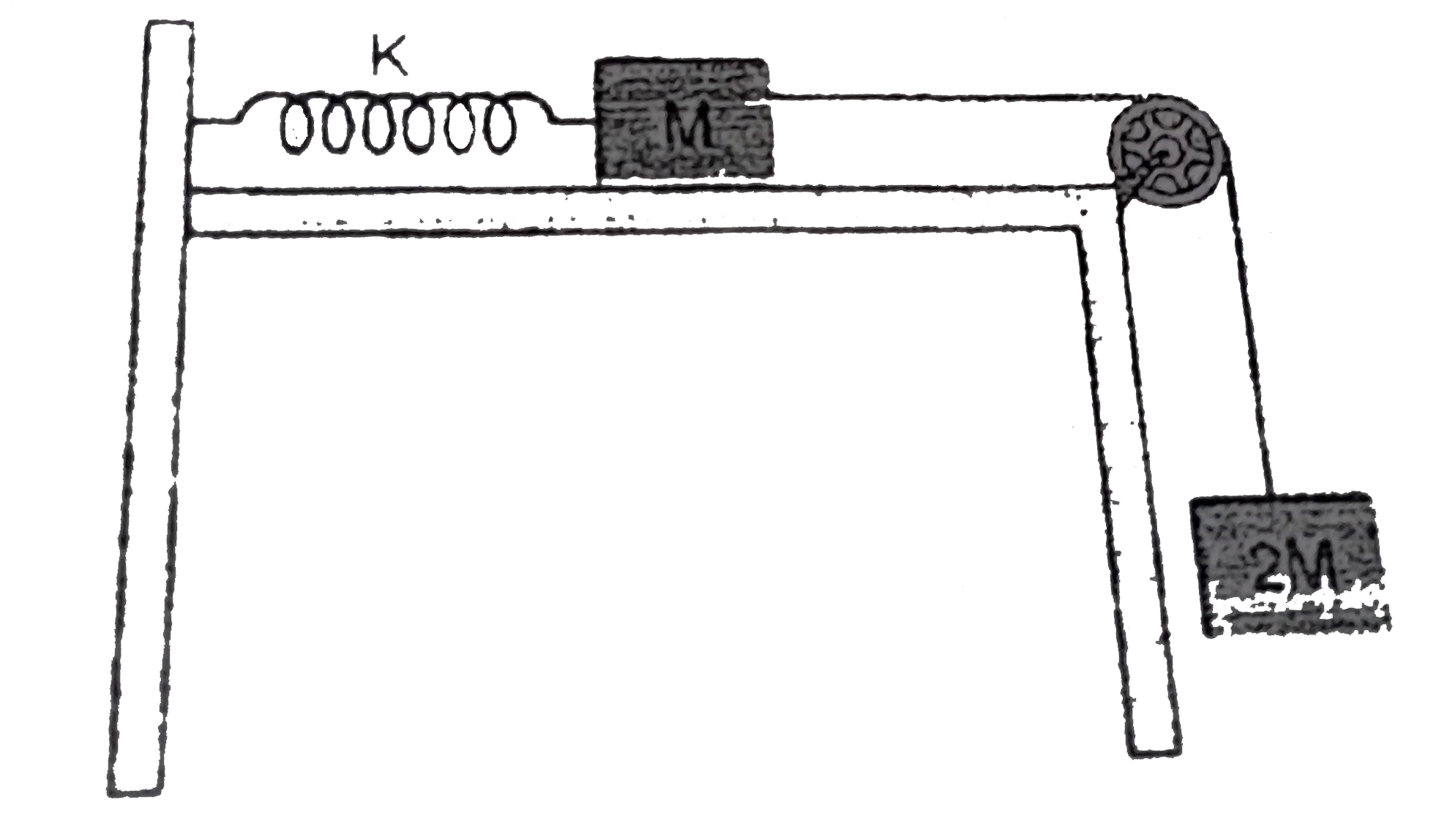
Two blocks, of masses `M` and `2M` are connected to a light spring of spring constant `K` that has one end fixed, as shown in figure. The horizontal surface and the pulley are frictionless. The blocks are released from rest when the spring is non deformed. The string is light.

A

Maximum extension in the spring is `(4Mg)/(K)`

B

Maximum kinetic energy of the system is `(2M^(2)g^(2))/(K)`

C

Maximum energy stored in the spring is four times that of maximum kinetic energy of the system.

D

When kinetic energy of the system is maximum , energy stored in the spring is `(4M^(2)g^(2))/(K)`

Text Solution

Verified by Experts

The correct Answer is:

A, B, C

Maximum extension will be at the moment when both masses stop momentarily after going down. Applying `W-E` theorem from starting to that instant.
`k_(f)-k_(i)=W_(gr.)+W_(sp)+W_(ten).`
`0-0=2M.g.x +(-(1)/(2)Kx^(2))+0`
`x=(4Mg)/(K)`
System will have maximum `KE` when net force on the system becomes zero. Therefore
`2Mg=T` and `T=kx`
`rArr x=(2Mg)/(K)`
Hence `KE` will be maximum when `2M` mass has gone down by `(2Mg)/(K)`
Applying `W//E` theorem
`k_(f)-0=2Mg.(2Mg)/(K)-(1)/(2)K. (4M^(2)g^(2))/(K^(2))`
`k_(f)=(2M^(2)g^(2))/(K^(2))`
Maximum energy of spring `=(1)/(2)K. ((4Mg)/(K))^(2)`
`=(8M^(2)g^(2))/(K)`
Therefore Maximum spring energy
When `K.E.` is maximum `x=(2Mg)/(K)`.
Spring energy `=(1)/(2) . K. (4M^(2)g^(2))/(K^(2))=(2M^(2)g^(2))/(K^(2))`
`i.e. (D)` is wrong.
Promotional Banner

Topper's Solved these Questions

  • DAILY PRACTICE PROBLEMS

    RESONANCE ENGLISH|Exercise dpp 53|5 Videos
  • DAILY PRACTICE PROBLEMS

    RESONANCE ENGLISH|Exercise dpp 54|8 Videos
  • DAILY PRACTICE PROBLEMS

    RESONANCE ENGLISH|Exercise dpp 51|7 Videos
  • CURRENT ELECTRICITY

    RESONANCE ENGLISH|Exercise Exercise|53 Videos
  • ELASTICITY AND VISCOCITY

    RESONANCE ENGLISH|Exercise Advanced Level Problems|9 Videos

Similar Questions

Explore conceptually related problems

Two blocks, of masses M and 2 M , are connected to a light spring of spring constant K that has one end fixed, as shown in figure. The horizontal surface and the pulley are frictionless. The blocks are released from when the spring is non deformed. The string is light. .

Two blocks, of masses M and 2 M , are connected to a light spring of spring constant K that has one end fixed, as shown in figure. The horizontal surface and the pulley are frictionless. The blocks are released from when the spring is non deformed. The string is light. .

Two blocks each of mass m are connected over two light and frictionless pulleys and a fixed wedge by a light string as shown in figure. The tension in the string is :

Two blocks of masses m and m' are connected by a light spring on a horizontal frictionless table . The spring is compressed and then released . Find the ratio of acceleration of masses .

Two blocks A and B of mass m and 2m respectively are connected by a light spring of force constant k. They are placed on a smooth horizontal surface. Spring is stretched by a length x and then released. Find the relative velocity of the blocks when the spring comes to its natural length

A block of mass m is attached to a spring of force constant k whose other end is fixed to a horizontal surface. Initially the spring is in its natural length and the block is released from rest. The average force acting on the surface by the spring till the instant when the block has zero acceleration for the first time is

A block of mass m held touching the upper end of a light spring of force constant K as shown in figure. Find the maximum potential energy stored in the spring if the block is released suddenly on the spring.

A block of mass m is connected to another .block of mass M by a massless spring of spring constant k. A constant force f starts action as shown in figure, then:

A block of mass m is attached to one end of a mass less spring of spring constant k. the other end of spring is fixed to a wall the block can move on a horizontal rough surface. The coefficient of friction between the block and the surface is mu then the compession of the spring for which maximum extension of the spring becomes half of maximum compression is .

Two masses m_1 and m_2 re connected by a spring of spring constant k and are placed on as frictionless horizontal surface. Initially the spring is stretched through a distance x_0 when the system is released from rest. Find the distance moved by the two masses before they again come to rest.
