Home
Class 11
PHYSICS
Two blocks A and B of mass m and 2m are...

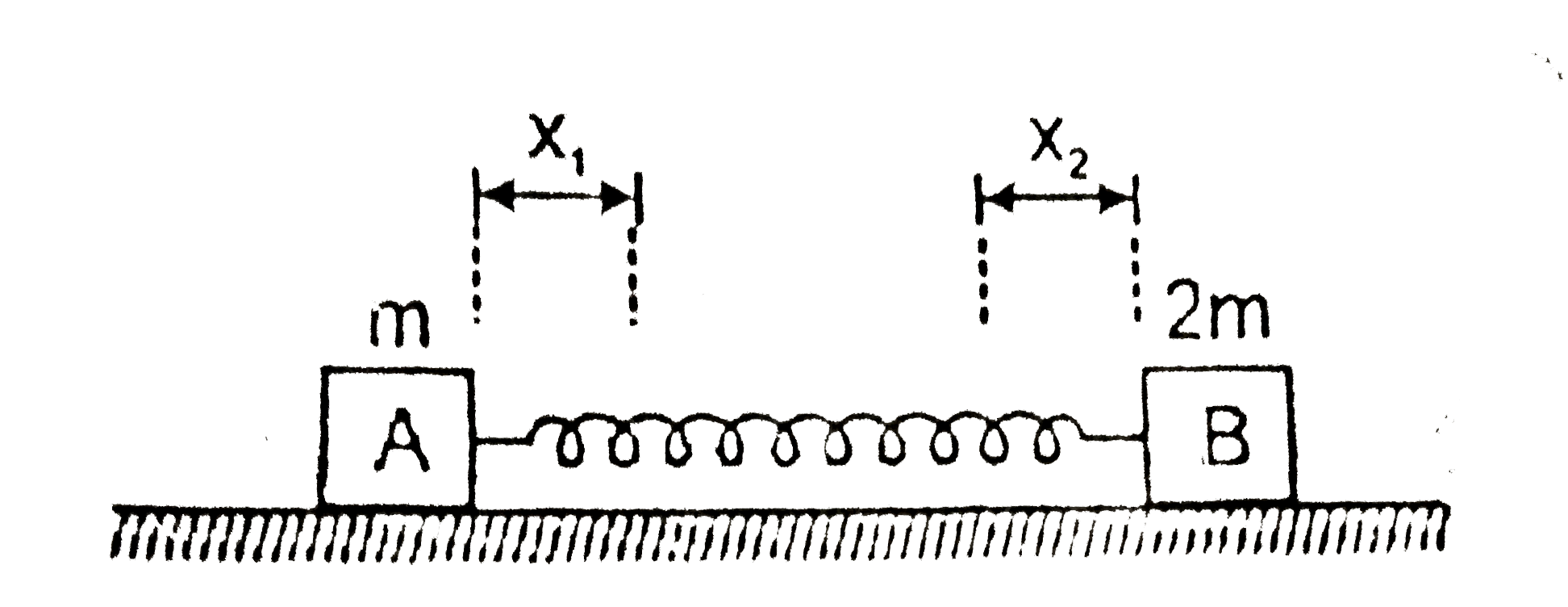
Two blocks A and B of mass m and 2m are connected by a massless spring of force constant k . They are placed on a smooth horizontal plane . Spring is stretched by an amount x and then released . The relative velocity of the blocks when the spring comes to its natural length is

Text Solution

Verified by Experts

The correct Answer is:
`(1)/(4)kx_(0)^(2)`


Let the block `A ` shift to left by `x_(1)` and block `B` shift to right by `x_(2)`. The centre of mass of the two block system is at rest.
Hence `mx_(1)=2ms_(2)`.
or `x_(2)=(x_(1))/(2) …..(1)`
and the spring force on either block is `k(x_(0)-[x_(1)+x_(2)]),` where `x_(0)` is the initial compression in the spring.
Let the block `A` shift further left by `dx_(1)`
`:. `work donw on block by spring is
`dW=(k(x_(0)-x_(1)-x_(2))dx_(1) .....(2)`
`=k(x_(0)-x_(1)-(x_(1))/(2))dx_(1)`
`:. `Net work done
`int dW=underset(x_(1)=0)overset(x_(0)//3)intk(x_(0)-(3)/(2)x_(1))dx_(1)=(kx_(0)^(2))/(4)`
`Ans. (1)/(2) kx_(0)^(2)`
Alternative Solution
Let the speeds of blocks `A` and `B` at the instant compression is `(x_(0))/(2)` be `v_(A)` and`v_(B)` as shown in figure
`[l_(0)]` natural length of spring `]`

No external forces act on the system in the horizontal direction
Applying conservation of momentum in horizontal direction
Initial momentum `=` final momentum
`0=m(-v_(A))+2mv_(B)`
or `v_(A)=2v_(B) ......(1)`
from conservation of energy
`(1)/(2)kx_(0)^(2)=(1)/(2)k((x_(0))/(2))^(2)+(1)/(2) mv_(A)^(2)+(1)/(2) 2mv_(B)^(2) ....(2)`
from `(1)` and `(2)` we get
`(1)/(2)mv_(A)^(2)=(1)/(4)kx_(0)^(2)`
work done on block `A` by spring `=` change in kinetic energy of block `A`
`=(1)/(2)mv_(A)^(2)=(1)/(4)kx_(0)^(2)`
Promotional Banner

Topper's Solved these Questions

  • DAILY PRACTICE PROBLEMS

    RESONANCE ENGLISH|Exercise dpp 53|5 Videos
  • DAILY PRACTICE PROBLEMS

    RESONANCE ENGLISH|Exercise dpp 54|8 Videos
  • DAILY PRACTICE PROBLEMS

    RESONANCE ENGLISH|Exercise dpp 51|7 Videos
  • CURRENT ELECTRICITY

    RESONANCE ENGLISH|Exercise Exercise|53 Videos
  • ELASTICITY AND VISCOCITY

    RESONANCE ENGLISH|Exercise Advanced Level Problems|9 Videos

Similar Questions

Explore conceptually related problems

Two blocks A and B of mass m and 2m respectively are connected by a light spring of force constant k. They are placed on a smooth horizontal surface. Spring is stretched by a length x and then released. Find the relative velocity of the blocks when the spring comes to its natural length

Two blocks A and B of masses 3 kg and 6 kg are connected by a massless spring of force constant "1800 N m"^(-1) and then they are placed on a smooth horizontal surface. The blocks are pulled apart to stretch the spring by 5 cm and then released. What is the relative velocity (in ms^(-1) ) of the blocks when the spring comes to its natural length?

Two blocks of masses m_(1) and m_(2) are connected by a massless spring and placed on smooth surface. The spring initially stretched and released. Then :

Two blocks of masses m_(1) and m_(2) are connected by an ideal sprit, of force constant k . The blocks are placed on smooth horizontal surface. A horizontal force F acts on the block m_(1) . Initially spring is relaxed, both the blocks are at rest. What is acceleration of centre of mass of system at the instant of maximum elongation of spring

Two blocks of masses m_(1) and m_(2) are connected by an ideal sprit, of force constant k . The blocks are placed on smooth horizontal surface. A horizontal force F acts on the block m_(1) . Initially spring is relaxed, both the blocks are at rest. Which of the following statement is not true tn the watt of above system.

Two blocks of masses m_(1) and m_(2) , connected by a weightless spring of stiffness k rest on a smooth horizontal plane as shown in Fig. Block 2 is shifted a small distance x to the left and then released. Find the velocity of centre of mass of the system after block 1 breaks off the wall.

Two blocks A and B of mass 2m and m respectively are connected to a massless spring of force constant K as shown in figure A and B are moving on the horizontal frcitionless surface with velocity v to right with underformed spring. If B collides with C elastically, then maximum compression of the spring will be

Two identical blocks A and B of mass m each are connected to each other by spring of spring constant k. Block B is initially shifted to a small distance x_(0) to the left and then released. Choose the correct statements for this problem, after the spring attains it's natural length.

A block of mass m is connected to another block of mass M by a massless spring of spring constant k . the blocks are kept of a smooth horizontal plane and are at rest. The spring is unstretched when a constant force F starts acting on the block of mass M of pull it. Find the maximum extension of the spring

A block of mass m is connect to another block of mass M by a massless spring of spring constant k. The blocks are kept on a smooth horizontal plane. Initially the blocks are at rest and the spring is upstretched when a constant force F starts acting on the block of mass M to pull it. Find the maximum extension of the spring.

