Home
Class 11
PHYSICS
A rod AB is moving on a fixed circle of ...

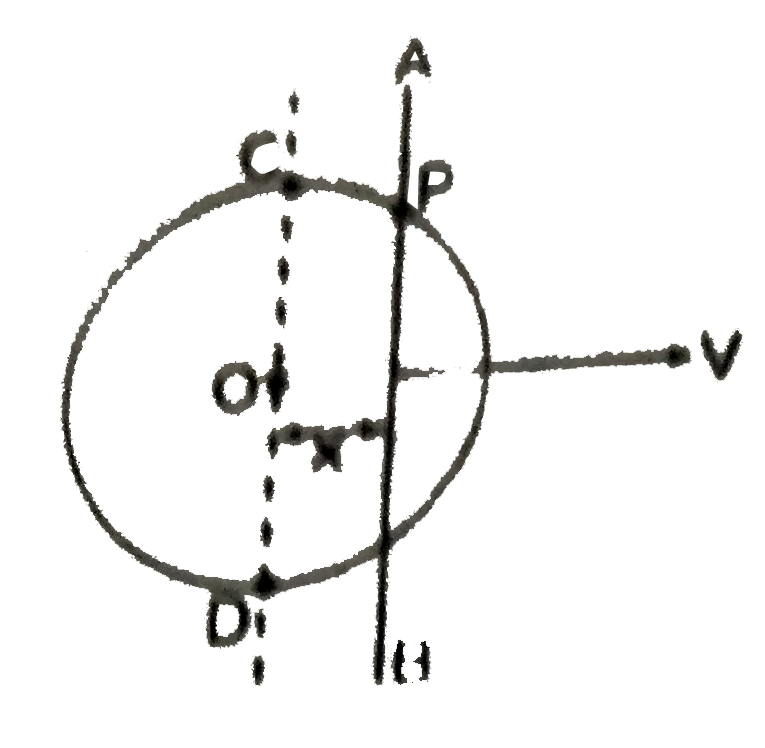
A rod `AB` is moving on a fixed circle of radius `R` with constant velocity `'v'` as shown in figure. `P` is the point of intersection of the rod and the circle. At an instant the rod is at a distance `x=(3R)/(5)` from centre of the circle. The velocity of the rod is perpendicular to the rod and the rod is always parallel to the diameter `CD`.

`(a)` Find the speed of point of intersection `P`
`(b)` Find the angular speed of point of intersection
`P` with respect to centre of the circle.

Text Solution

Verified by Experts

The correct Answer is:
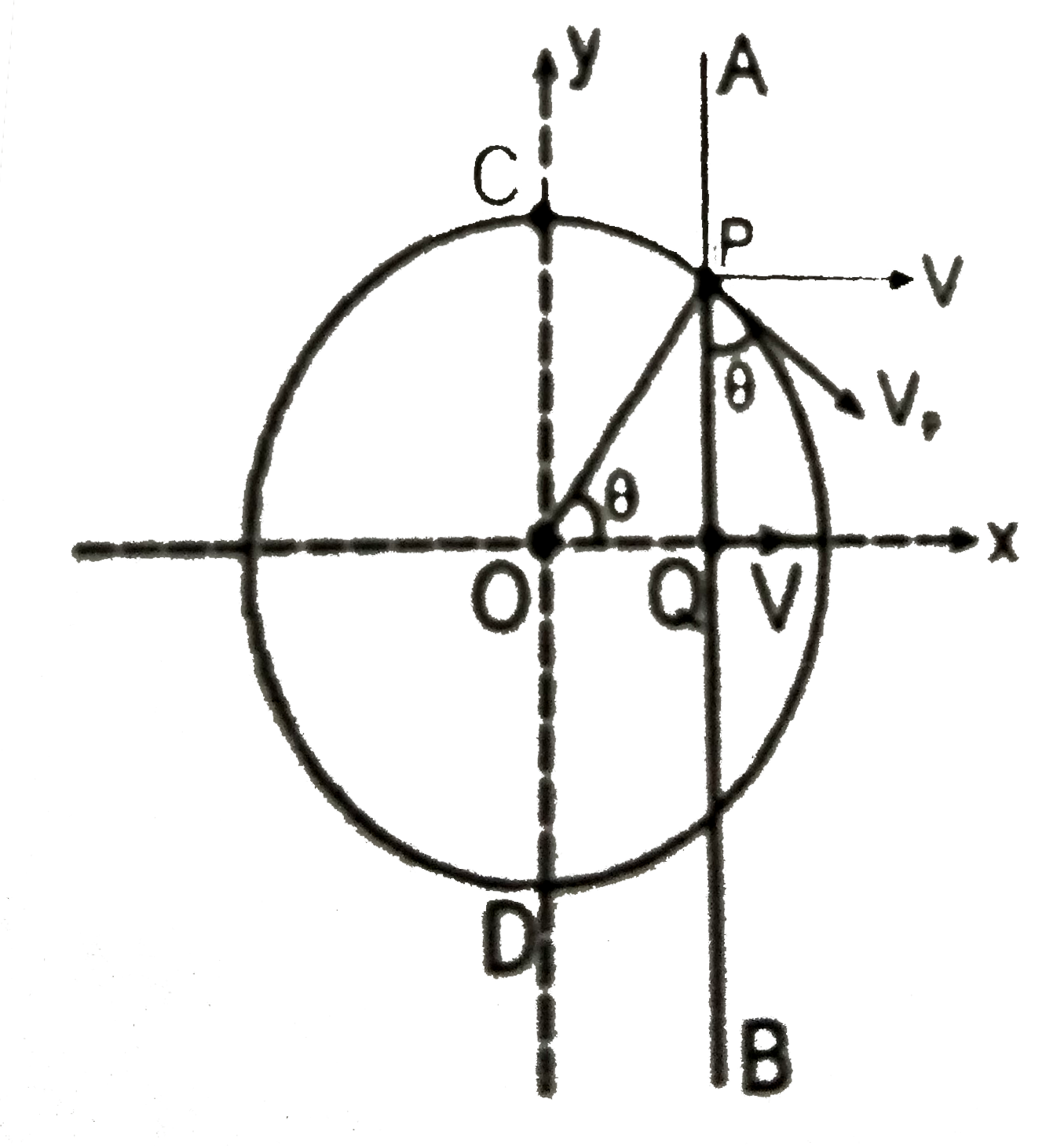
`(a)_(p)=(5)/(4)V (v)V co sectheta`


As a rod `AB` moves, the point `'P'` will always lies on the circle.
`:. `Its velcoity will be along the circle as shown by `'V_(P)'` in the figure. If the point `P` has to lie on the rod `'AB'` also then it should have component in `'x'` direction as `'V'`
`:. V_(P) sin theta =V`
`rArr V_(p)=V co se ctheta`
here` cos theta=(x)/(R)=(1)/(R). (3R)/(5)=(3)/(5)`
`....Ans. `
`omega =(V_(P))/(R)=(5V)/(4R)`
ALTERNATE SOLUTION `:`
Sol. `(a)` Let `'P'` have coordinate `(x,y)`
`x=R cos theta, y=R sin theta `
`V_(x)=(dx)/(dt)=-R sin theta (d theta )/(dt)=VrArr (d theta)/(dt)=(-V)/(R sin theta )`
`V_(y)=R cos theta (d theta )/(dt)=R cos theta (-(V)/(R sin theta ))`
`=-V cot theta`
`:. V_(P)=sqrt(V_(x)^(2)+V_(y)^(2))=sqrt(V^(2)+V^(2)cot ^(2) theta )`
`=V c o s ec theta ....Ans. `
`Sol. (b)omega =(V_(P))/(R)=(5V)/(4R)`
Promotional Banner

Topper's Solved these Questions

  • DAILY PRACTICE PROBLEMS

    RESONANCE ENGLISH|Exercise dpp 64|5 Videos
  • DAILY PRACTICE PROBLEMS

    RESONANCE ENGLISH|Exercise DPP 65|5 Videos
  • DAILY PRACTICE PROBLEMS

    RESONANCE ENGLISH|Exercise DPP 62|4 Videos
  • CURRENT ELECTRICITY

    RESONANCE ENGLISH|Exercise Exercise|53 Videos
  • ELASTICITY AND VISCOCITY

    RESONANCE ENGLISH|Exercise Advanced Level Problems|9 Videos

Similar Questions

Explore conceptually related problems

Two points of a rod move with velocity 3 v and v perpendicular to the rod and in the same direction. Separated by a distance r . Then the angular velocity of the rod is :

A rod AB is placed on smooth inclined plane as shown in the figure. At the instant which is shown in the figure, the angular velocity of the rod is

A rod AB of mass M and length L is shown in figure. End A of rod is hinged and end B is lying on the ground. Find the Normal reaction by ground on the rod

A rod AB is shown in figure. End A of the rod is fixed on the ground. Block is moving with velocity 2 ms^-1 towards right. The velocity of end B of rod at the instant shown in figure is

The velocity of point A on the rod is 2ms^(-1) (leftwards) at the instant shown in fig. The velocity of the point B on the rod at this instant is

A rod of length 1m is sliding in a corner as shown. At an instant when the rod makes an angle of 60^(@) with the horizontal plane, the velocity of point A on the rod is 1 m/s. The angular velocity of the rod at this instant is :

Find the velocity of the moving rod at time t if the initial velocity of the rod is zero and a constant force F is applied on the rod.Neglect the resistance of the rod.

A rod of length l is placed perpendicular to a long wire carrying current i . The rod is moved parallel to the wire with a velocity v . Find the emf induced in the rod, if its nearest end is at a distance a from the wire.

A rod of length l is placed perpendicular to a long wire carrying current i . The rod is moved parallel to the wire with a velocity v . Find the emf induced in the rod, if its nearest end is at a distance a from the wire.

In the figure shown, the instantaneous speed of end A of the rod is v to the left. The angular velocity of the rod of length L must be

