Home
Class 12
PHYSICS
Two point like charges Q(1) and Q(2) are...

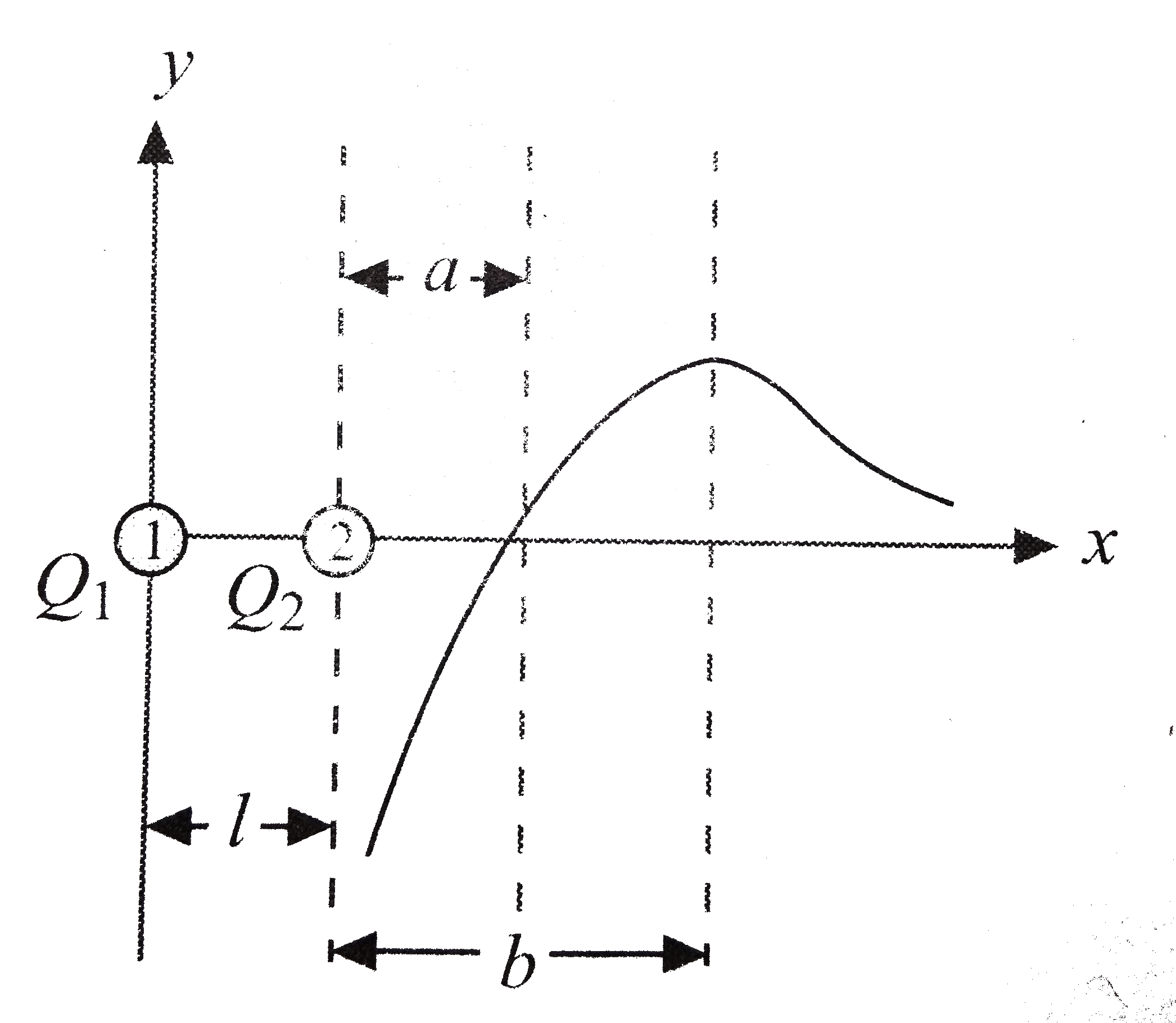
Two point like charges `Q_(1)` and `Q_(2)` are positioned at point 1 and 2. The firld intensity to the right of the chaege `Q_(2)` on the line that passes through the two charges varies accoreing to a law that is represented schematically in fig. The field intensity is assumed to be positive if its direction coincides with the positive direction on the x-axis. The distance between the charges is l.

The ratio of the absolute values of the charges `|Q_(1)//Q_(2)|` is

A

`(l)/(((l+x_(1))/(x_(1)))^((2)/(3))-1)`

B

`(l)/(((l+x_(1))/(x_(1)))^((1)/(3))-1)`

C

`(l)/(((l+2x_(1))/(x_(1)))^((2)/(3))-1)`

D

`(l)/(((l+2x_(1))/(x_(1)))^((1)/(3))-1)`

Text Solution

Verified by Experts

The correct Answer is:
A

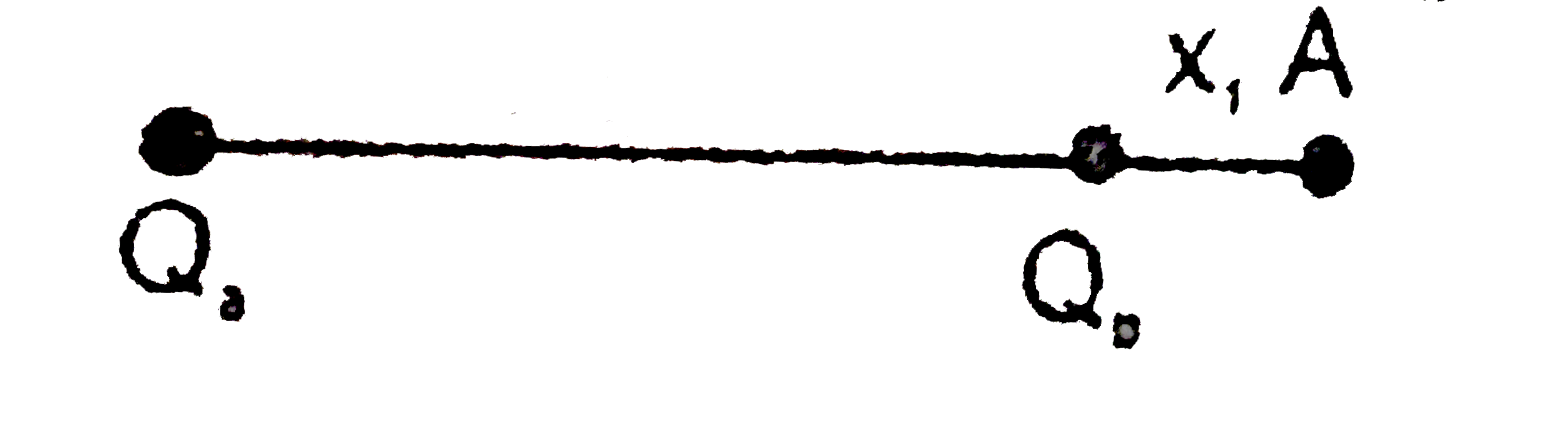
`because` Electric field near point b is `- infty`
`:. 'b'` shluld be negative electric field at `x_(1)` is O which possible only if 'a' and 'b' are of opposite sign
`:. 'a'` is positive
Charge b is negative and charge a is positive

E at `A = 0 (A = ) E =2)`
`rArr(|Q_(a)|)/((l+x_(1))^(2))=(|Q_(b)|)/((x_(1))^(2))`
`|(Q_(a))/(Q_(b))| =((l+x_(1))/(x_(1)))^(2)=(1+(l)/(x_(1)))^(2)`
W at a general X
`(K|Q_(a)|)/((l+x^(2)))-(K|Q_(b)|)/((x^(2)))`
`= K|Q_(a)|{(1)/((l+x)^(2))-|(Q_(b))/(Q_(a))|(1)/(x^(2))}`
If E is a maximum, `(dE)/(dx) = 0`
`rArr (-2)/((l+x)^(3))+((x_(1))/(l+x_(1)))^(2)(2)/(x^(3))=0`
`(l+x)^(2)=x^(3)((l+x_(1))/(x_(1)))^(2)`
`l+x = x((l+ x_(1))/(x_(1)))^((2)/(3))`
`x_(2)=(l)/(((l+x_(1))/(x_(1)))^((2)/(3))-1)`
`x_(2)=(l)/(((l+x_(1))/(x_(1)))^((2)/(3))-1),|Q_(a)/(Q_(b))|=(1+(l)/(x_(1)))^(2)`
Charge b is negative and charge a is positive.
Promotional Banner

Topper's Solved these Questions

  • DAILY PRACTICE PROBLEM

    RESONANCE ENGLISH|Exercise DPP No.31|20 Videos
  • DAILY PRACTICE PROBLEM

    RESONANCE ENGLISH|Exercise DPP No.32|9 Videos
  • DAILY PRACTICE PROBLEM

    RESONANCE ENGLISH|Exercise DPP No.29|20 Videos
  • CURRENT ELECTRICITY

    RESONANCE ENGLISH|Exercise High Level Problems (HIP)|19 Videos
  • ELECTRO MAGNETIC WAVES

    RESONANCE ENGLISH|Exercise Exercise 3|27 Videos

Similar Questions

Explore conceptually related problems

Two point charge Q_(a) and Q_(b) are positional at point A and B. The field strength to the right of charge Q_(b) on the line that passes through the two charges varies according to a law represented schematically in fig. (without employing a definite scale). The field strength is assumed to be positive if its direction coincides with the positive direction of the x-axis. The distance between the charges is l=21 cm . (a) Find the sign of the charges. (b) Find the ratio between the absolute value of charge Q_(a) and Q_(b) . (c ) Find the coordinate x of the point where the field strength is maximum.

Two point charge Q_(a) and Q_(b) are positional at point A and B. The field strength to the right of charge Q_(b) on the line that passes through the two charges varies according to a law represented schematically in fig. (without employing a definite scale). The field strength is assumed to be positive if its direction coincides with the positive direction of the x-axis. The distance between the charges is l=21 cm . (a) Find the sign of the charges. (b) Find the ration between the absolute value of charge Q_(a) and Q_(b) . (c ) Find the coordinate x of the point where the field strength is maximum.

Two point charges Q and -Q/4 are separated by a distance x.

Two point charges +Q and -Q are separated by a certain distance. The resultant electric field is parallel to the line joining the charges at the points

A positive charge +q_(1) is located to the left of a negative charge -q_(2) On a line passing through the two charges, there are two places where the total potential is zero. The reference is assumed to be at infinity The first place is between the charges and is 4.00 cm to the left of the negative charge. The second place is 7.00cm to the right of the negative charge if q_(2)=-12muC , what is the value of charge q_(1) in muC

Two point charges (+Q) and (-2Q) are fixed on the X-axis at positions a and 2a from origin respectively. At what positions on the axis, the resultant electric field is zero

Two point like charges q_(1) and q_(2) are fixed in free space. At every point on the curve shown, the net electrostatic potential created by these charges is V. Find the separation r between the charges. .

Two charge +aq and -q are kept apart. Then , at any point on the right bisector of line joining the two charge

Two point charges Q_1 = 400 muC and Q_2 = 100 muC are kept fixed, 60 cm apart in vacuum. Find intensity of the electric field at midpoint of the line joining Q_1 and Q_2 .

Two point charges +8q and -2q are located at x=0 and x=L respectively. The location of a point on the x axis at which the net electric field due to these two point charges is zero is

