Home
Class 12
PHYSICS
The electric field intensity at all poin...

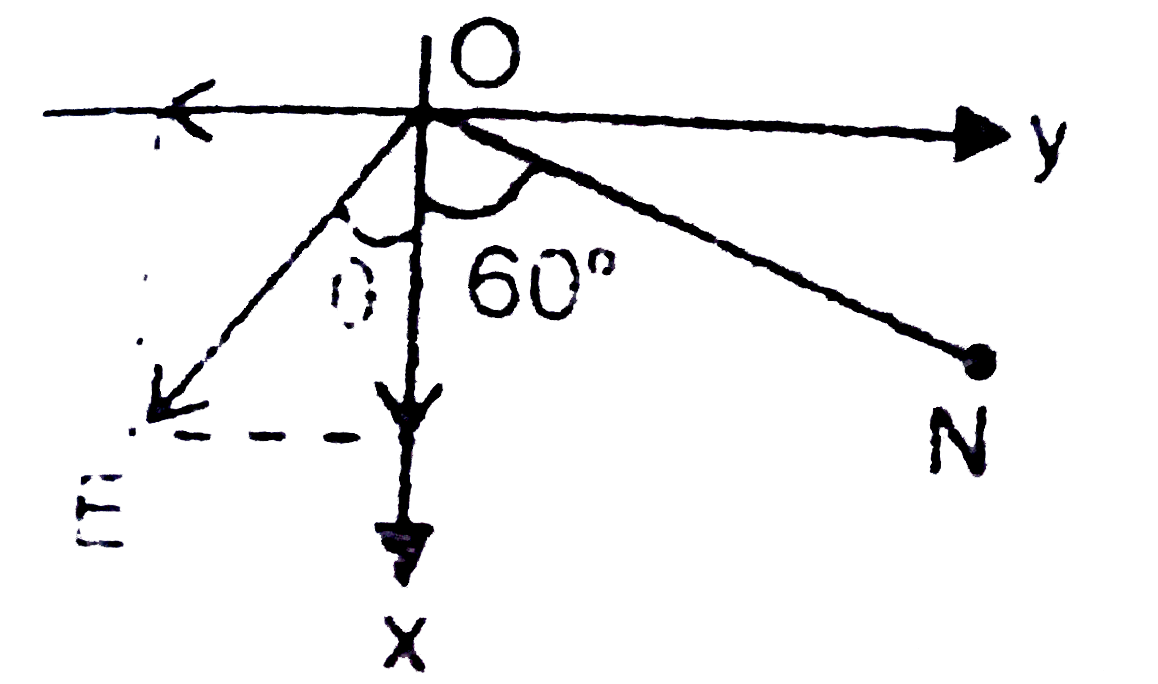
The electric field intensity at all points in space is given by `vecE = sqrt(3)hati - hatj` `V//m`. The nature of equipotential lines is x-y plane is given by

A

a.The magnitude of electric flux increases from initial value as `theta` is increased

B

b.The magnitude of electric flux increases from initial value as `theta` is decreased

C

c.The magnitude of electric flux may increase or decrease from initial value as `theta` is changed

D

d.The magnitude of electric flux will decrease from initial value as `theta` is changed.

Text Solution

Verified by Experts

The correct Answer is:
D


The direction of electric field is in x-y plane as shown in figure
The magnitude of electric field is E =
`sqrt(E_(x)^(2)+E_(y)^(2))=sqrt(3+1)=2V//m`
The direction of electric field is given by `theta =`
`"tan"^(-1)(E_(y))/(E_(x))"tan"^(-1)(1)/(sqrt(3))=30^(@) ="tan"^(-2)(1)/(sqrt(3))=30^(@)`
Hence electric field is normal to square frame LMNO as shown in figure
`:.` electric flux `vec(E) = vec(A)`
`= E A cos 0 = 2 xx 1 = 2 V//m`
`:.` C is correct of Q.7
Since flux is maximum at `0 = 60^(@)`, rotation of `30^(@)` either way would lead to decrease in flux
`:.` D is correct option of Q.9
Lines ON and NM are both normal to uniform electric field `vec(E)`. Hence work done by electric field as a point charge `2 mu C` is taken from O to M is zero.
`:.` A is correct option of Q.8.
Promotional Banner

Topper's Solved these Questions

  • DAILY PRACTICE PROBLEM

    RESONANCE ENGLISH|Exercise DPP No.38|20 Videos
  • DAILY PRACTICE PROBLEM

    RESONANCE ENGLISH|Exercise DPP No.39|9 Videos
  • DAILY PRACTICE PROBLEM

    RESONANCE ENGLISH|Exercise DPP No.36|20 Videos
  • CURRENT ELECTRICITY

    RESONANCE ENGLISH|Exercise High Level Problems (HIP)|19 Videos
  • ELECTRO MAGNETIC WAVES

    RESONANCE ENGLISH|Exercise Exercise 3|27 Videos

Similar Questions

Explore conceptually related problems

The electric field intensity at all points in space is given by vec(E) = sqrt(3) hat (i) - hat (j) volts/metre. A square frame LMNO of side 1 metre is shown in figure. The point N lies in x-y plane. The initial angle between line ON and x-axis is theta = 60^(@) The work done by electric field in taking a point charge of 1 muC from origin O to point M is -

The electric field intensity at all points in space is given by vec(E) = sqrt(3) hat (i) - hat (j) volts/metre. A square frame LMNO of side 1 metre is shown in figure. The point N lies in x-y plane. The initial angle between line ON and x-axis is theta = 60^(@) The magnitude of electric flux through area enclosed in square frame LMNO is -

the electric field intensity at all points is space is given by vecE=sqrt3hati-hatj volts/meter. A square frame LMNO of side 1 meter is shown in the figure. The point N lies in x-y plane. The initial angle between line ON and x -axis is theta = 60^(@) The work done by electric field in taking a point charge 1muC from origin O to point M is

the electric field intensity at all points is space is given by vecE=sqrt3hati-hatj volts/meter. A square frame LMNO of side 1 meter is shown in the figure. The point N lies in x-y plane. The initial angle between line ON and x -axis is theta = 60^(@) the magnitude of electric flux through area enclosed in square frame LMNO is

The electrostatic potential V at any point (x, y, z) in space is given by V=4x^(2)

The gravitational field in a region is given by vecE=(yhati+ xhatj) N/kg, where x and y are in metres. The equipotential lines are plotted as

The electric field in a region of space is given by E=5hati+2hatjN//C . The flux of E due ot this field through an area 1m^2 lying in the y-z plane, in SI units is

The electric field in a region is given by vecE = (A/x^3) hati. Write a suitable SI unit for A. Write an expression for the potential in the region assuming the potential at infinity to be zero.

The electric field in a certain region is given by E=(5hati-3hatj)kV//m . Find the difference in potential V_B-V_A . If A is at the origin and point B is at a. (0,0,5)m, b. (4,0,3) m.

Electrostatic field in a region is given by , vecE= (yzhati + zxhatj + xyhatk)V/m , where x,y and z are in m. If electric potential at origin is zero, then potential at (1m,1m, 1m) is

