Home
Class 12
PHYSICS
Two balls having masses m and 2m are fas...

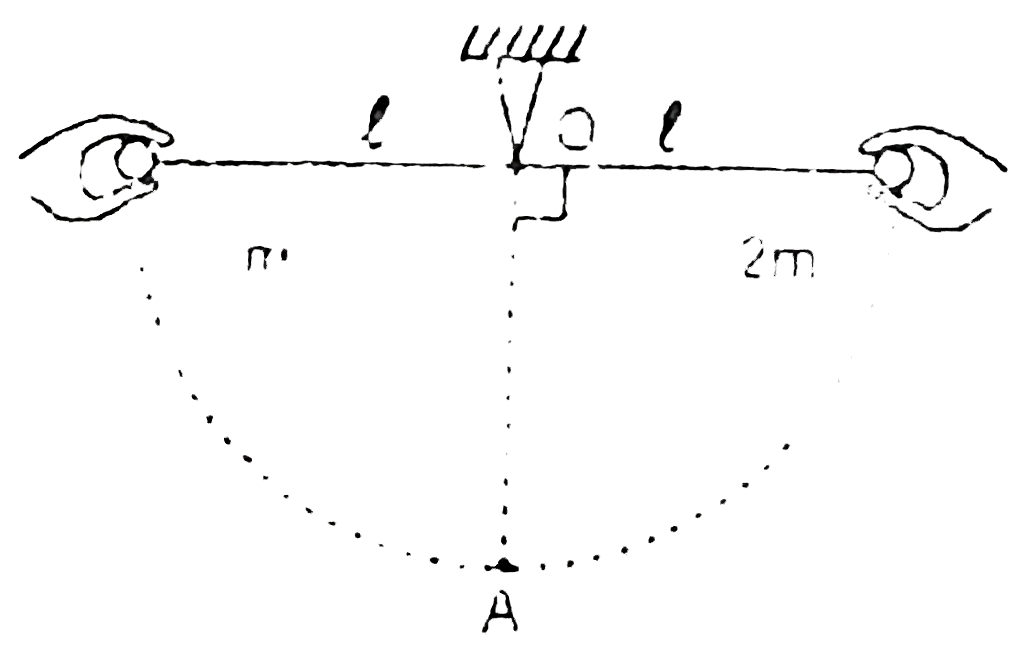
Two balls having masses m and 2m are fasrtened to two light strings of same length (figure). The other ends of the strings are fixed at O. The strings are kept in the same horizontal line and the system is released from rest. The collision between the balls is elastic. Point A is the lowest point at which either ball can reach

The speed of ball of mass 2m just after collision (for the first time) is over

A

`(l)/(g)`

B

`(2l)/(g)`

C

`l`

D

`2l`

Text Solution

Verified by Experts

The correct Answer is:

A

The maximum height to which the wall of mass `2m` rises is
`h = (v_(2)^(2))/(2g) = (l)/(g)`
Promotional Banner

Topper's Solved these Questions

  • DAILY PRACTICE PROBLEM

    RESONANCE ENGLISH|Exercise DPP No.63|9 Videos
  • DAILY PRACTICE PROBLEM

    RESONANCE ENGLISH|Exercise DPP No.64|20 Videos
  • DAILY PRACTICE PROBLEM

    RESONANCE ENGLISH|Exercise DPP No.61|20 Videos
  • CURRENT ELECTRICITY

    RESONANCE ENGLISH|Exercise High Level Problems (HIP)|19 Videos
  • ELECTRO MAGNETIC WAVES

    RESONANCE ENGLISH|Exercise Exercise 3|27 Videos

Similar Questions

Explore conceptually related problems

Two balls having masses m and 2m are fasrtened to two light strings of same length (figure). The other ends of the strings are fixed at O. The strings are kept in the same horizontal line and the system is released from rest. The collision between the balls is elastic. Point A is the lowest point at which either ball can reach The position at which the balls will collide for the first time

Two balls having masses m and 2m are fastened to two light strings of same length shown in the figure. The other ends of the strings are fixed at O. The strings are kept in the same horizontal line and the system is released from rest. The collision between the balls is elastic. (a). Find velocities of the balls just after their collision. (b). How high will the balls rise after the collision.

Two identical balls, each of mass m , are tied with a string and kept on a frictionless surface. Initially, the string is slack. They are given velocities 2u and u . in the same direction. Collision between the balls is perfectly elastic. After the first collision, what is the total loss in kinetic energy of the balls?

Two identical balls, each of mass m , are tied with a string and kept on a frictionless surface. Initially, the string is slack. They are given velocities 2u and u . in the same direction. Collision between the balls is perfectly elastic. What is the impulse generated in the string during the first collision?

Two identical balls, each of mass m , are tied with a string and kept on a frictionless surface. Initially, the string is slack. They are given velocities 2u and u . in the same direction. Collision between the balls is perfectly elastic. What is the final loss in kinetic energy of the balls?

A ball of mass m is fastened to a string. The ball swings in a vertical circle of radius R with the other end of the string held fixed. Neglecting the air resistance, the difference between the string's tension at the bottom of the circle and at the quarter of the cirlce is

A ball of mass m is released from A inside a smooth wedge of mass m as shown in figure. What is the speed of the wedge when the ball reaches point B?

Two metallic balls of mass m are suspended by two strings of length L . The distance between upper ends is L . The angle at which the string will be inclined with vertical due to attraction is (m lt lt M where M is the mass of Earth)

Two massless string of length 5 m hang from the ceiling very near to each other as shown in the figure. Two balls A and B of masses 0.25kg and 0.5kg are attached to the string. The ball A is released from rest at a height 0.45m as shown in the figure. The collision between two balls is completely elastic. Immediately after the collision, the kinetic energy of ball B is 1 J The velocity of ball A just after the collision is

Two small balls A and B of mass M and 3M hang from the ceiling by strings of equal length. The ball A is drawn aside, so that it is raised to a height H. It is then releases and collides with ball B. Select the correct answer (s)
