Home
Class 11
PHYSICS
A large open tank has two holes in the w...

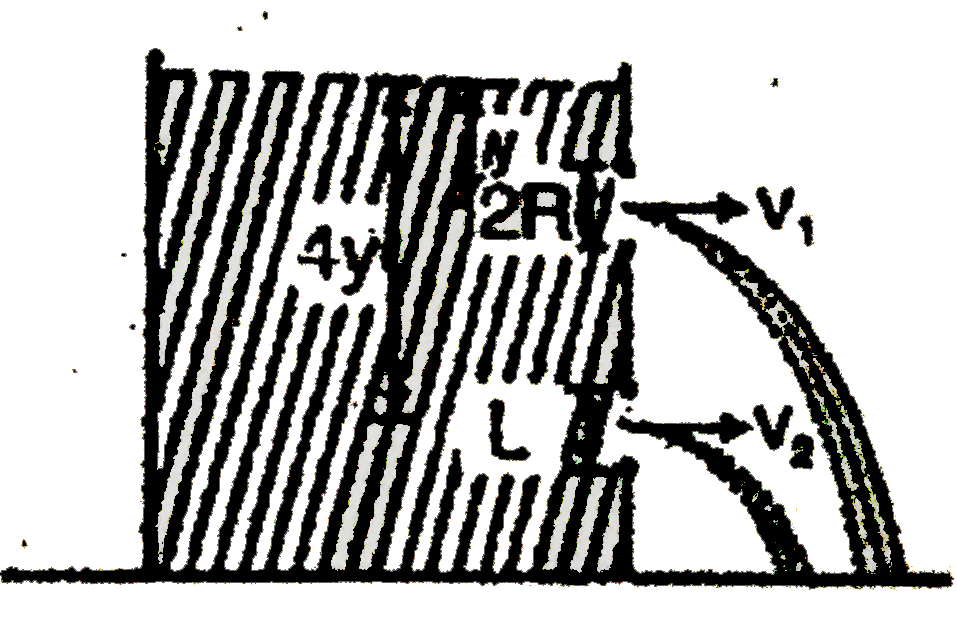
A large open tank has two holes in the wall. One is a square hole of side L at a depth h from the top and the other is a circular hole of radius R at a depth 4h from the top. When the tank is completely filled with water, quantities of water flowing out per second from both holes are the same. Then R is equal to

A

`L/(sqrt(2pi))`

B

`2piL`.

C

`sqrt(2/(pi)).L`

D

`L/(2pi)`

Text Solution

Verified by Experts

The correct Answer is:
C

Let `v_(1)` and `v_(2)` be the velocity of efflux from square and circular hole respectively. `S_(1)` and `S_(2)` be cross-section areas of square and circular holes.

`v_(1)=sqrt(8gy)` and `v_(2)=sqrt(2g(y))`
The volume of water coming out of square and circular hole per second is
`Q_(1)=v_(1)S_(1)=sqrt(8gy)L^(2) , Q_(2)=v_(2)S_(2)=sqrt(2gy) pi R^(2) :' Q_(1)=Q_(2)`
`:. R=sqrt(2/(pi)).L`
Promotional Banner

Topper's Solved these Questions

  • FLUID MECHANICS

    RESONANCE ENGLISH|Exercise Examples|22 Videos
  • FLUID MECHANICS

    RESONANCE ENGLISH|Exercise Board Level Exercise|18 Videos
  • ELECTROSTATICS

    RESONANCE ENGLISH|Exercise Exercise|52 Videos
  • FULL TEST 1

    RESONANCE ENGLISH|Exercise Exercise|30 Videos

Similar Questions

Explore conceptually related problems

A large open tank has two holes in the wall. One is a square hole of side L at a depth y from the top and the other is a circular hole of radius R at a depth 4y from the top. When the tank is completely filled with water, the quantities of water flowing out per second from both holes are the same. Then, R is equal to

A large open tank has two holes in the wall. One is square hole of side L at a depth y from the top and the other is a circular hole of radius R at a depth of 4y from the top. When the tank is completely filled with water, the quantities of water flowing out per second from both holes are the same. Then R is equal to

A vessel completely filled with water has holes 'A' and 'B' at depths 'h' and '3h' from the top respectively. Hole 'A' is a square of side 'L' and 'B' is circle of radius 'r'. The water flowing out per second from both the holes is same. Then 'L' is equal to

A vessel completely filled with water has holes 'A' and 'B' at depths 'h' and '3h' from the top respectively. Hole 'A' is a square of side 'L' and 'B' is circle of radius 'r'. The water flowing out per second from both the holes is same. Then 'L' is equal to

A tank filled with fresh water has a hole in its bottom and water is flowing out of it. If the size of the hole is increased, then

A tank is filled to a height H. The range of water coming out of a hole which is a depth H//4 from the surface of water level is

In a cylindrical water tank there are two small holes Q and P on the wall at a depth of h_(1) from the upper level of water and at a height of h_(2) from the lower end of the tank, respectively, as shown in the figure. Water coming out from both the holes strike the ground at the same point. The ratio of h_(1) and h_(2) is

The bottom of a cylindrical vessel has a circlular hole of radius r and at depth h below the water] level. If the diameter of the vessel is D, the find then speed with which the water level in the] vessel drops.

Two holes 1 and 2 are made at depths h and 16h reapectively. Both the holes are circular but radius of hole-1 is two times.

A tank is filled with water and two holes A and B are made in it.- For getting same range, ratio of h' and h is

