Home
Class 11
PHYSICS
The cubical container ABCDEFGH which is ...

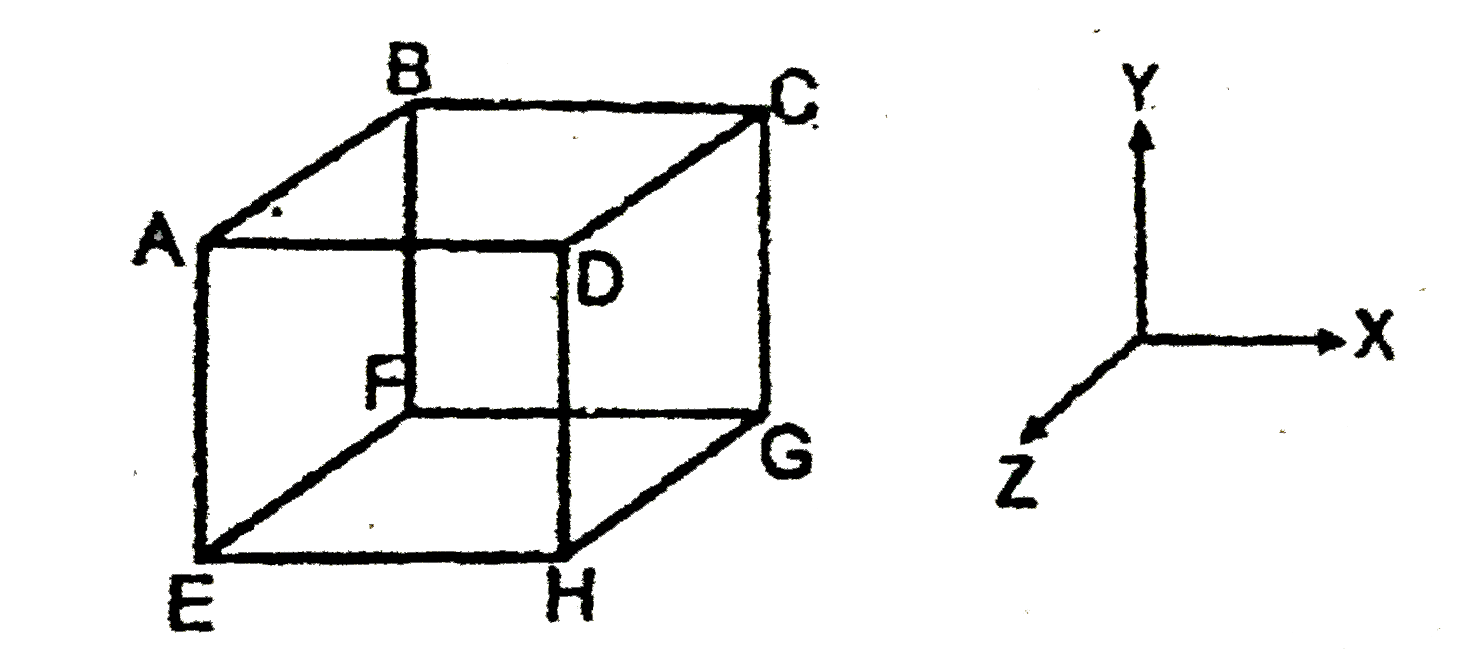
The cubical container ABCDEFGH which is completely filled with an ideal (nonviscous and incompressible) fluid, moves in a gravity free space with a acceleration of `a=a_0 (hat i -hatj +hat k)` where `a_0` is a positive constant. Then the minimum pressure at the point will be

A

B

B

C

C

E

D

H

Text Solution

Verified by Experts

The correct Answer is:

D

`a=a_(0) (hati-hatj+hatk)`
As there is no gravity, the pressure difference will be only due to the acceleration. All points other than point 'B' are acted upon by a pseudo force. Hence, at point 'B' pressure developed is zero.
Promotional Banner

Topper's Solved these Questions

  • FLUID MECHANICS

    RESONANCE ENGLISH|Exercise Examples|22 Videos
  • FLUID MECHANICS

    RESONANCE ENGLISH|Exercise Board Level Exercise|18 Videos
  • ELECTROSTATICS

    RESONANCE ENGLISH|Exercise Exercise|52 Videos
  • FULL TEST 1

    RESONANCE ENGLISH|Exercise Exercise|30 Videos

Similar Questions

Explore conceptually related problems

A positively charged particle is moving along the positive x-axis in a unifom electric field vec E= E_0hatj and magnetic field vec B = B_0hat k (where E_0 and B_0 are positive constants), then

One mole of an ideal gas undergoes a process in which T = T_(0) + aV^(3) , where T_(0) and a are positive constants and V is molar volume. The volume for which pressure with be minimum is

One mole of an ideal gas undergoes a process in which T = T_(0) + aV^(3) , where T_(0) and a are positive constants and V is molar volume. The volume for which pressure with be minimum is

A particle of charge qgt0 is moving at speed v in the +z direction through a region of uniform magnetic field. The magnetic force on the particle vec F = F_0 (3 hat i + 4 hat j) , where F_0 is a positive constant. (a) Determine the components B_x, B_y and B_z or at least as many of the three components as is possible from the information given. (b) If it is given in addition that the magnetic field has magnitude 6F_0 / (qv) , determine the magnitude of B_z .

A paarticle starts from origin at t=0 with a velocity 5.0 hat i m//s and moves in x-y plane under action of a force which produces a constant acceleration of ( 3.0 hat i + 2.0 j) m//s^(2) . (a) What is the y-cordinate of the particle at the instant its x-coordinate is 84 m ? (b) What is the speed of the particle at this time?

A particle initially (i.e., at t = 0) moving with a velocity u is subjected to a retarding force, as a result of which it decelerates a=-ksqrt v at a rate where v is the instantaneous velocity and k is a positive constant. The time T taken by the particle to come to rest is given by :

A U - shaped conducting frame is fixed in space. A conducting rod CD lies at rest on the smooth frame as shown. The frame is in a uniform magnetic field B_0 which is perpendicular to be plane of the frame . At the time t = 0 , the magnitude of the magnetic field being to change with time t as, B =B_0/(1+kt) , where k is a positive constant . For no current to be ever induced in the frame the speed with which rod should be pulled starting from time t = 0 is (the rod CD should be moved such that its velocity must lie in the plane of frame and perpendicular to rod (CD)

A magnetic field vec(B) = B_(0)hat(j) , exists in the region a ltxlt2a , and vec(B) = -B_(0) hat(j) , in the region 2a lt xlt 3a , where B_(0) is a positive constant . A positive point charge moving with a velocity vec(v) = v_(0) hat (i) , where v_(0) is a positive constant , enters the magnetic field at x= a . The trajectory of the charge in this region can be like

A circle is the locus of a point in a plane such that its distance from a fixed point in the plane is constant. Anologously, a sphere is the locus of a point in space such that its distance from a fixed point in space in constant. The fixed point is called the centre and the constant distance is called the radius of the circle/sphere. In anology with the equation of the circle |z-c|=a , the equation of a sphere of radius a is |r-c|=a , where c is the position vector of the centre and r is the position vector of any point on the surface of the sphere. In Cartesian system, the equation of the sphere, with centre at (-g, -f, -h) is x^2+y^2+z^2+2gx+2fy+2hz+c=0 and its radius is sqrt(f^2+g^2+h^2-c) . Q. Equation of the sphere having centre at (3, 6, -4) and touching the plane rcdot(2hat(i)-2hat(j)-hat(k))=10 is (x-3)^2+(y-6)^2+(z+4)^2=k^2 , where k is equal to

A ball of mass M//2 filled with a gas ( whose mass is M//2 ) is kept on a frictionless table . A bullet of mass m = M//4 and velocity v_(0)hat(i) penetrates the ball , and rests inside at t=0. Assume that the amount of gas emitted during the collision can be neglected. The compressed gas is emitted at a contant velocity v_(0)//2 relative to the ball and at an even rate k ( k is a positive constant ) . (a) What is the velocity of the ball after the collision with the bullet ? (b) Find the velocity of the ball v(t) as a function of time. Assume that the emission of gas starts at t=0. What is the final velocity of the ball ?
