Home
Class 11
PHYSICS
An empty glass jar is submerged in tank ...

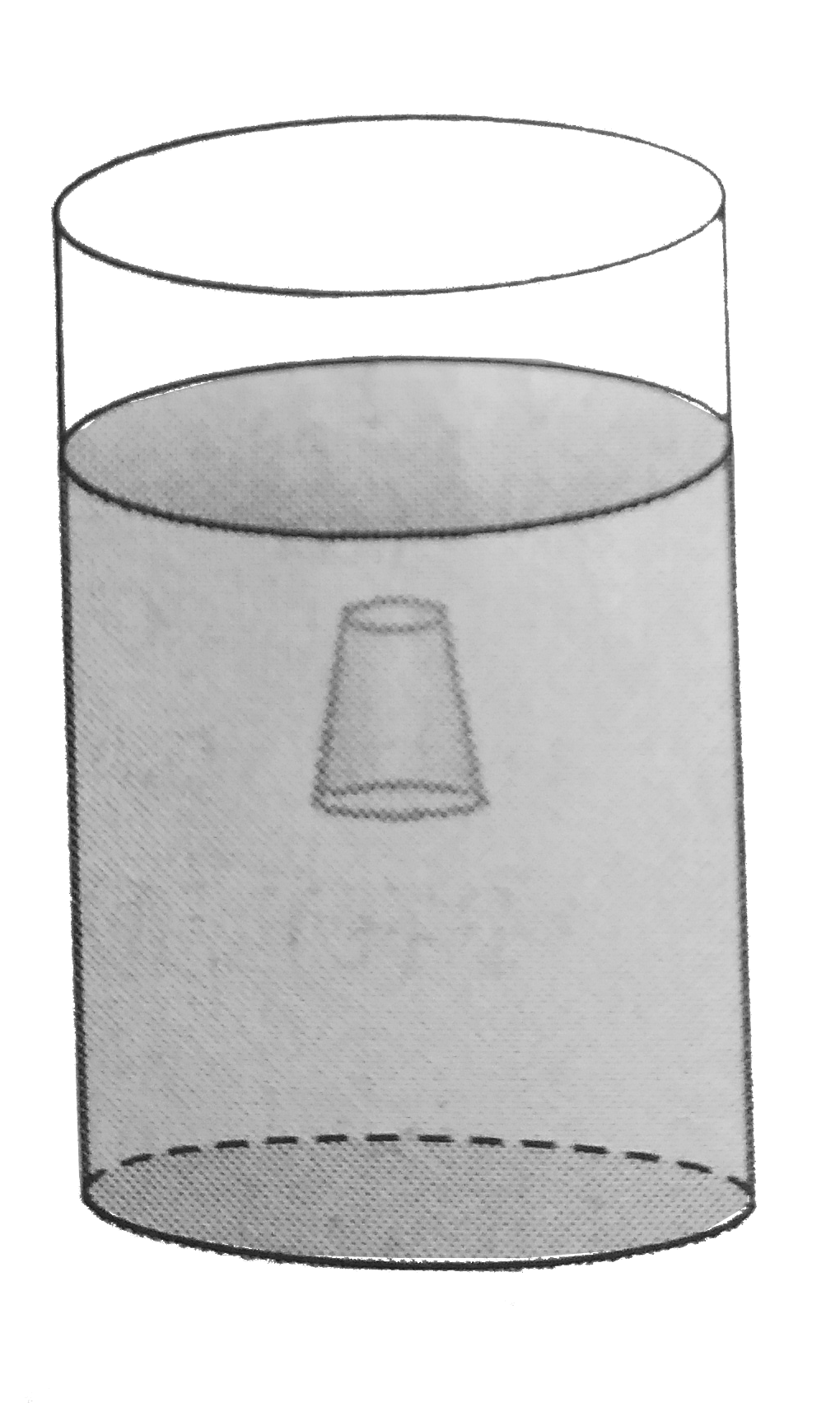
An empty glass jar is submerged in tank of water with open mouth of the jar downwards, so that air inside the jar is trapped and cannot get out. As the jar is pushed down slowly, the magnitude of net buoyant force on the system of volume of gas trapped in the jar and the jar.

A

increases

B

decreases

C

remains same

D

information is insufficient to draw inference

Text Solution

Verified by Experts

The correct Answer is:

B

As the jar is pushed down, due to increases in hydrostatic pressure, volume of gas trapped decreases. Hence net bouyant force decreases.
Promotional Banner

Topper's Solved these Questions

  • FLUID MECHANICS

    RESONANCE ENGLISH|Exercise Examples|22 Videos
  • FLUID MECHANICS

    RESONANCE ENGLISH|Exercise Board Level Exercise|18 Videos
  • ELECTROSTATICS

    RESONANCE ENGLISH|Exercise Exercise|52 Videos
  • FULL TEST 1

    RESONANCE ENGLISH|Exercise Exercise|30 Videos

Similar Questions

Explore conceptually related problems

A satellite, rotating around the earth has water in a jar inside it. A cork is pushed into the water in the jar and then released. The cork will

A beaker containing a liquid is kept inside a big closed jar. If the air inside the jar is continuously pumped out, the pressure in the liquid near the bottom of the liquid will

Give reasons : A candle brought near the mouth of a jar containing hydrogen gas starts burning but is extinguished when pushed inside the jar.

A glass full of water upto a height of 10 cm has a bottom of are 10 cm^(2) , top of area 30cm^(2) and volume 1 litre. (a) Find the force exerted by the water on the bottom. (b) Find the resultant force exerted by the sides of the glass on the water. (c ) If the glass is convered by a jar and the air inside the jar is completely pumped out, what will be the answer to parts (a) and (b). (d) If a glass of different shape is used, provided the height, the bottom area, the top area and the volume are unchanged, will the answer to parts (a) and (b) change. Take g=10m//s^(3) , density of water =10^(3) kg//m^(3) and atmospheric pressure =1.01xx10^(5)N//m^(2) .

A curved glass vessel full of water upto a height of 10 cm has a bottom of area 10 cm^(2) , top of area 30 cm^(2) and volume 1 L. (i) Find the force exerted by the water on the bottom. (ii) Find the resultant force exerted by the sides of the glass on the water. (iii) If the glass vessel is covered by a jar and the air inside the jar is completely pumped out, what will be the answers to parts (a) and (b) (iv) If a glass vessel of different shape is used provided the height, the bottom area and the volume are unchanged, will the answers to parts (a) and (b) change. (Take, g=10 ms^(-2) , density of water = 10^(3) kgm^(-2) and atmospheric pressure =1.01xx10^(5)Nm^(-2))

An excited tuning fork of frequency 512 Hz is held over the open end of a tall jar and water is slowly poured into it. Resonance was first observed at a level and then at a higher level. Calculate the difference in heights of the two levels. Velocity of sound in air at the time of experiment is 346 m/s.

Consider a water jar of radius R that has water filled up to height H and is kept on a stand of height h (see figure) through a hole of radius r(rltltR) at its bottom the water leaks out and the stream of water coming down towards the gound has a shape like a funnel as shown in the figure. it the radius of teh cross-section of water stream when it hits the ground is x. then.
