Home
Class 11
PHYSICS
A space 2.5cm wide between two large pla...

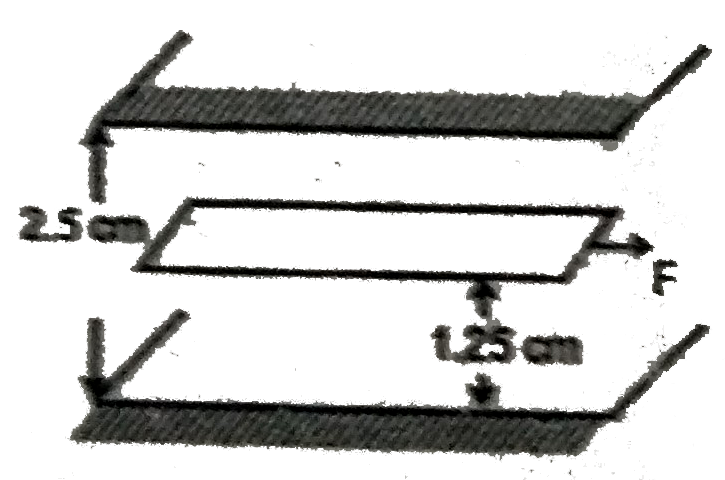
A space 2.5cm wide between two large plane surfaces is filled with oil. Force required to drag a very thin plate of area `0.5m^2` just midway the surfaces at a speed of `0.5m//sec` is 1N. The coefficient of vescosity in `kg-s//m^2` is:

A

`5xx10^(-2)`

B

`2.5 xx10^(-2)`

C

`1xx10^(-2)`

D

`7.5 xx10^(-2)`

Text Solution

Verified by Experts

The correct Answer is:
B

Velocity gradient `=0.5/(2.5/2xx10^(-2))`
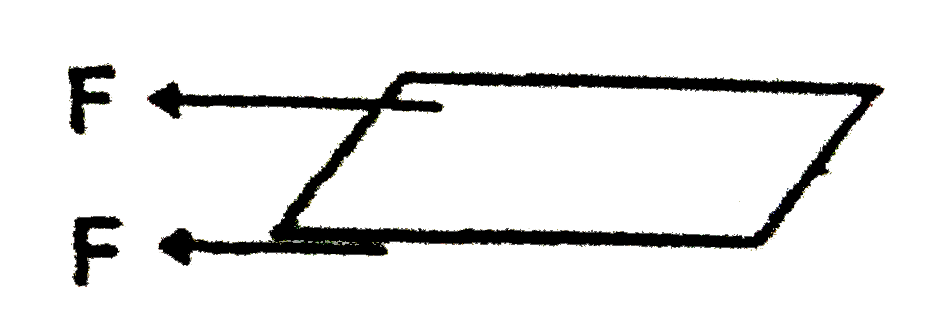
as force on the plate due to viscocity is from upper as well as lower portion of the oil, equal from each part,
Then`F=2 etaA(dv)/(dz) =2xxetaxx(0.5)0.5/(1.25xx10^(-2))`

`rArr eta=2.5xx10^(-2) kg -sec//m^(2)`
Promotional Banner

Topper's Solved these Questions

  • FLUID MECHANICS

    RESONANCE ENGLISH|Exercise Examples|22 Videos
  • FLUID MECHANICS

    RESONANCE ENGLISH|Exercise Board Level Exercise|18 Videos
  • ELECTROSTATICS

    RESONANCE ENGLISH|Exercise Exercise|52 Videos
  • FULL TEST 1

    RESONANCE ENGLISH|Exercise Exercise|30 Videos

Similar Questions

Explore conceptually related problems

A space 2.5cm wide between two large plane surfaces is filled with oil. Force required to drag a very thin plate of area 0.5m^2 just midway the surfaces at a speed of 0.5(m)/(sec) is 1N . The coefficient of viscosity in kg-(s)/(m^2) is:

The space between two large plane surfaces is 2.5 cm and it is filled with glycerine. What force is required to drag a very thin plate 1 m^2 in area, between the surfaces at a speed of 1m/s ? (The plate is at a distance of 1 cm from one of the surfaces. ) (eta=0.75Ns//m^2)

Find the force required to pull a block of mass 100kg up an incline of 8^(@) at a uniform speed of 5m//s . The coefficient of friction between the block and the plane is 0.3 .

Glycerine is filled in 25 mm wide space between two large plane horizontal surfaces. A thin plate of area 0.75 m^(2) at a distance of 10 mm from one of the surfaces is in a horizontal position be the plates inside the glycerine. It is dragged horizontally at a constant speed of 0.5 ms^(2) . Take coefficient of viscosity eta =" 0.5 Ns m"^(-2) . What is the force required to drag the plate at a constant speed (in newton) ?

Find the minimum force required to drag a hard polythene plate of area 2 m^(2) on a thin film of oil of thickness 0.25 cm and eta= 15 poise. Assume the speed of the plate is 10 cm s^(-1) .

A layer of glycerine of thickness 1 mm is present between a large surface and small surface of area 0.1m^(2) . With what force the small surface is to be pulled, so that it can move with a velocity of 1 m/s ? (coefficient of viscosity =0.07g-m^(-1)s^(-1) )

Calculate the Force (F) required to cause the block of mass m_(1) = 20 kg just to slide under the block of mass m_(2) = 10 kg [ coefficient of friction mu = 0*25 for all surfaces ]

A rectangular metal plate has dimensions of 10cmxx20cm . A thin film of oil separates the plate from a fixed horizontal surface. The separation between the rectangular plate and the horizontal surface is 0.2mm . An ideal string is attached to the plate and passes over an ideal pulley to a mass m . When m=125gm , the metal plate moves at constant speed of 5(cm)/(s) , across the horizontal surface. Then the coefficient of viscosity of oil in ("dyne"-s)/(cm^2) is (Use g=1000(cm)/(s^2) )

Calculate the force required to separate the glass plates of area 10^(-2)m^(2) with a film of water 0.05 mm thickness between them (surface tension of water =70xx10^(-3)N//m) )

The surface tension of liquid is 0.5 N / m . If a film is held on a ring of area 0.02 m square , its surface energy is

