Home
Class 11
PHYSICS
A block of density 2000 kg//m^(3) and ma...

A block of density `2000 kg//m^(3)` and mass 10 kg is suspended by a spring of force constant `100 N//m`. The other end of the spring is attached to a fixed support. The block is completely submerged in a liquid of density `1000 kg//m^(3)`. If the block is in equilibrium position.

A

The elongation of the spring is 1 m

B

the magnitude of buoyant force acting on the block is 25 N

C

the spring potential energy is 12.5 J

D

magnitude of spring force on the block is greater than the weight of the block

Text Solution

Verified by Experts

The correct Answer is:
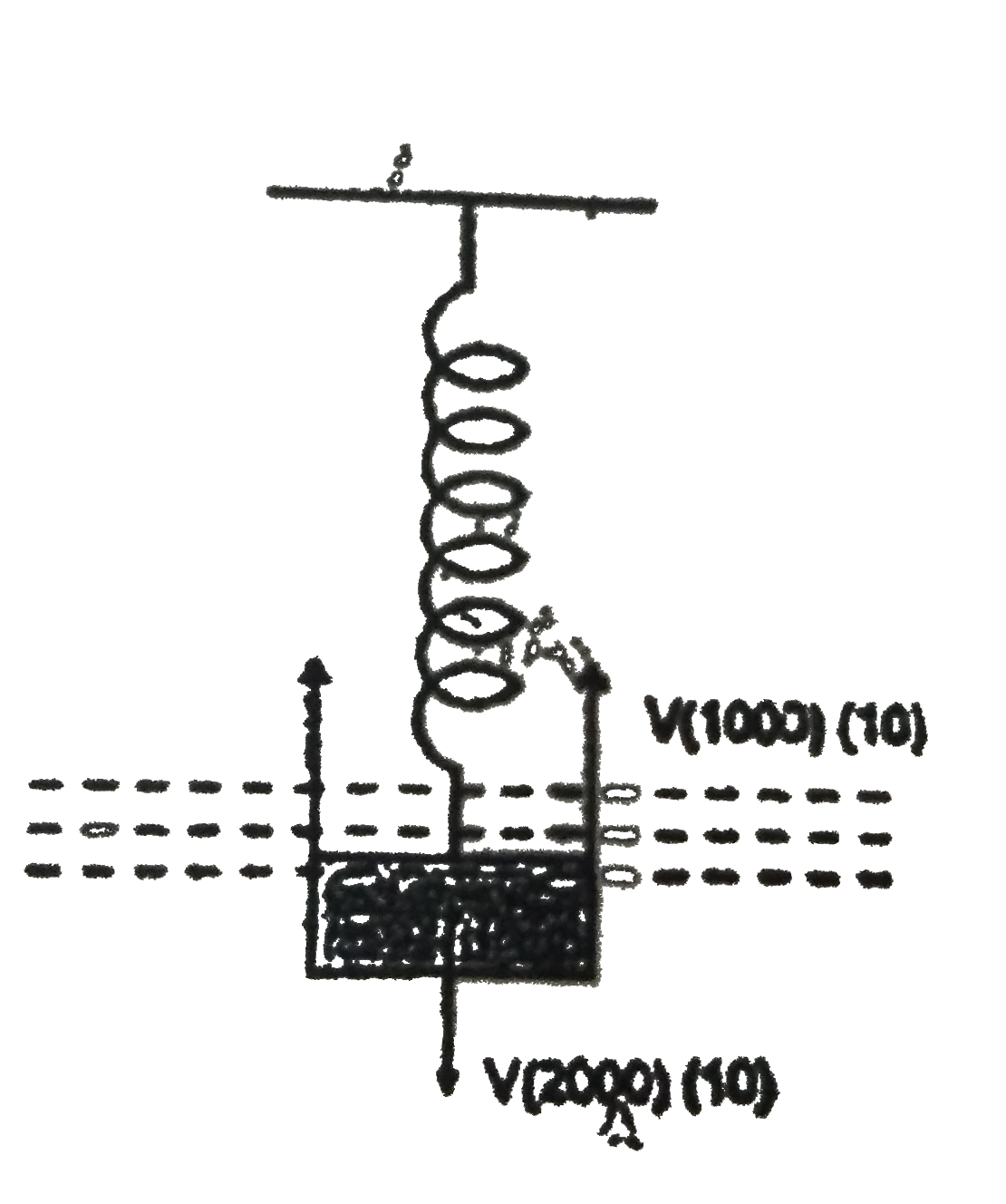
C

`Kx=V(2000)(10)-V(1000) (10)`
`=10/2000[1000xx10]`
Kx=50N ....(b)
`U_("Stored")=1/2xx(100)(50/100)^(2)=1/2xx2500/100=12.5 J`
Promotional Banner

Topper's Solved these Questions

  • FLUID MECHANICS

    RESONANCE ENGLISH|Exercise Examples|22 Videos
  • FLUID MECHANICS

    RESONANCE ENGLISH|Exercise Board Level Exercise|18 Videos
  • ELECTROSTATICS

    RESONANCE ENGLISH|Exercise Exercise|52 Videos
  • FULL TEST 1

    RESONANCE ENGLISH|Exercise Exercise|30 Videos

Similar Questions

Explore conceptually related problems

A block of density 2000kg//m^3 and mass 10kg is suspended by a spring stiffness 100N//m . The other end of the spring is attached to a fixed support. The block is completely submerged in a liquid of density 1000kg//m^3 . If the block is in equilibrium position.

A block of mass m is suspended by different springs of force constant shown in figure.

A block of mass 1 kg is attached to one end of a spring of force constant k = 20 N/m. The other end of the spring is attached to a fixed rigid support. This spring block system is made to oscillate on a rough horizontal surface (mu = 0.04) . The initial displacement of the block from the equilibrium position is a = 30 cm. How many times the block passes from the mean position before coming to rest ? (g = 10 m//s^(2))

A mass of 0.2 kg is attached to the lower end of a massless spring of force constant 200(N)/(m) the other end of which is fixed to a rigid support. Study the following statements.

A block of mass m suspended from a spring of spring constant k . Find the amplitude of S.H.M.

A block of 2 kg is suspended from the ceiling through a massless spring of spring constant k=100 N/m. What is the elongation of the spring? If another 1 kg is added to the block, what would be the further elongation?

A block of mass m, lying on a smooth horizontal surface, is attached to a spring (of negligible mass) of spring constant k. The other end of the spring is fixed, as shown in the figure. The block is initally at rest in its equilibrium position. If now the block is pulled withe a constant force F, the maximum speed of the block is :

A block of mass m is dropped onto a spring of constant k from a height h . The second end of the spring is attached to a second block of mass M as shown in figure. Find the minimum value of h so that the block M bounces off the ground. If the block of mass m sticks to the spring immediately after it comes into contact with it.

A block of mass 4 kg and volume 5xx10^(-4) m^(3) is suspended by a spring balance in a lift which is accelerating. The apparent weight shown by the spring balance is 3 kg. Now the block is immersed in water in kg shown by the spring balance is

A block of mass m = 2 kg is connected to a a spring of force constant k = 50 N//m . Initially the block is at rest and tlhe spring has natural length. A constant force F = 60 N is applied horizontally towards, the maximum speed of the block (in m//s ) will be (negelect friction).

