Home
Class 12
PHYSICS
The energy spectrum of beta - particle [...

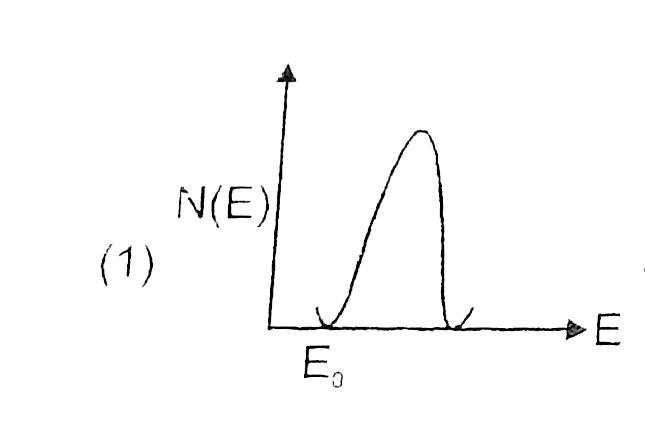
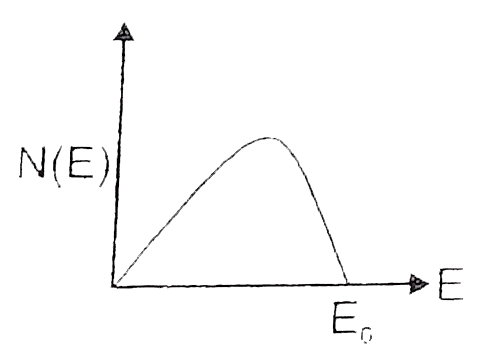
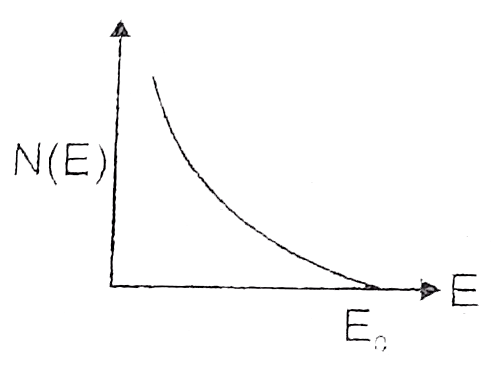
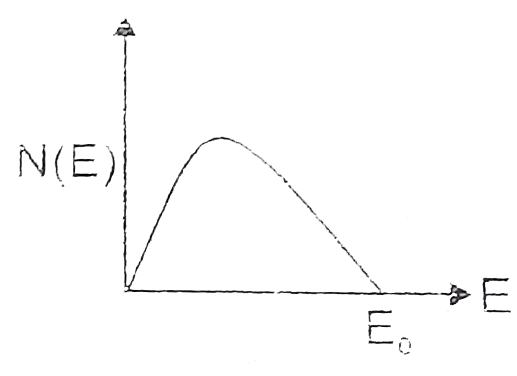
The energy spectrum of `beta` - particle [number `N(E)` as a function of `beta` - energy E] emitted from a radioactive source is

A

B

C

D

Text Solution

Verified by Experts

The correct Answer is:

D
Promotional Banner

Topper's Solved these Questions

  • NUCLEAR PHYSICS

    RESONANCE ENGLISH|Exercise Exercise -3 Part-III CBSE PROBLEMS (LAST 10 YEARS)|34 Videos
  • NUCLEAR PHYSICS

    RESONANCE ENGLISH|Exercise Advanced level solutions|16 Videos
  • NUCLEAR PHYSICS

    RESONANCE ENGLISH|Exercise Exercise 3 Part -1 JEE (Advanced)|19 Videos
  • GRAVITATION

    RESONANCE ENGLISH|Exercise HIGH LEVEL PROBLEMS|16 Videos
  • REVISION DPP

    RESONANCE ENGLISH|Exercise All Questions|463 Videos

Similar Questions

Explore conceptually related problems

The graph showing the energy spectrum of beta particle is

The electron emitted in beta radiation originates from

The electron emitted in beta radiation originates from

In the disintegration of a radioactive element, alpha - and beta -particles are evolved from the nucleus. ._(0)n^(1) rarr ._(1)H^(1) + ._(-1)e^(0) + Antineutrino + Energy 4 ._(1)H^(1) rarr ._(2)He^(4) + 2 ._(+1)e^(0) + Energy Then, emission of these particles changes the nuclear configuration and results into a daughter nuclide. Emission of an alpha -particles results into a daughter element having atomic number lowered by 2 and mass number by 4, on the other hand, emission of a beta -particle yields an element having atomic number raised by 1. How many alpha - and beta -particle should be emitted from a radioactive nuclide so that an isobar is formed?

The total energy of a particle in SHM is E. Its kinetic energy at half the amplitude from mean position will be

What are the respective number of alpha and beta -particles emitted in the following radioactive decay?

During alpha-decay , a nucleus decays by emitting an alpha -particle ( a helium nucleus ._2He^4 ) according to the equation ._Z^AX to ._(Z-2)^(A-4)Y+._2^4He+Q In this process, the energy released Q is shared by the emitted alpha -particle and daughter nucleus in the form of kinetic energy . The energy Q is divided in a definite ratio among the alpha -particle and the daughter nucleus . A nucleus that decays spontaneously by emitting an electron or a positron is said to undergo beta -decay .This process also involves a release of definite energy . Initially, the beta -decay was represented as ._Z^AX to ._(Z+1)^AY + e^(-)"(electron)"+Q According to this reaction, the energy released during each decay must be divided in definite ratio by the emitted e' ( beta -particle) and the daughter nucleus. While , in alpha decay, it has been found that every emitted alpha -particle has the same sharply defined kinetic energy. It is not so in case of beta -decay . The energy of emitted electrons or positrons is found to vary between zero to a certain maximum value. Wolfgang Pauli first suggested the existence of neutrinoes in 1930. He suggested that during beta -decay, a third particle is also emitted. It shares energy with the emitted beta particles and thus accounts for the energy distribution. The beta particles (positron) are emitted with different kinetic energies because

During alpha-decay , a nucleus decays by emitting an alpha -particle ( a helium nucleus ._2He^4 ) according to the equation ._Z^AX to ._(Z-2)^(A-4)Y+._2^4He+Q In this process, the energy released Q is shared by the emitted alpha -particle and daughter nucleus in the form of kinetic energy . The energy Q is divided in a definite ratio among the alpha -particle and the daughter nucleus . A nucleus that decays spontaneously by emitting an electron or a positron is said to undergo beta -decay .This process also involves a release of definite energy . Initially, the beta -decay was represented as ._Z^AX to ._(Z+1)^AY + e^(-)"(electron)"+Q According to this reaction, the energy released during each decay must be divided in definite ratio by the emitted e' ( beta -particle) and the daughter nucleus. While , in alpha decay, it has been found that every emitted alpha -particle has the same sharply defined kinetic energy. It is not so in case of beta -decay . The energy of emitted electrons or positrons is found to vary between zero to a certain maximum value. Wolfgang Pauli first suggested the existence of neutrinoes in 1930. He suggested that during beta -decay, a third particle is also emitted. It shares energy with the emitted beta particles and thus accounts for the energy distribution. During beta^+ decay (positron emission) a proton in the nucleus is converted into a neutron, positron and neutrino. The reaction is correctly represented as

From a radioactive substance x numbers of alpha -particles any y numbers of beta -particles are emitted. As a result atomic number decreases by n and mass number by m. Then, match the following two columns.

In the disintegration of a radioactive element, alpha - and beta -particles are evolved from the nucleus. ._(0)n^(1) rarr ._(1)H^(1) + ._(-1)e^(0) + Antineutrino + Energy 4 ._(1)H^(1) rarr ._(2)He^(4) + 2 ._(+1)e^(0) + Energy Then, emission of these particles changes the nuclear configuration and results into a daughter nuclide. Emission of an alpha -particles results into a daughter element having atomic number lowered by 2 and mass number by 4, on the other hand, emission of a beta -particle yields an element having atomic number raised by 1. A radioactive element belongs to III B group, it emits ona alpha - and beta -particle to form a daughter nuclide. The position of daughter nuclide will be in

RESONANCE ENGLISH-NUCLEAR PHYSICS-Exercise-3 Part-II JEE (MAIN)
  1. Starting with a sample of pure ""^(66)Cu,(7)/(8) of it decays into Zn ...

    Text Solution

    |

  2. If the nucleus .(13)^(27)Al has a nuclear radius of about 3.6 fm, then...

    Text Solution

    |

  3. A nuclear transformation is given by Y (n,alpha ) rarr.(3)Li^7 . The...

    Text Solution

    |

  4. The energy spectrum of beta - particle [number N(E) as a function of b...

    Text Solution

    |

  5. When .3Li^7 nuclei are bombarded by protons , and the resultant nucl...

    Text Solution

    |

  6. The 'rad' is the correct unit used to report the measurement of :

    Text Solution

    |

  7. The binding energy per nucleon of ""(3)^(7)Liand (2)^(4)He nuclei are ...

    Text Solution

    |

  8. If MO is the mass of an oxygen isotope .8O^(17) ,Mpand Mn are the ma...

    Text Solution

    |

  9. In a gamma ray emission from nucleus:

    Text Solution

    |

  10. The half-life period of a radioactive element X is same as the mean li...

    Text Solution

    |

  11. Statement I: The higher the range, the greater the resistance of an am...

    Text Solution

    |

  12. The above plot shows the variation of binding energy per nucleon E.. ...

    Text Solution

    |

  13. The binding energy per nucleon for the parent nucleus is E1 and that f...

    Text Solution

    |

  14. A nucleus of mass M+Deltam is at rest and decays into two daughter nuc...

    Text Solution

    |

  15. A radioactive nucleus (initial mass number A and atomic number Z) emit...

    Text Solution

    |

  16. The half-life of a radioactive substance is 20 min. The approximate ti...

    Text Solution

    |

  17. Statement-1:A nucleus having energy E(1) decays by beta^(-) emission t...

    Text Solution

    |

  18. Assume that a neutron breaks into a proton and an electron. The energy...

    Text Solution

    |

  19. In a hydrogen like atom electron makes transition from an energy level...

    Text Solution

    |
