Home
Class 12
PHYSICS
(a) Draw the energy level diagram showin...

(a) Draw the energy level diagram showing the emission of `beta`-particles followed by `gamma`-rays by a `._(27)^(60)Co` nucleus.
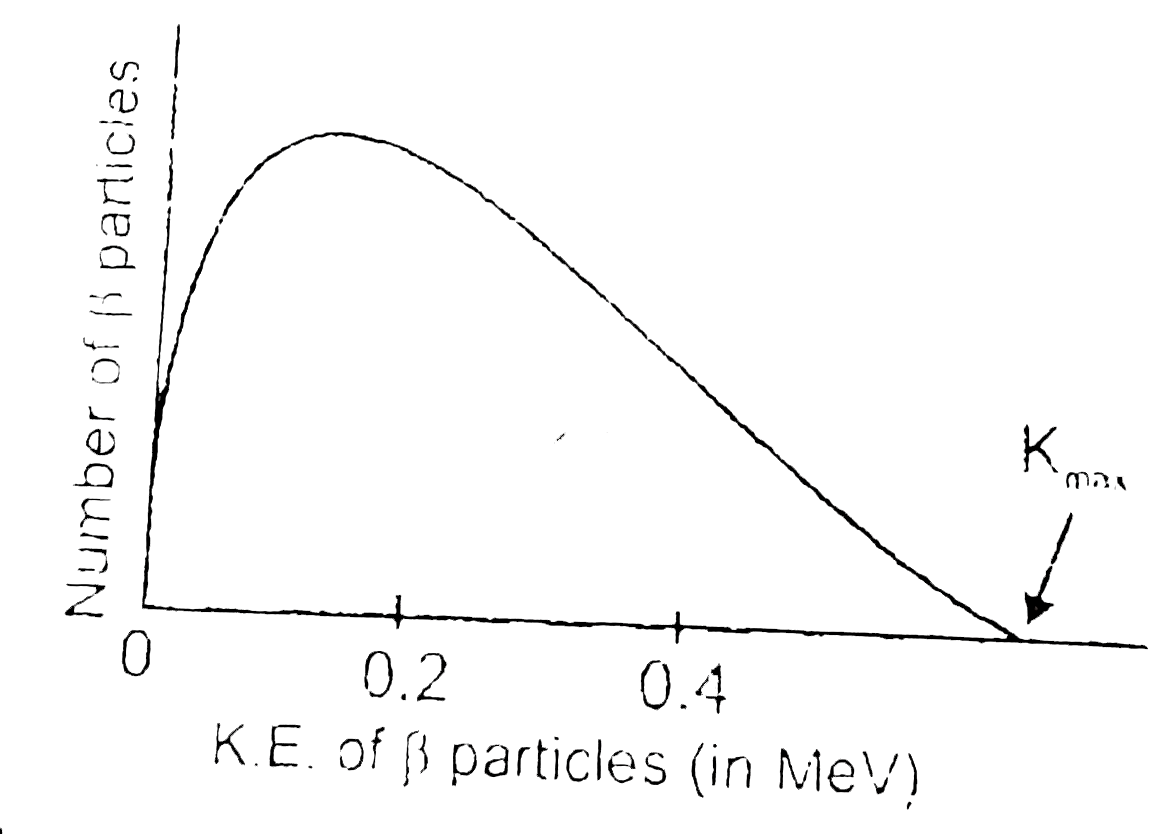
(b) Plot the distribution of kinetic enrgy of `beta`-particles and state why the energy spectrum is continous.

Text Solution

Verified by Experts
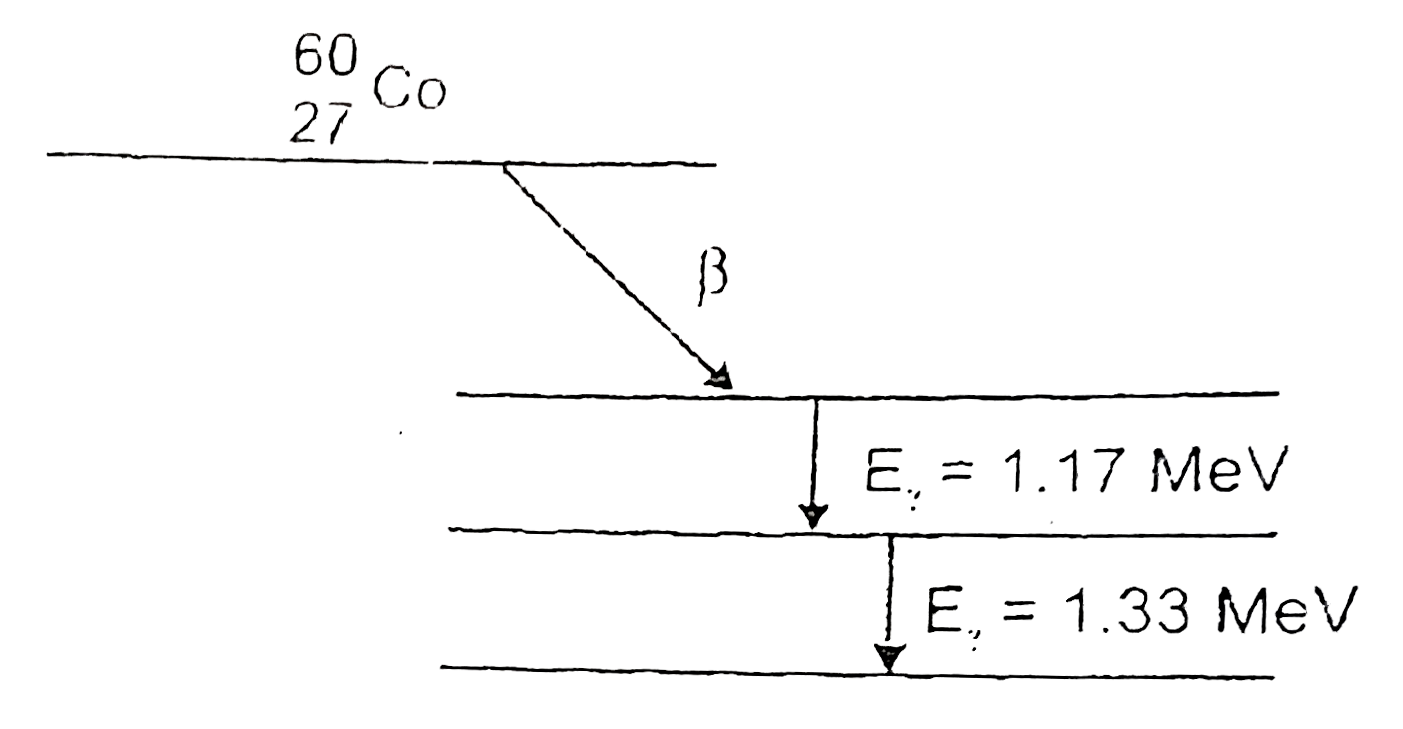
(a)
(b) The distribution of kinectic energy of `beta`-particles is shown below:

In `beta`-decay, the disintergration is shared by threee decay products, the daughter nucleus, electron`//`positron and anitneutrino`//`neutrino. So the kinetic energy of electron`//`positron is not fixed. Consequently. the energy of spectrum is continuous.
Promotional Banner

Topper's Solved these Questions

  • NUCLEAR PHYSICS

    RESONANCE ENGLISH|Exercise Advanced level solutions|16 Videos
  • NUCLEAR PHYSICS

    RESONANCE ENGLISH|Exercise Exercise-3 Part-II JEE (MAIN)|19 Videos
  • GRAVITATION

    RESONANCE ENGLISH|Exercise HIGH LEVEL PROBLEMS|16 Videos
  • REVISION DPP

    RESONANCE ENGLISH|Exercise All Questions|463 Videos

Similar Questions

Explore conceptually related problems

The graph showing the energy spectrum of beta particle is

Correct increasing order of penetrating powers of alpha,beta particles and gamma -rays, all moving with same kinetic energy is

During alpha-decay , a nucleus decays by emitting an alpha -particle ( a helium nucleus ._2He^4 ) according to the equation ._Z^AX to ._(Z-2)^(A-4)Y+._2^4He+Q In this process, the energy released Q is shared by the emitted alpha -particle and daughter nucleus in the form of kinetic energy . The energy Q is divided in a definite ratio among the alpha -particle and the daughter nucleus . A nucleus that decays spontaneously by emitting an electron or a positron is said to undergo beta -decay .This process also involves a release of definite energy . Initially, the beta -decay was represented as ._Z^AX to ._(Z+1)^AY + e^(-)"(electron)"+Q According to this reaction, the energy released during each decay must be divided in definite ratio by the emitted e' ( beta -particle) and the daughter nucleus. While , in alpha decay, it has been found that every emitted alpha -particle has the same sharply defined kinetic energy. It is not so in case of beta -decay . The energy of emitted electrons or positrons is found to vary between zero to a certain maximum value. Wolfgang Pauli first suggested the existence of neutrinoes in 1930. He suggested that during beta -decay, a third particle is also emitted. It shares energy with the emitted beta particles and thus accounts for the energy distribution. During beta^+ decay (positron emission) a proton in the nucleus is converted into a neutron, positron and neutrino. The reaction is correctly represented as

During alpha-decay , a nucleus decays by emitting an alpha -particle ( a helium nucleus ._2He^4 ) according to the equation ._Z^AX to ._(Z-2)^(A-4)Y+._2^4He+Q In this process, the energy released Q is shared by the emitted alpha -particle and daughter nucleus in the form of kinetic energy . The energy Q is divided in a definite ratio among the alpha -particle and the daughter nucleus . A nucleus that decays spontaneously by emitting an electron or a positron is said to undergo beta -decay .This process also involves a release of definite energy . Initially, the beta -decay was represented as ._Z^AX to ._(Z+1)^AY + e^(-)"(electron)"+Q According to this reaction, the energy released during each decay must be divided in definite ratio by the emitted e' ( beta -particle) and the daughter nucleus. While , in alpha decay, it has been found that every emitted alpha -particle has the same sharply defined kinetic energy. It is not so in case of beta -decay . The energy of emitted electrons or positrons is found to vary between zero to a certain maximum value. Wolfgang Pauli first suggested the existence of neutrinoes in 1930. He suggested that during beta -decay, a third particle is also emitted. It shares energy with the emitted beta particles and thus accounts for the energy distribution. The beta particles (positron) are emitted with different kinetic energies because

An electron-positron pair is produced when a gamma -ray photon of energy 2.36MeV passes close to a heavy nucleus. Find the kinetic energy carried by each particle produced, as well as the total energy with each.

Consider the following statements and state whether true (T ) or false ( F ) : (i) Nuclear fission is normally followed by emission of beta^(-) - particles. (ii)Emission of alpha - particle is normally followed by emission of gamma - rays (iii) As the mass number A increases, the binding energy per nucleon in a nucleus also increases Choose the correct order from the options given below

During alpha-decay , a nucleus decays by emitting an alpha -particle ( a helium nucleus ._2He^4 ) according to the equation ._Z^AX to ._(Z-2)^(A-4)Y+._2^4He+Q In this process, the energy released Q is shared by the emitted alpha -particle and daughter nucleus in the form of kinetic energy . The energy Q is divided in a definite ratio among the alpha -particle and the daughter nucleus . A nucleus that decays spontaneously by emitting an electron or a positron is said to undergo beta -decay .This process also involves a release of definite energy . Initially, the beta -decay was represented as ._Z^AX to ._(Z+1)^AY + e^(-)"(electron)"+Q According to this reaction, the energy released during each decay must be divided in definite ratio by the emitted e' ( beta -particle) and the daughter nucleus. While , in alpha decay, it has been found that every emitted alpha -particle has the same sharply defined kinetic energy. It is not so in case of beta -decay . The energy of emitted electrons or positrons is found to vary between zero to a certain maximum value. Wolfgang Pauli first suggested the existence of neutrinoes in 1930. He suggested that during beta -decay, a third particle is also emitted. It shares energy with the emitted beta particles and thus accounts for the energy distribution. When a nucleus of mass number A at rest decays emitting an alpha -particle , the daugther nucleus recoils with energy K . What is the Q value of the reaction ?

Sulphur 35 (34,96903 amu) emits a beta- particles but no gamma -rays. The product is c hlorine -35 ( 34,96885 amu),. The maximum energy carried by beta- particle is:

Heavy radioactive nucleus decay through alpha- decay also. Consider a radioactive nucleus x. It spontaneously undergoes decay at rest resulting in the formation of a daughter nucleus y and the emission of an alpha- particle. The radioactive reaction can be given by x rarr y + alpha However , the nucleus y and the alpha- particle will be in motion. Then a natural question arises that what provides kinetic energy to the radioactive products. In fact, the difference of masses of the decaying nucleus and the decay products provides for the energy that is shared by the daughter nucleus and the alpha- particle as kinetic energy . We know that Einstein's mass-energy equivalence relation E = m c^(2) . Let m_(x), m_(y) and m_(alpha) be the masses of the parent nucleus x, the daughter nucleus y and alpha- particle respectively. Also the kinetic energy of alpha- particle just after the decay is E_(0) . Assuming all motion of to be non-relativistic. Which of the following is correct ?

RESONANCE ENGLISH-NUCLEAR PHYSICS-Exercise -3 Part-III CBSE PROBLEMS (LAST 10 YEARS)
  1. Draw the graph showing thervariation of binding energy per nucleon wit...

    Text Solution

    |

  2. Name the reaction which takes place when a slow neutron beam strikes ....

    Text Solution

    |

  3. (a) Draw the energy level diagram showing the emission of beta-particl...

    Text Solution

    |

  4. A radioactive sample contains 2.2 mg of pure .(6)^(11)C which has a ha...

    Text Solution

    |

  5. Define decay constant

    Text Solution

    |

  6. Define the term half-life period and decay constant of a radioactive s...

    Text Solution

    |

  7. Define 'activity' of a radioactive material and write its S.I.unit. ...

    Text Solution

    |

  8. Characteristic of Angiosperms which distinguish them from gymnosperms

    Text Solution

    |

  9. State and explain the laws of radioactive disintergration. Hence defin...

    Text Solution

    |

  10. The value of binding energy per nucleon of .(20)^(40)Ca nucleus is Giv...

    Text Solution

    |

  11. Calculate the energy released in MeV in the following nuclear reaction...

    Text Solution

    |

  12. Calculate the energy released in MeV in the following nuclear reaction...

    Text Solution

    |

  13. A neutron is absorbed by a .(3)^(6)Li nucleus with the subsequent emis...

    Text Solution

    |

  14. What do you understand by isotopes, isobars and isotones? Explain with...

    Text Solution

    |

  15. The nucleus ""(10)^(23) Ne decays by beta– emission. Write down the ...

    Text Solution

    |

  16. Two nuclei have mass numbers in the ratio 1 : 2. What is the ratio of ...

    Text Solution

    |

  17. A radioactive nucleus undergoes a series of deacy according to the sch...

    Text Solution

    |

  18. Name and define, the SI unit for the 'activity' of a given sample of r...

    Text Solution

    |

  19. Draw a plot of potential energy of a pair of nucleons as a function of...

    Text Solution

    |

  20. (a) Write symbolically the beta-decay process of ""(15)^(32)P. (b) ...

    Text Solution

    |