Home
Class 12
PHYSICS
What is the force exerted by a Light Bea...

What is the force exerted by a Light Beam On a Surface ?

Text Solution

Verified by Experts
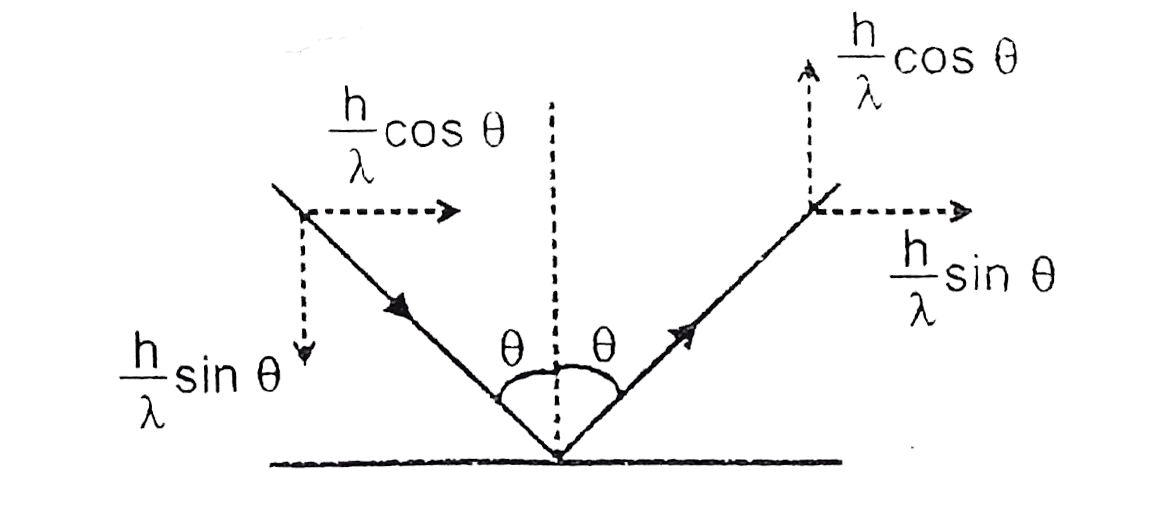
Case I- `a=1, r=0`
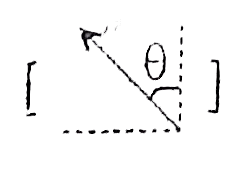
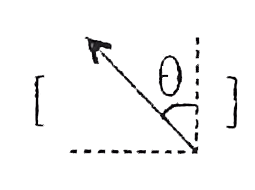
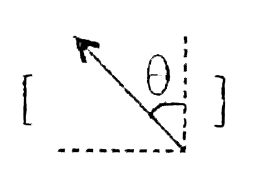
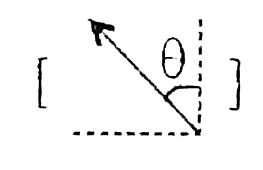
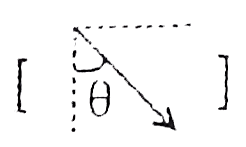
Initial momentum of photon ( in downward direction at an angle `theta` with vertical)`=(h)/(lambda)`

final momentum of photon `=0`
change in momentum ( in upward direction at an angle `theta` with vertical) `=(h)/(lambda)`

energy incident per unit time `= IA cos theta`
Intensity`=`power per unit normal area
`I=(P)/(A cos theta), P=IA cos theta`
No.of photons incident per unit time `=(IA cos theta)/(hc). lambda`
total change in momentum per unit time ( in upward direction at an angel `theta` with vertical)
`-(IAcos thetalambda)/(hc).(h)/(lambda)=(IA cos theta)/(c )`

Force `(F)=` total change in momentum per unit time
`F=(IA cos theta)/(c )` ( direaction on photon and on the plate)
Pressure`=`normal force per unit Area
`"Pressure"=(F cos theta)/(A) P(IA cos^(2)theta)/(cA)=(I)/(c )cos^(2) theta`
CaseII When `r=1,a=0`
`:.` change in momentum of one photon
`=(2h)/(lambda) cos theta` ( upward)

No.of photons incident per unit time
`=("energy incident per unit time")/(hv)`
`=(IA cos theta.lambda)/(hc)`
`:.` total change in momentum per unit time
`=(IA cos theta.lambda)/(hc)xx(2h)/(lambda)cos theta =(2IAcos^(2)theta)/(c )`(upward)
`:.` force on the plate`=(2IA cos ^(2)theta)/(c )` (downward)
Pressure `=(2IAcos^(2)theta)/(cA) P=(2Icos^(2)theta)/(c )`
Case III `0 lt r lt 1, a+r=1`
change in momentum of photon when it is reflected `=(2h)/(lambda) cos theta` (downward)
change in momentum of photon when it is absorbed `=(h)/(lambda)` ( in the opposite direction of incident beam)
energy incident per unit time `IA cos theta`
no. of photns incident per unit time `=(IA cos theta.lambda)/(hc)`
no. of reflected photon `(n_(r ))=(IA cos theta.lambda)/(hc)`
no.of reflected photon`(n_(r ))=(IA cos theta lambda)/(hc) (1-r)`
force on plate due to absorbed photons `F_(a)=n_(a).DeltaP_(a)`
`=(IA cos theta lambda)/(hc) (1-r)(h)/(lambda)`
`=(IA cos theta)/(c )(1-r)` ( at an angle `theta` with vertical)
force on plate due to reflected photons `F_(r )=n_(r )DeltaP_(r )`
`=(IA cos theta.lambda)/(hc)xx(2h)/(lambda)cos theta`(vertically downward)
`=(IAcos^(2) theta)/(c ).2r`
now resultant force is given by `F_(R )=sqrt((1-r)^(2)+(2r)^(2)cos^(2)theta+4r(r-1)cos^(2)theta)`
and pressure, `P=(F_(a)cos theta+F_(r ))/(A)`
`=(IA cos theta(1-r)cos theta)/(cA)+(IA cos^(2)theta.2r)/(cA)`
`=(Icos ^(2)theta)/(c )(1-r)+(Icos^(2)theta)/(c )=(Icos^(2)theta)/(c )(1+r)`
Promotional Banner

Topper's Solved these Questions

  • ATOMIC PHYSICS

    RESONANCE ENGLISH|Exercise Solved miscellaneous problems|14 Videos
  • ATOMIC PHYSICS

    RESONANCE ENGLISH|Exercise Exercise 1 Part-1 subjective questions|35 Videos
  • ALTERNATING CURRENT

    RESONANCE ENGLISH|Exercise HIGH LEVEL PROBLEMS|11 Videos
  • CAPACITANCE

    RESONANCE ENGLISH|Exercise High Level Problems|16 Videos

Similar Questions

Explore conceptually related problems

A parallel beam of monochromatic light of wavelength 500nm is incident normally on a perfectly absorbing surface. The power through any cross- section of the beam is 10 W. Find (a) the number of photons absorbed per second by the surface and (b) the force exerted by the light beam on the surface.

A parellel beam of monochromatic light of wavelength 500 nm is incident normally on a perfectly absorbing surface. The power through any cross section of the beam is 10 W. Find (a) the number of photons absorbed per second by the surface and (b) the force exerted by the light beam on the surface.

A plate of mass 10g is in equilibrium in air due to the force exerted by a light beam on the plate. Calculate power of the beam. Assume that the plate is perfectly absorbing.

A sphere of radius 1.00 cm is placed in the path of a parallel beam of light of large aperture. The intensity of the light is 0.50 W cm^-2 . If the sphere completely absorbs the radiation falling on it, find the force exerted by the light beam on the sphere.

A block of mass m is moving on a rough horizontal surface. mu is the coefficient of kinetic friction between the block and the surface. What is the net force exerted by the surface on the block?

A plate of mass 10 gm is in equillibrium in air due to the force exterted by light beam on plate. Calculate powder of beam. Assume plates is perfectly absorbing.

Light of intensity 50W//m^(2) is incident on a arae of 1m^(2) in such a way that 25% of light is reflected back. Find the force exerted by light on surface if light incident perpendicularly

A parallel beam of monochromatic light of wavelength 663 nm is incident on a totally reflecting plane mirror. The angle of incidence is 60^@ and the number of photons striking the mirror per second is 1.0 xx 10^19 . Calculate the force exerted by the light beam on the mirror.

A parallel beam of monochromatic light of wavelength 663 nm is incident on a totally reflection plane mirror. The angle of incidence is 60^@ and the number of photons striking the mirror per second is 1.0xx10^19 . Calculate the force exerted by the light beam on the mirror.

What is the torque exerted by the gravitational force of sun on the earth ? Explain.

RESONANCE ENGLISH-ATOMIC PHYSICS-Advanved level problems
  1. What is the force exerted by a Light Beam On a Surface ?

    Text Solution

    |

  2. A small particle of mass m moves in such a way that the potential ener...

    Text Solution

    |

  3. Supose the potential energy between electron and proton at a distance ...

    Text Solution

    |

  4. In atension of state n from a state of excitation energy given is 10.1...

    Text Solution

    |

  5. Suppose in certine condition only those transition are allowed to hydr...

    Text Solution

    |

  6. The velocity of the electrons liberated by electromagnetic radiation o...

    Text Solution

    |

  7. (a) Find the maximum wavelength lambda(0) of light which can ionize a ...

    Text Solution

    |

  8. A beam of momechromatic light of wavelength lambda ejectes photonelect...

    Text Solution

    |

  9. Hydrogen atom is ground state is excited by mean of monochromatic radi...

    Text Solution

    |

  10. Avarage lifetime of a hydrogen atom excited to n =2 state 10^(-6)s fin...

    Text Solution

    |

  11. In a hydrogen like ionized atom a single electron is orbiting around ...

    Text Solution

    |

  12. For atoms of light and heavy hydrogen (H and D) fine the difference, ...

    Text Solution

    |

  13. An electron in the ground state of hydrogen atom is removing in unanti...

    Text Solution

    |

  14. A proton and electron, both at rest initially, combine to form a hydro...

    Text Solution

    |

  15. A neutron of kinetic energy 65 eV collides inelastically with a singly...

    Text Solution

    |

  16. Supose the potential energy between electron and proton at a distance ...

    Text Solution

    |

  17. A positronium consists of an electron and a positron revolving about t...

    Text Solution

    |

  18. in an experimental set up to study the photoelectric effect a point so...

    Text Solution

    |