Home
Class 12
PHYSICS
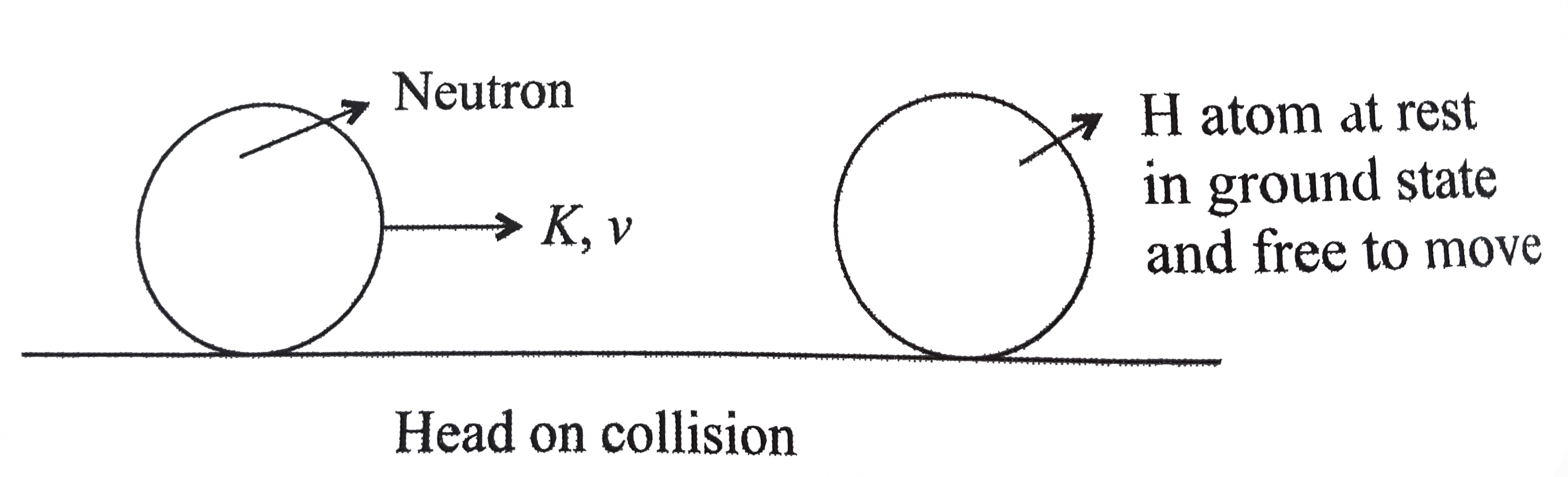
In the figure , what type of collision c...

In the figure , what type of collision can be possible , if `K = 14 eV, 20.4 eV,22 eV, 24.18 eV,(elastic // inelastic // perfectly inelastic).

Text Solution

Verified by Experts

Loss in the energy `(DeltaE)` during the collision will be used to excite the atom from one level to another.
`DeltaE={0,10.2 eV, 12.09 eV,......13.6 eV)`
According to Newtonion mechanics
minimum loss = 0. (elastic collision)

for maximum loss collision will be perfectly inelasitc if nuutron colliedrs perfectly inelastically then, Applying momentum conservation
`mv_(0)=2mv`,
`v_(f)=(v_(0))/(2)`
final `K.E=(1)/(2)xx2mxx(v_(0)^(2))/(4)=((1)/(2)mv_(0)^(2))/(2)=(K)/(2)`
maximum loss `=(K)/(2)`
According to classical mechanics `(DeltaE)=[0,(K)/(2)]`
(a) If `K=14 eV` According to quantum meachics
`(DeltaE)={0,10.2eV,12.09eV}`
According to classical mechanics
`Delta E=[0.7eV]`
loss `= 0`, hence it is elastic collision speed of particle changes.
(b) If `K=20.4 eV`
According to classical mechanics
loss `=[0,10.2 eV]`
According to quantum mechanics
loss `={0,10.2eV,12.09 eV,.....}`
loss `= 0` elastic collision.
loss `=10.2 eV` perfectly inelastic collision
(b) If `K=22 eV`
Classical mechanics `DeltaE=[0,11]`
Quantum mechanics `DeltaE={0,10.2eV,12.09eV,....}`
loss `= 0` elastic collision
loss `=10.2 eV` elastic collision
(d) If `K=24.18eV`
According to classical mechanics `DeltaE=[0,12.09eV]`
According to quantum mechanics `DeltaE={0,10.2eV,12.09eV,....13.6eV}`
loss `=0` elastic collision
loss `=10.2 eV` inelastic collision
loss `=12.09eV` perfectly in elastic collision
Promotional Banner

Topper's Solved these Questions

  • ATOMIC PHYSICS

    RESONANCE ENGLISH|Exercise Solved miscellaneous problems|14 Videos
  • ATOMIC PHYSICS

    RESONANCE ENGLISH|Exercise Exercise 1 Part-1 subjective questions|35 Videos
  • ALTERNATING CURRENT

    RESONANCE ENGLISH|Exercise HIGH LEVEL PROBLEMS|11 Videos
  • CAPACITANCE

    RESONANCE ENGLISH|Exercise High Level Problems|16 Videos

Similar Questions

Explore conceptually related problems

A vertically jet of water coming out of a nozzle with velocity 20 m//s supports a plate of mass M stationary at a height h = 15 m , as shown in the figure. If the rate of water flow is 1 litre per second, the mass of the plate is (Assume the collision to be perfectly inelastic).

A particle of mass m strikes a disc of radius R and mass m with a speed u as shown in the figure. What is the speed of the particle just after the collision if the collision is perfectly inelastic ?

A ball is projected from the point O with velocity 20 m//s at an angle of 60^(@) with horizontal as shown in figure. At highest point of its trajectory it strikes a smooth plane of inclination 30^(@) at point A. The collision is perfectly inelastic. The maximum height from the ground attained by the ball is (g=10 m//s^(2))

The blocks shown in figure have equal masses. The surface of A is smooth but that of B has a friction coefficient of 0.10 with the floor. Block A is moving at a speed of 10 m/s towards B which is kept at rest. Find the distance travelled by B if a. the collision is perfectly elastic and b. the collision is perfectly inelastic. Take g=10 m/s^2 .

An object of mass 80 kg moving with velocity 2ms^(-1) hit by collides with another object of mass 20 kg moving with velocity 4 ms ^(-1) Find the loss of energy assuming a perfectly, inelastic collision

An object of mass 80 kg moving with velocity 2ms^(-1) hit by collides with another object of mass 20 kg moving with velocity 4 ms ^(-1) Find the loss of energy assuming a perfectly, inelastic collision

The work function for the following metals is given Na: 2.75 eV, K:2.30 eV , Mo: 4.17 eV , Ni: 515 eV. Which of these metals will not give photoelectric emission for a radiation of wavelength 3300 A from a He-Cd laser placed 1m away from the photocell? What happens if the laser is brought nearer and placed 50 cm away?

The ionisation potentials of Li and K are 5.4 and 4.3 eV respectively. The ionization potential of Na will be:

A : Work function of aluminium is 4.2 eV . Emission of electrons will be possible by two photons , each of 2.5 eV energy , striking the electron of aluminium . R : Energy of a photon can be less then the work function of the metal , for photoelectron emission .

In a mixture of He^(o+) gas H atom and He^(o+) ions Are excited to three respective first excited subsepuenly , H atom transfers its total excitation energy to He^(o+) ions by collision .Assuming that Bohr model of an atom is applicable , answer the following question If each hydrogen atom in the ground state of 1.0 mol of H atom is excited by absorbing photon of energy 8.4 eV, 12.09 eV and 15.0 eV of energy then the number of spectral lines emitted is equal to

RESONANCE ENGLISH-ATOMIC PHYSICS-Advanved level problems
  1. In the figure , what type of collision can be possible , if K = 14 eV,...

    Text Solution

    |

  2. A small particle of mass m moves in such a way that the potential ener...

    Text Solution

    |

  3. Supose the potential energy between electron and proton at a distance ...

    Text Solution

    |

  4. In atension of state n from a state of excitation energy given is 10.1...

    Text Solution

    |

  5. Suppose in certine condition only those transition are allowed to hydr...

    Text Solution

    |

  6. The velocity of the electrons liberated by electromagnetic radiation o...

    Text Solution

    |

  7. (a) Find the maximum wavelength lambda(0) of light which can ionize a ...

    Text Solution

    |

  8. A beam of momechromatic light of wavelength lambda ejectes photonelect...

    Text Solution

    |

  9. Hydrogen atom is ground state is excited by mean of monochromatic radi...

    Text Solution

    |

  10. Avarage lifetime of a hydrogen atom excited to n =2 state 10^(-6)s fin...

    Text Solution

    |

  11. In a hydrogen like ionized atom a single electron is orbiting around ...

    Text Solution

    |

  12. For atoms of light and heavy hydrogen (H and D) fine the difference, ...

    Text Solution

    |

  13. An electron in the ground state of hydrogen atom is removing in unanti...

    Text Solution

    |

  14. A proton and electron, both at rest initially, combine to form a hydro...

    Text Solution

    |

  15. A neutron of kinetic energy 65 eV collides inelastically with a singly...

    Text Solution

    |

  16. Supose the potential energy between electron and proton at a distance ...

    Text Solution

    |

  17. A positronium consists of an electron and a positron revolving about t...

    Text Solution

    |

  18. in an experimental set up to study the photoelectric effect a point so...

    Text Solution

    |

