Home
Class 12
CHEMISTRY
In which of the following Hoffmann elimi...

In which of the following Hoffmann elimination product is more ?

A

`CH_(3)-underset(" "CH_(3))underset(|)overset(" "CH_(3))overset(|)(C)-underset(""OH)underset(|)(CH)-CH_(3) " "underset(Delta)overset("conc."H_(2)SO_(4))(rarr)`

B

`CH_(3)-underset(CH_(3))underset(|)overset(H)overset(|)(C)-underset(Br)underset(|)(CH)-CH_(3)" "overset(("potassium"),("ethoxide"))(rarr)`

C

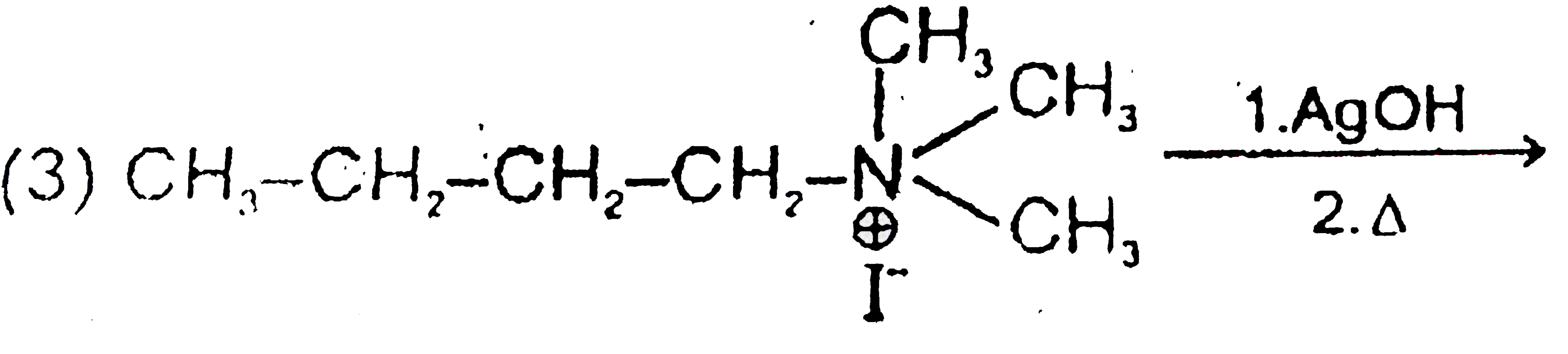
D

`CH_(3)-underset(CH_(3))underset(|)overset(CH_(3))overset(|)(C)-CH_(2)-Cl " "underset(Delta)overset(alc. KOH)(rarr)`

Text Solution

AI Generated Solution

The correct Answer is:

To determine which of the following reactions follows the Hofmann elimination product, we need to analyze each reaction step by step. The Hofmann elimination product is characterized by the formation of the less substituted alkene, which is contrary to the Zaitsev's rule that states that the more substituted alkene is favored. ### Step-by-Step Solution: 1. **Understanding Hofmann Elimination**: - In Hofmann elimination, the major product is the less substituted alkene. This is in contrast to Zaitsev's rule, where the more substituted alkene is the major product. 2. **Analyzing Reaction A**: - The reactant is a tertiary alcohol treated with concentrated H2SO4. - Upon dehydration, a carbocation is formed, which can rearrange to form a more stable tertiary carbocation. - The major product formed is a more substituted alkene. - **Conclusion**: This reaction follows Zaitsev's rule, not Hofmann elimination. 3. **Analyzing Reaction B**: - The reactant is a bromoalkane treated with potassium ethoxide. - Similar to reaction A, a carbocation is formed, which can also rearrange. - The major product formed is again a more substituted alkene. - **Conclusion**: This reaction also follows Zaitsev's rule, not Hofmann elimination. 4. **Analyzing Reaction C**: - The reactant is a tertiary amine treated with a weak base like silver hydroxide. - The NR3 group is a good leaving group and is removed, leading to the formation of a double bond. - The product formed is a less substituted alkene. - **Conclusion**: This reaction follows Hofmann elimination. 5. **Analyzing Reaction D**: - The reactant has three methyl groups on the beta carbon and is treated with KOH. - Upon elimination, a carbocation is formed, which can rearrange to a more stable form. - The product formed is a more substituted alkene. - **Conclusion**: This reaction follows Zaitsev's rule, not Hofmann elimination. ### Final Conclusion: Based on the analysis, the only reaction that follows Hofmann elimination is **Reaction C**. Therefore, the correct answer is **C**.
Promotional Banner

Topper's Solved these Questions

  • HYDROCARBON

    RESONANCE ENGLISH|Exercise INORGANIC CHEMISTRY (COORDINATION COMPOUNDS)|7 Videos
  • GASEOUS STATE

    RESONANCE ENGLISH|Exercise Exercise-3|1 Videos
  • IONIC EQUILIBRIUM

    RESONANCE ENGLISH|Exercise partIII one or more than one options correct type|10 Videos

Similar Questions

Explore conceptually related problems

Which of the following reactions is Hofmann elimination ? .

Which of the following is a beta -elimination reaction ?

In which of the following cases product will contain more number of carbon atoms than do present in reactant molecule?

Which of the following is not a plant product

One of the following group eliminates uric acid

In which of the following Saytzeff product will not be formed as major product?

In which of the following, the product is not correct?

Amines are basic in nature and show many types of reactions such as substitution, Hoffmann elimination, carbylamine, acylation, diazotisation etc. What is the major alkene formed in the following Hoffmann elimination?

RESONANCE ENGLISH-HYDROCARBON-ORGANIC CHEMISTRY(Hydrocarbon)
  1. The threshold wavelength for ejection of electrons from a metal is 230...

    Text Solution

    |

  2. The reaction of HBr with gives

    Text Solution

    |

  3. In which of the following Hoffmann elimination product is more ?

    Text Solution

    |

  4. Which of the following is not aromatic?

    Text Solution

    |

  5. Identify Z in the series CH(3)CH(2)CH(2)OHunderset(160-180^(@)C)over...

    Text Solution

    |

  6. In the reaction, product 'X' is : CH(3)-C=CH+H(2)Ooverset(H^(+)//Hg^...

    Text Solution

    |

  7. For the given reaction how many monochloro products are optically acti...

    Text Solution

    |

  8. The threshold wavelength for ejection of electrons from a metal is 350...

    Text Solution

    |

  9. Oberve the following reaction sequence

    Text Solution

    |

  10. . The product 'W' is:

    Text Solution

    |

  11. . The product C is :

    Text Solution

    |

  12. The threshold wavelength for ejection of electrons from a metal is 450...

    Text Solution

    |

  13. The velocity of electron of H-atom in its ground state is 8.4×10^(5)m/...

    Text Solution

    |

  14. The threshold wavelength for ejection of electrons from a metal is 280...

    Text Solution

    |

  15. The minimum heat of reaction is required in the formation of :

    Text Solution

    |

  16. CH(3)-underset(" "C(2)H(5))underset(|)overset(D)overset(|)(C)-MgBr+CH(...

    Text Solution

    |

  17. Using corey - house synthesis we can't prepare ………………….. from ethylbro...

    Text Solution

    |

  18. During the electrolysis of sodium ethanoate, the gas liberated at cath...

    Text Solution

    |

  19. During Kolbe's electrolytic method, the pH of aqueous solution of sa...

    Text Solution

    |

  20. In Kolbe's electrolysis sodium propanoate gives :

    Text Solution

    |
