Home
Class 12
PHYSICS
Figure shows elliptical path ‘abcd’ of a...

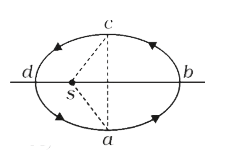
Figure shows elliptical path ‘abcd’ of a planet around the sun S such that the area of triangle ‘csa’ is 1/4 the area of the ellipse. (See figure) With ‘db’ as the major axis, and ‘ca’ as the minor axis. If `t_1` is the time taken for planet to go over path ‘abc’ and `t_2` for path taken over ‘cda’ then:

A

`t_(1)=3t_(2)`

B

`t_(1)=t_(2)`

C

`t_(1)=2t_(2)`

D

`t_(1)=4t_(2)`

Text Solution

Verified by Experts

The correct Answer is:

A

Total area `=A`
Area of `sabc=(3A)/A`
Area of `sadc=A/4`
`(3A)/(4t_(1))=A/(4t_(2))impliest_(1)=3t_(2)`
Promotional Banner

Topper's Solved these Questions

  • TEST PAPERS

    RESONANCE ENGLISH|Exercise PART - II PHYSICS|106 Videos
  • SIMPLE HARMONIC MOTION

    RESONANCE ENGLISH|Exercise Advanced Level Problems|13 Videos
  • TEST SERIES

    RESONANCE ENGLISH|Exercise PHYSICS|130 Videos

Similar Questions

Explore conceptually related problems

Figure elliptical path abcd of a planet around the sun S such that the area of Delta csa is (1)/(4) the area of the ellipse, (see figure) with db as the semimajor axis, and ca as the semiminor axis if t_(1) is the time taken for planet to go over path abc and t_(2) for path taken over cda then:

Figure shows the elipticla path of a planet about the sun. The two shaded parts have equal area. If t_1 and t_2 be the tim taken by the planet to go from a to b and from c to d respectively

The figure shows elliptical orbit of a planet m about the sun S. the shaded area SCD is twice the shaded area SAB. If t_(1) be the time for the planet to move from C to D and t_(2) is the time to move from A to B, then:

The figure shows elliptical orbit of a planet m about the sun S. the shaded area SCD is twice the shaded area SAB. If t_(1) be the time for the planet to move from C to D and t_(2) is the time to move from A to B, then:

Figure shows the motion of a planet around the Sun S in an elliptical orbit with the Sun at the focus. The shaded areas A and B are also shown in the figure which can be assumed to be equal. If t_(1) and t_(2) represent the time taken for the planet to move from a to b and c to d , respectively then

Figure shows the motion of a planet around the Sun S in an elliptical orbit with the Sun at the focus. The shaded areas A and B are also shown in the figure which can be assumed to be equal. If t_(1) and t_(2) represent the time taken for the planet to move from a to b and c to d , respectively then

The figure shows elliptical orbit of a plant P about the sun S. The shaded area CSD is twice tha shaded area ASB. If t_(1) is the time taken by the planet to move from C to D and t_(2) is the time to move from A to B, determine the ratio t_(1)//t_(2)

The figure represents an elliptical orbit a planet around sun. The planet takes time T_(1) to travel from A to B and it takes time T_(2) to travel from C to D . If the area CSD is double that of area ASB , them

A planet revolves around the sun in elliptical orbit of eccentricity 'e'. If 'T' is the time period of the planet then the time spent by the planet between the ends of the minor axis and major axis close to the sun is

Figure 1.31 shows the trace of the path of a charged particle in a bubble chamber. Assume that the magnetic field is into the plane of the paper with magnitude 0.4 T. The smooth spiral path occurs because the particle loses energy in ionizing molecules along the path. a. Which part of the path corresponds to higher kinetic energy for the particle? Inner or outer part of spiral. b. Is the charge positive or negative? c. The radius of curvature ranges from 70 mm to 10 mm. What is the range of values of the magnitude of momentum if the magnitude of the charge is e?

RESONANCE ENGLISH-TEST PAPERS-PHYSICS
  1. There is an infinite line of uniform linear density of charge +lamda. ...

    Text Solution

    |

  2. In the adjacent figure, a uniform cube of mass m and edge l=2m is lyin...

    Text Solution

    |

  3. Figure shows elliptical path ‘abcd’ of a planet around the sun S such ...

    Text Solution

    |

  4. An unknown transistor needs to be identified as npn and pnp type. A mu...

    Text Solution

    |

  5. A uniformly tapering conical wire is made from a material of young's m...

    Text Solution

    |

  6. Which of the following option correctly describes the variation of the...

    Text Solution

    |

  7. An audio signal consists of two distinct sound. One a human speech sig...

    Text Solution

    |

  8. An electron in a hydrogen atom makes a transition from n = 2 to n = 1 ...

    Text Solution

    |

  9. When photons of wavlength lambda(1) are incident on an isolated sphere...

    Text Solution

    |

  10. In the following 'I' refers to current and other symbols have their us...

    Text Solution

    |

  11. If it takes 5 minutes to fill a 15 litre bucket from a water tap diame...

    Text Solution

    |

  12. x and y displacements of a particle are given as x(t)=-asinomegat and ...

    Text Solution

    |

  13. Suppose the drift velocity v(d) in a material varied with the applie...

    Text Solution

    |

  14. When the current in a coil changes from 5A to 2A in 0.1s, an average v...

    Text Solution

    |

  15. A 25 cm long solenoid has radius 2 cm and 500 total number of turns. I...

    Text Solution

    |

  16. You are asked to design a shaving mirror assuming that a person keeps ...

    Text Solution

    |

  17. If two glass plates have water between them and are separated by very ...

    Text Solution

    |

  18. In the circuit shown, charge on the capacitor connected between B and ...

    Text Solution

    |

  19. A 10kg weight is suspended with a wire AB of linear mass density 0.01k...

    Text Solution

    |

  20. A particle is moving in x-y plane with y=x/2 and v(x)=4-2t. The displa...

    Text Solution

    |
