Home
Class 12
PHYSICS
x and y displacements of a particle are ...

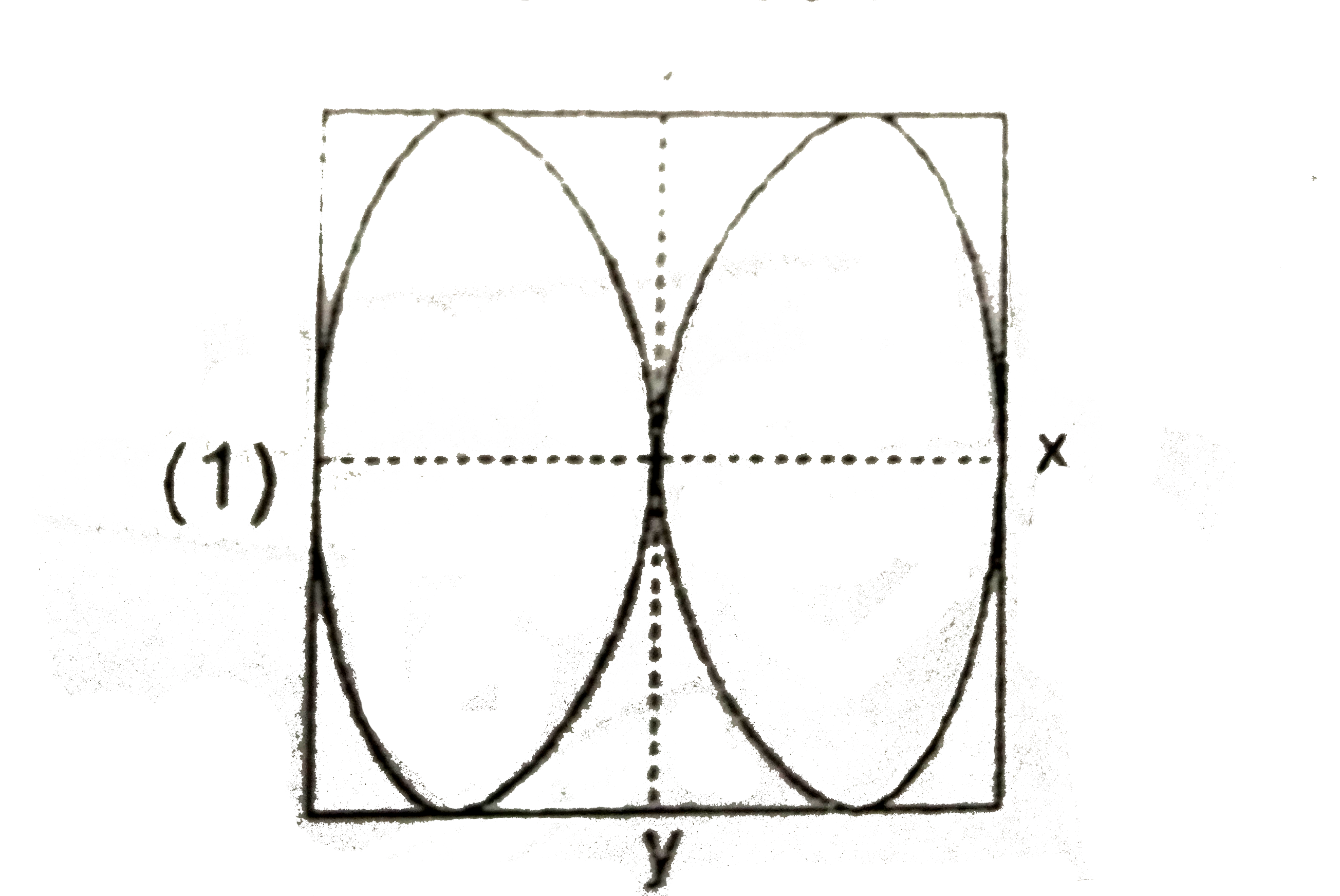
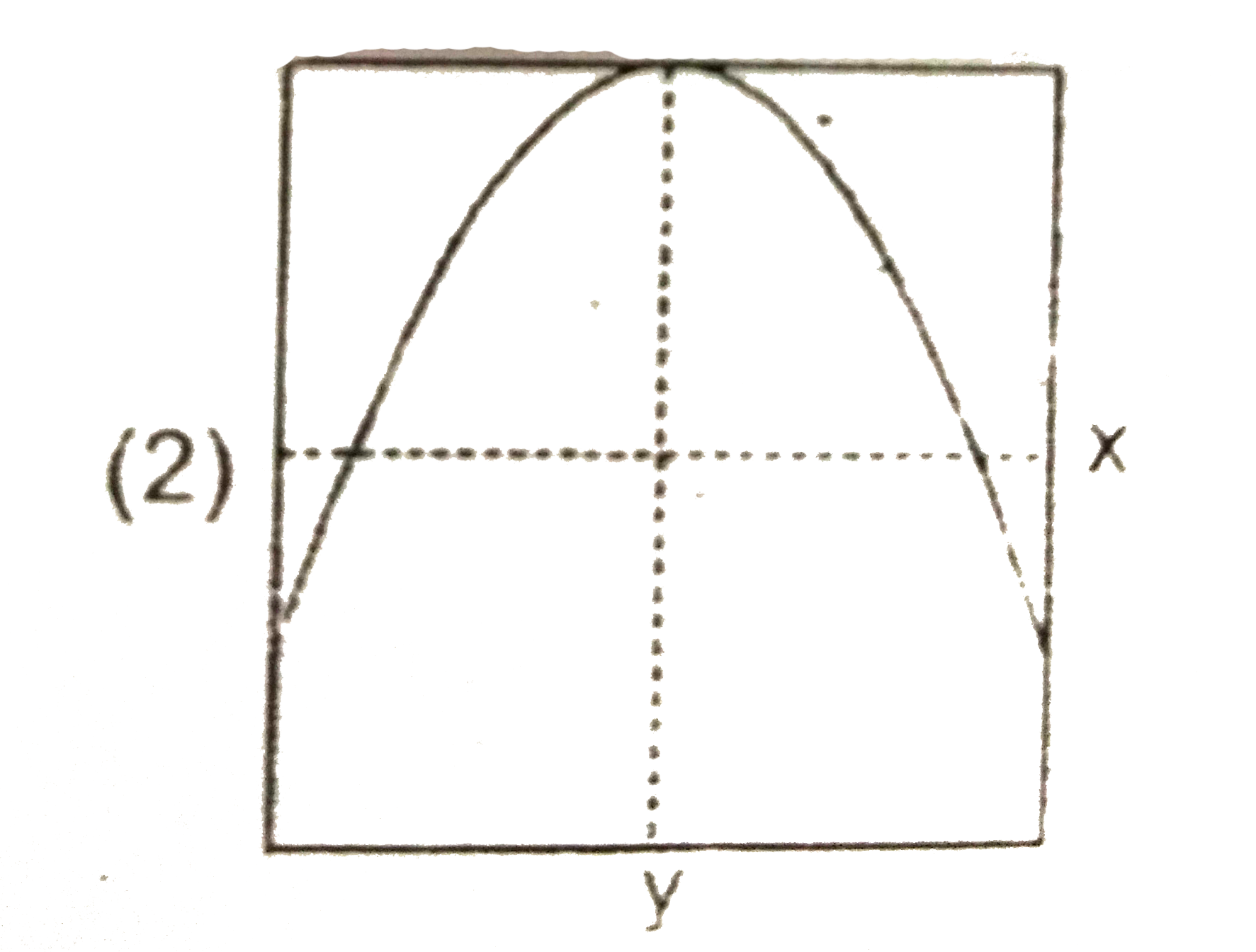
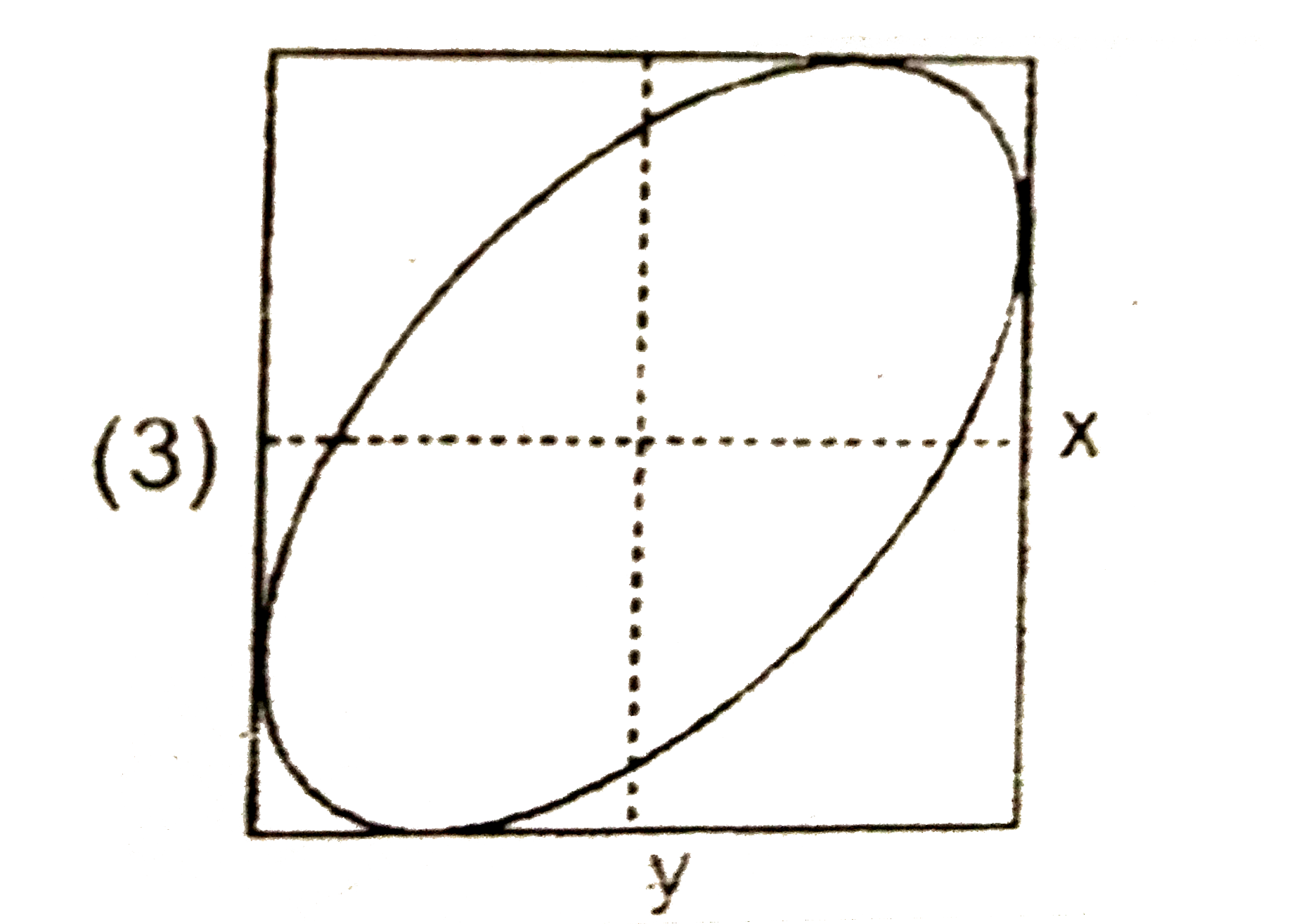
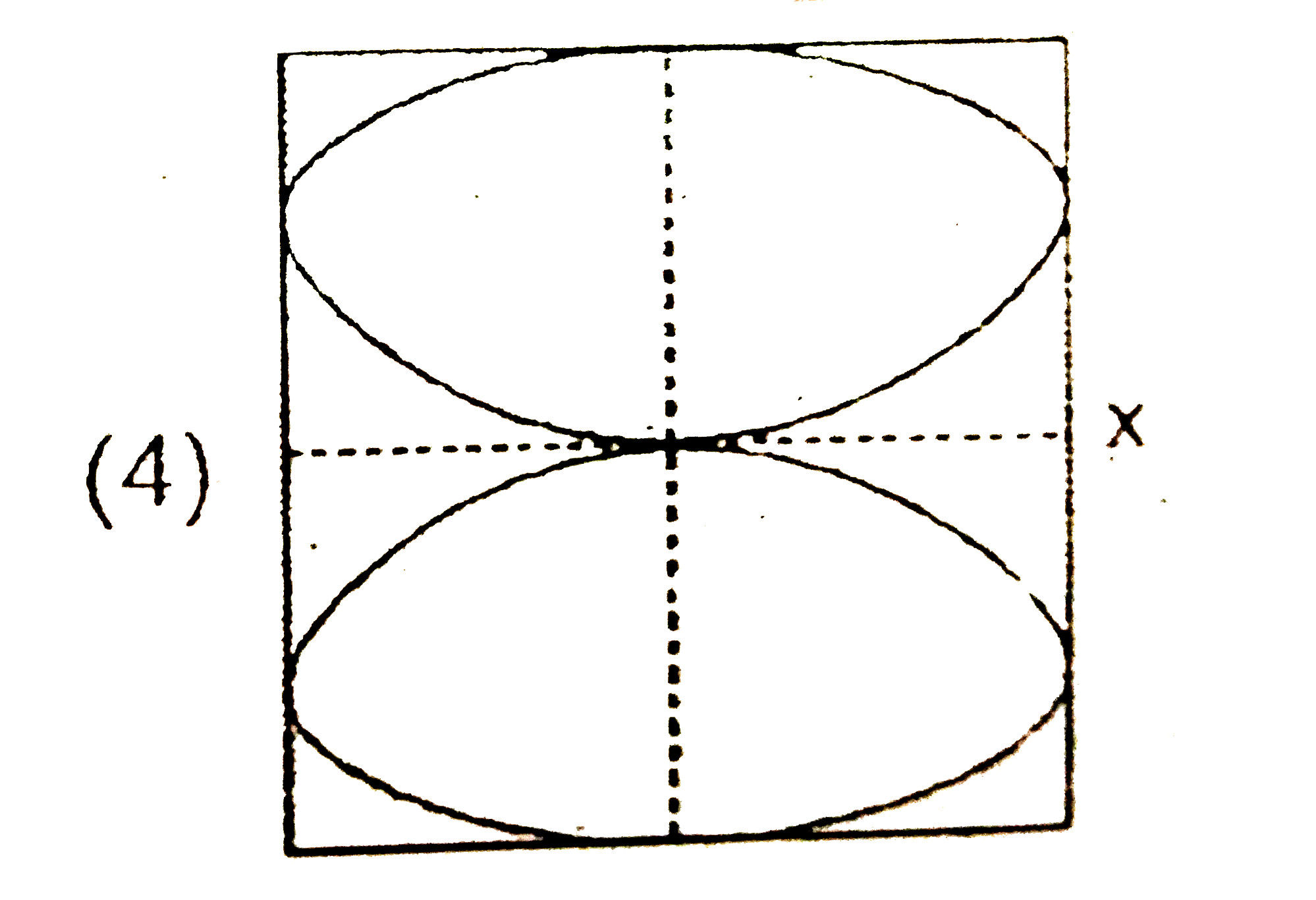
`x` and `y` displacements of a particle are given as `x(t)=-asinomegat` and `y(t)=asin2omegat`. Its trajectory will look like.

A

B

C

D

Text Solution

AI Generated Solution

The correct Answer is:

To solve the problem, we need to analyze the given equations for the displacements \( x(t) \) and \( y(t) \): 1. **Given Equations:** \[ x(t) = -a \sin(\omega t) \] \[ y(t) = a \sin(2\omega t) \] 2. **Finding Points on the Trajectory:** - We will evaluate the trajectory at specific time intervals to understand how \( x \) and \( y \) change. 3. **At \( t = 0 \):** \[ x(0) = -a \sin(0) = 0 \] \[ y(0) = a \sin(0) = 0 \] - So, the particle starts at the origin \( (0, 0) \). 4. **At \( t = \frac{\pi}{2\omega} \):** \[ x\left(\frac{\pi}{2\omega}\right) = -a \sin\left(\omega \cdot \frac{\pi}{2\omega}\right) = -a \sin\left(\frac{\pi}{2}\right) = -a \] \[ y\left(\frac{\pi}{2\omega}\right) = a \sin\left(2\omega \cdot \frac{\pi}{2\omega}\right) = a \sin(\pi) = 0 \] - At this point, the particle is at \( (-a, 0) \). 5. **At \( t = \frac{\pi}{4\omega} \):** \[ x\left(\frac{\pi}{4\omega}\right) = -a \sin\left(\frac{\pi}{4}\right) = -a \cdot \frac{\sqrt{2}}{2} = -\frac{a\sqrt{2}}{2} \] \[ y\left(\frac{\pi}{4\omega}\right) = a \sin\left(\frac{\pi}{2}\right) = a \] - The particle is at \( \left(-\frac{a\sqrt{2}}{2}, a\right) \). 6. **At \( t = \frac{\pi}{\omega} \):** \[ x\left(\frac{\pi}{\omega}\right) = -a \sin(\pi) = 0 \] \[ y\left(\frac{\pi}{\omega}\right) = a \sin(2\pi) = 0 \] - The particle returns to the origin \( (0, 0) \). 7. **At \( t = \frac{3\pi}{4\omega} \):** \[ x\left(\frac{3\pi}{4\omega}\right) = -a \sin\left(\frac{3\pi}{4}\right) = -a \cdot \frac{\sqrt{2}}{2} = -\frac{a\sqrt{2}}{2} \] \[ y\left(\frac{3\pi}{4\omega}\right) = a \sin\left(\frac{3\pi}{2}\right) = -a \] - The particle is at \( \left(-\frac{a\sqrt{2}}{2}, -a\right) \). 8. **At \( t = \frac{3\pi}{2\omega} \):** \[ x\left(\frac{3\pi}{2\omega}\right) = -a \sin\left(\frac{3\pi}{2}\right) = a \] \[ y\left(\frac{3\pi}{2\omega}\right) = a \sin(3\pi) = 0 \] - The particle is at \( (a, 0) \). 9. **At \( t = 2\pi/\omega \):** \[ x\left(2\pi/\omega\right) = -a \sin(2\pi) = 0 \] \[ y\left(2\pi/\omega\right) = a \sin(4\pi) = 0 \] - The particle returns to the origin \( (0, 0) \). 10. **Conclusion:** - The trajectory of the particle will form a closed loop, oscillating between the points \( (-a, 0) \), \( (0, a) \), \( (a, 0) \), and \( (0, -a) \). The shape of the trajectory is a vertical ellipse.

To solve the problem, we need to analyze the given equations for the displacements \( x(t) \) and \( y(t) \): 1. **Given Equations:** \[ x(t) = -a \sin(\omega t) \] \[ y(t) = a \sin(2\omega t) ...
Promotional Banner

Topper's Solved these Questions

  • TEST PAPERS

    RESONANCE ENGLISH|Exercise PART - II PHYSICS|106 Videos
  • SIMPLE HARMONIC MOTION

    RESONANCE ENGLISH|Exercise Advanced Level Problems|13 Videos
  • TEST SERIES

    RESONANCE ENGLISH|Exercise PHYSICS|130 Videos

Similar Questions

Explore conceptually related problems

The displacement of a particle varies with time according to the relation y=asinomegat+bcosomegat .

The displacement of a particle varies with time according to the relation y=asinomegat+bcoasomegat .

A particle is acted simultaneously by mutually perpendicular simple harmonic motions x=acos omegat and y =asinomegat. The trajectory of motion of the particle will be

A particle is acted simultaneously by mutually perpendicular simple harmonic motions x=a cos omegat and y=asinomegat . The trajectory of motion of the particle will be

A x and y co-ordinates of a particle are x=A sin (omega t) and y = A sin(omegat + pi//2) . Then, the motion of the particle is

A particle is acted simultaneously by mutally perpendicular simple harmonic motion x=acosomegat and y=asinomegat . The trajectory of motion of the particle will be

The displacement of a particle along the x-axis is given by x = a sin^(2) omega t . The motion of the particle corresponds to

The displacement of a particle along the x- axis it given by x = a sin^(2) omega t The motion of the particle corresponds to

If the displacement of a particle varies with time as x = 5t^2+ 7t . Then find its velocity.

The horizontal and vertical displacements of a particle moving along a curved line are given by x=5t and y = 2t^2 + t. Time after which its velocity vector makes an angle of 45^@ with the horizontal is

RESONANCE ENGLISH-TEST PAPERS-PHYSICS
  1. In the following 'I' refers to current and other symbols have their us...

    Text Solution

    |

  2. If it takes 5 minutes to fill a 15 litre bucket from a water tap diame...

    Text Solution

    |

  3. x and y displacements of a particle are given as x(t)=-asinomegat and ...

    Text Solution

    |

  4. Suppose the drift velocity v(d) in a material varied with the applie...

    Text Solution

    |

  5. When the current in a coil changes from 5A to 2A in 0.1s, an average v...

    Text Solution

    |

  6. A 25 cm long solenoid has radius 2 cm and 500 total number of turns. I...

    Text Solution

    |

  7. You are asked to design a shaving mirror assuming that a person keeps ...

    Text Solution

    |

  8. If two glass plates have water between them and are separated by very ...

    Text Solution

    |

  9. In the circuit shown, charge on the capacitor connected between B and ...

    Text Solution

    |

  10. A 10kg weight is suspended with a wire AB of linear mass density 0.01k...

    Text Solution

    |

  11. A particle is moving in x-y plane with y=x/2 and v(x)=4-2t. The displa...

    Text Solution

    |

  12. Difference between nth and (n+1) the Bohr's radius of 'H' atom is equa...

    Text Solution

    |

  13. A radioactive substance X decays into another radioactive substance Y ...

    Text Solution

    |

  14. A charged particle enters a unifrom magnetic field with velocity vec...

    Text Solution

    |

  15. A Connot engine having an efficiency of (1)/(10) as heat engine, is u...

    Text Solution

    |

  16. A block of mass m(1) lies on the top of fixed wedge as shown in fig. a...

    Text Solution

    |

  17. A sphere of mass m and radius r is projected in a gravity free space w...

    Text Solution

    |

  18. An ideal gas undergoes a process ArarrBrarrC shown in P-V graph. Then ...

    Text Solution

    |

  19. A boy of mass 30 kg starts running from rest along a circular path of ...

    Text Solution

    |

  20. In the figure shown magnetic field B is constant and uniform and in th...

    Text Solution

    |
