Home
Class 12
PHYSICS
Suppose the drift velocity v(d) in a m...

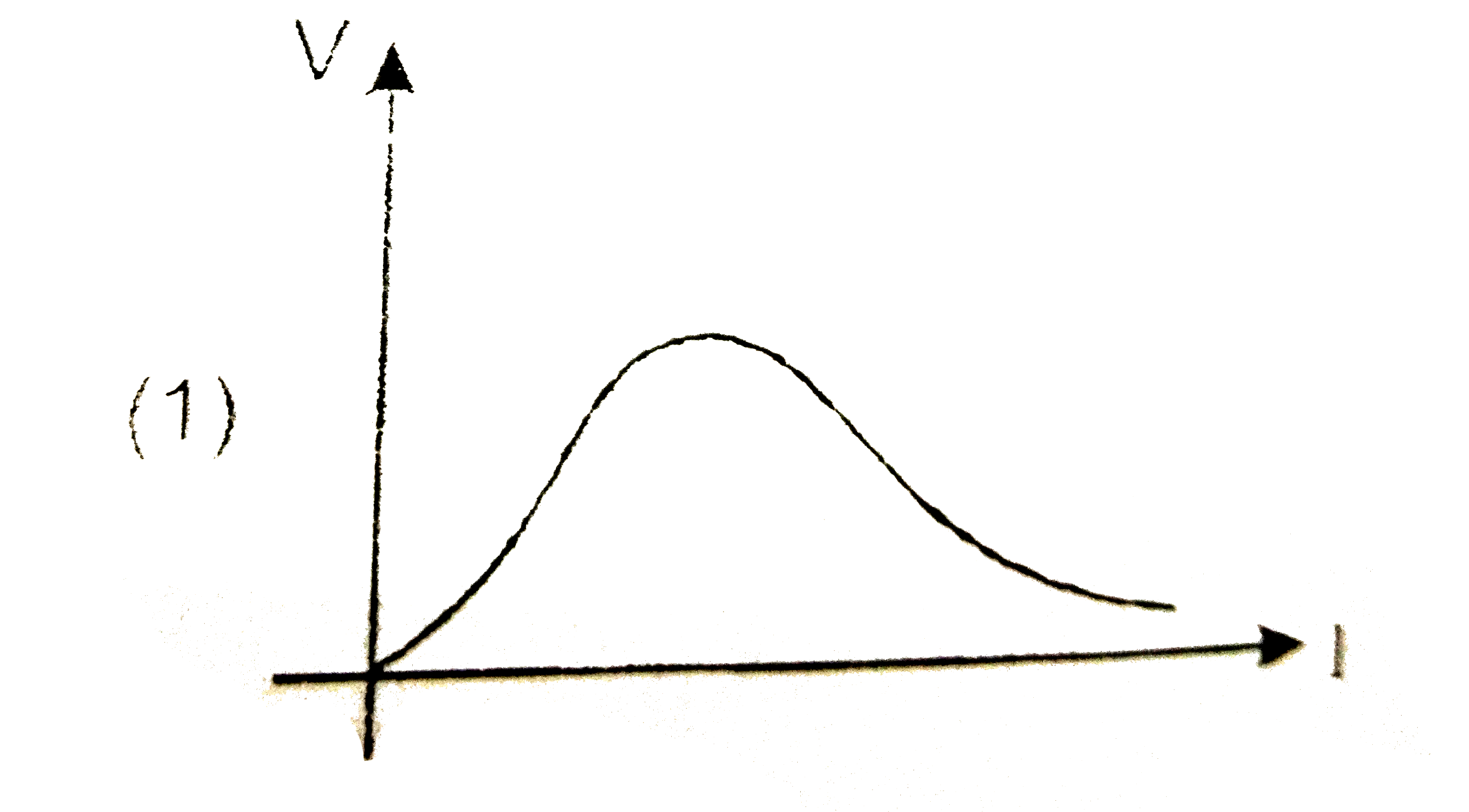
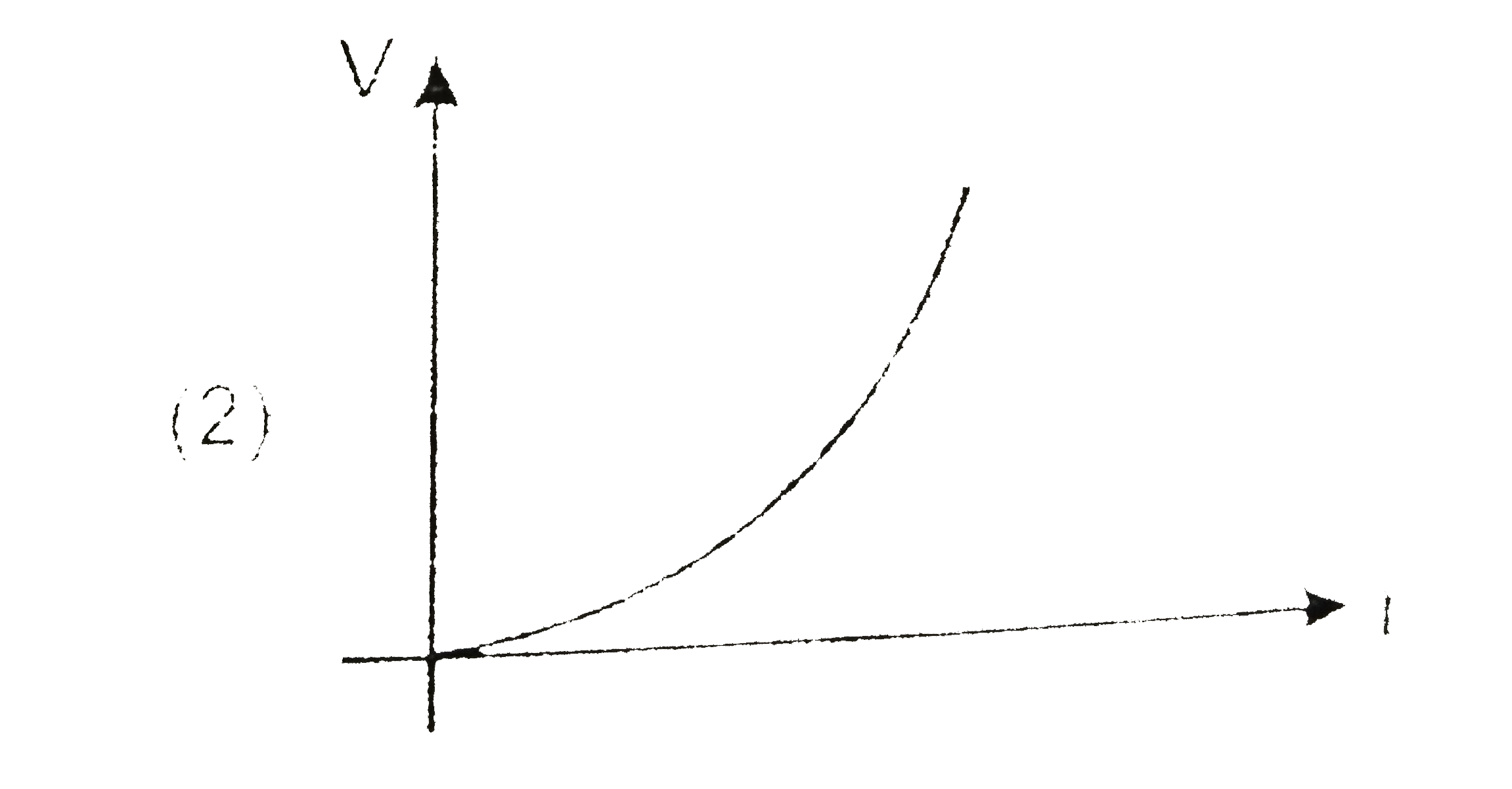
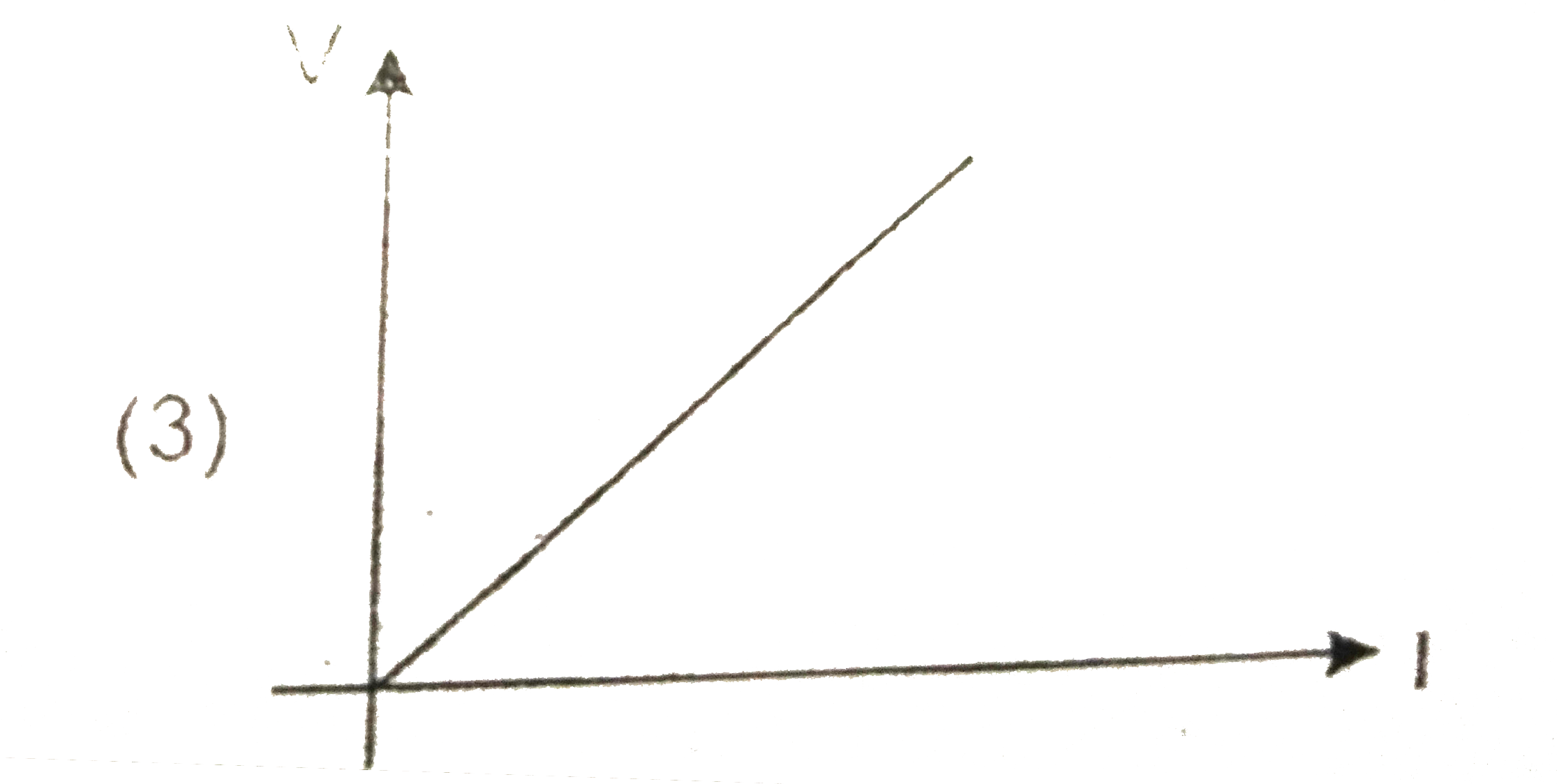
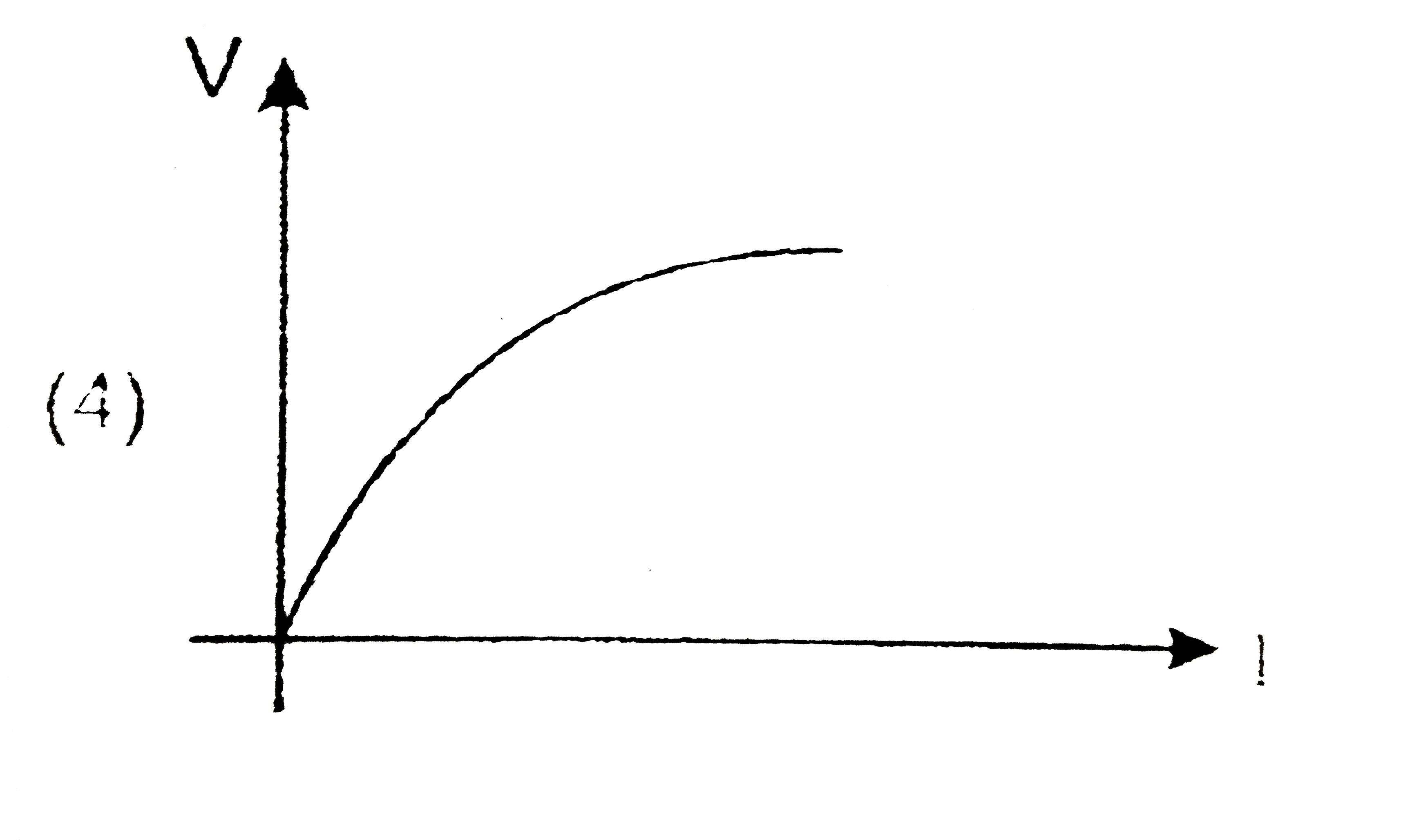
Suppose the drift velocity `v_(d)` in a material varied with the applied electric field E as `v_(d) prop sqrt(E)`. Then V – I graph for a wire made of such a material is best given by :

A

B

C

D

Text Solution

AI Generated Solution

The correct Answer is:

To solve the problem, we need to analyze the relationship between the drift velocity \( v_d \), the electric field \( E \), and the current \( I \) in the wire. Here’s a step-by-step breakdown of the solution: ### Step 1: Understand the relationship between drift velocity and electric field We are given that the drift velocity \( v_d \) is proportional to the square root of the electric field \( E \): \[ v_d \propto \sqrt{E} \] This can be expressed mathematically as: \[ v_d = k \sqrt{E} \] where \( k \) is a proportionality constant. ### Step 2: Relate drift velocity to current The current \( I \) in a conductor is given by the formula: \[ I = n e A v_d \] where: - \( n \) is the number density of charge carriers, - \( e \) is the charge of an electron, - \( A \) is the cross-sectional area of the wire, - \( v_d \) is the drift velocity. ### Step 3: Substitute the expression for drift velocity Substituting the expression for \( v_d \) from Step 1 into the current equation: \[ I = n e A (k \sqrt{E}) = n e A k \sqrt{E} \] This shows that the current \( I \) is directly proportional to \( \sqrt{E} \): \[ I \propto \sqrt{E} \] ### Step 4: Relate electric field to potential difference The electric field \( E \) can also be expressed in terms of the potential difference \( V \) and the length \( L \) of the conductor: \[ E = \frac{V}{L} \] ### Step 5: Substitute electric field in the current equation Now, substituting \( E \) in terms of \( V \): \[ I \propto \sqrt{\frac{V}{L}} \] Since \( L \) is a constant for a given wire, we can simplify this to: \[ I \propto \sqrt{V} \] ### Step 6: Express the relationship between voltage and current From the relationship \( I \propto \sqrt{V} \), we can express it as: \[ I = k' \sqrt{V} \] where \( k' \) is a new constant. ### Step 7: Square both sides to find the relationship between \( V \) and \( I \) Squaring both sides gives: \[ I^2 = (k')^2 V \] This indicates that the potential difference \( V \) is proportional to the square of the current \( I \): \[ V \propto I^2 \] ### Step 8: Identify the shape of the V-I graph The relationship \( V \propto I^2 \) describes a parabolic curve that opens upwards, which means the graph of \( V \) versus \( I \) is a parabola that is concave upwards. ### Conclusion Thus, the V-I graph for a wire made of such a material is best represented by a parabolic curve concave upwards. ### Final Answer The correct option is **B**. ---

To solve the problem, we need to analyze the relationship between the drift velocity \( v_d \), the electric field \( E \), and the current \( I \) in the wire. Here’s a step-by-step breakdown of the solution: ### Step 1: Understand the relationship between drift velocity and electric field We are given that the drift velocity \( v_d \) is proportional to the square root of the electric field \( E \): \[ v_d \propto \sqrt{E} \] This can be expressed mathematically as: ...
Promotional Banner

Topper's Solved these Questions

  • TEST PAPERS

    RESONANCE ENGLISH|Exercise PART - II PHYSICS|106 Videos
  • SIMPLE HARMONIC MOTION

    RESONANCE ENGLISH|Exercise Advanced Level Problems|13 Videos
  • TEST SERIES

    RESONANCE ENGLISH|Exercise PHYSICS|130 Videos

Similar Questions

Explore conceptually related problems

Drift velocity v_(d) varies with the intensity of electric field as per their relation

For which of the following depndences of drift velocity, v_(d) on electric field E, Ohm's law obeyed?

A charged oil drop falls with terminal velocity v_(0) in the absence of electric field. An electric field E keeps it stationary. The drop acquires charge 3q, it starts moving upwards with velocity v_(0) . The initial charge on the drop is

A current .I. flows through a metallic wire of radius .r. and the free electrons in it drift with a velocity v_(d) . Calculate the drift velocity of the free electrons through the wire of the same material, having double the radius, when same current flows through it.

The drift velocity of free electron in a metal wire of a given potential gradient along it is V_(d) . If this potential gradient is doubled the new drift velocity will be

The electric field and the electric potential at a point are E and V respectively. Give the relationship between E and V

An electron projectes with velocity vecv=v_(0)hati in the electric field vecE=E_(0)hatj . There the path followed by the electron E_(0) .

The electric field and the electric potential at a point are E and V respectively.

Let V be electric potential and E the mangitude of the electric field. At a given position, which of the statement is true ?

Let V_(0) be the potential at the origin in an electric field vecE=E_(x)hati+E_(y)hatj . The potential at the point (x,y) is

RESONANCE ENGLISH-TEST PAPERS-PHYSICS
  1. If it takes 5 minutes to fill a 15 litre bucket from a water tap diame...

    Text Solution

    |

  2. x and y displacements of a particle are given as x(t)=-asinomegat and ...

    Text Solution

    |

  3. Suppose the drift velocity v(d) in a material varied with the applie...

    Text Solution

    |

  4. When the current in a coil changes from 5A to 2A in 0.1s, an average v...

    Text Solution

    |

  5. A 25 cm long solenoid has radius 2 cm and 500 total number of turns. I...

    Text Solution

    |

  6. You are asked to design a shaving mirror assuming that a person keeps ...

    Text Solution

    |

  7. If two glass plates have water between them and are separated by very ...

    Text Solution

    |

  8. In the circuit shown, charge on the capacitor connected between B and ...

    Text Solution

    |

  9. A 10kg weight is suspended with a wire AB of linear mass density 0.01k...

    Text Solution

    |

  10. A particle is moving in x-y plane with y=x/2 and v(x)=4-2t. The displa...

    Text Solution

    |

  11. Difference between nth and (n+1) the Bohr's radius of 'H' atom is equa...

    Text Solution

    |

  12. A radioactive substance X decays into another radioactive substance Y ...

    Text Solution

    |

  13. A charged particle enters a unifrom magnetic field with velocity vec...

    Text Solution

    |

  14. A Connot engine having an efficiency of (1)/(10) as heat engine, is u...

    Text Solution

    |

  15. A block of mass m(1) lies on the top of fixed wedge as shown in fig. a...

    Text Solution

    |

  16. A sphere of mass m and radius r is projected in a gravity free space w...

    Text Solution

    |

  17. An ideal gas undergoes a process ArarrBrarrC shown in P-V graph. Then ...

    Text Solution

    |

  18. A boy of mass 30 kg starts running from rest along a circular path of ...

    Text Solution

    |

  19. In the figure shown magnetic field B is constant and uniform and in th...

    Text Solution

    |

  20. A uniform cube of mass M is floating on the surface of a liquid with t...

    Text Solution

    |
