Home
Class 12
PHYSICS
Two radio stations broadcast their progr...

Two radio stations broadcast their programs at the same amplitude A, and at slightly different frequencies `omega_(1) and omega_(2)` respectively, where `omega_(2)-omega_(1)=10^(3)Hz`. A detector receives the signals from the two stations simultaneously. It can detect signals only of intensity `ge2A^(2)`.
(i) Find the time intervals between successive maxima of the intensity of the signal received by the detector
(ii) Find the time for which the detector remains idle in each cycle of the intensity of the signal

Text Solution

Verified by Experts

The correct Answer is:
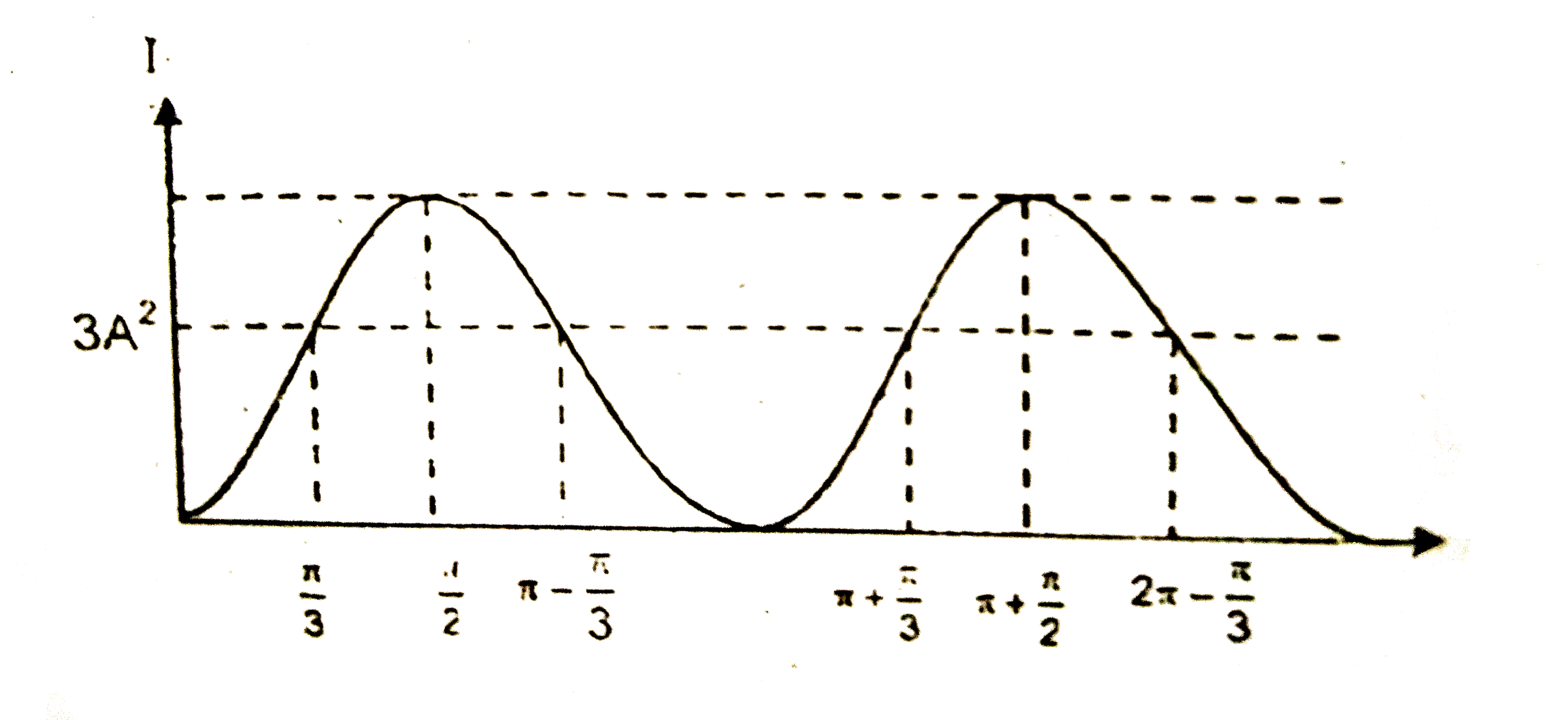
5

`I=4A^(2)sin^(2)Deltaomegat`

`t_(0)=((2pi)/3)/(Deltaomega) =(2pi)/(3Deltaomega)`
`=2/3xx10^(-2)sec`
Promotional Banner

Topper's Solved these Questions

  • TEST PAPERS

    RESONANCE ENGLISH|Exercise PART - II PHYSICS|106 Videos
  • SIMPLE HARMONIC MOTION

    RESONANCE ENGLISH|Exercise Advanced Level Problems|13 Videos
  • TEST SERIES

    RESONANCE ENGLISH|Exercise PHYSICS|130 Videos

Similar Questions

Explore conceptually related problems

Two radio stations broadcast their programmes at the same amplitude A and at slightly different frequencies omega_(1) and omega_(2) respectively, where omega_(1) - omega_(2) = 10^(3) Hz . A detector receives the signals from the two stations simultaneously, it can only detect signals of intensity ge 2A^(2) . (i) Find the time interval between successive maxima of the intensity of the signal received by the detector. (ii) Find the time for which the detector remains idle in each cycle of the intensity of the signal.

Two radio stations broadcast their programmes at the same amplitude A , and at slightly different frequencies omega_(1) and omega_(2) respectively , where omega_(2) - omega_(1) = 10^(3) Hz . A detector receives the signals from the two stations simultaneously . It can emit signals only of intensity ge 2 A^(2) . (i). Find the time intervals between successive maxima of the intensity of the signal received by the detector . ii. Find the time for which the detector remains idle in each cycle of the intensity of the signal .

When two waves of almost equal frequencies n_(1) and n_(2) reach at a point simultaneously, what is the time interval between successive maxima ?

Find the amplitude of the electric field in a parallel bean of light of intensity 2.0 W m^-2.

When two waves of almost equal frequencies v_(1) and v_(2) reach at a point simultaneously, the time interval between successive maxima is

The planes sources of sound of frequency n_(1)=400Hz,n_(2)=401Hz of equal amplitude of a each, are sounded together. A detector receives waves from the two sources simultaneously. It can detect signals of amplitude with magnitude ge a only,

Two waves of frequencies 50 Hz and 45 Hz are produced simultaneously, then the time interval between successive maxima of the resulting wave is [maxima refers to the maximum intensity]

Two waves of frequency 500 Hz and 498 Hz are produced simultaneously. Calculate the time interval between successive maxima.

Two lenses have focal lengths f_(1) and f_(2) and their dispersive powers are omega_(1) and omega_(2) respectively. They will together form an achromatic combination if

When two progressive waves of intensity I_(1) and I_(2) but slightly different frequencies superpose, the resultant intensity flutuates between :-

RESONANCE ENGLISH-TEST PAPERS-PHYSICS
  1. A particle with mass m and charge q moving with a velocity v, enters a...

    Text Solution

    |

  2. The circuit shown in the figure above consists of eight resistors, eac...

    Text Solution

    |

  3. Two radio stations broadcast their programs at the same amplitude A, a...

    Text Solution

    |

  4. Rod AB of length 1m is released from the shown position. End A undergo...

    Text Solution

    |

  5. A conductor carrying current 60A is in the form of a semicircle AB of ...

    Text Solution

    |

  6. A source of sound of frequency 1.8kHz moves uniformly along a straight...

    Text Solution

    |

  7. An object and a plane mirror are shown in figure. Mirror is moved with...

    Text Solution

    |

  8. A reflecting surface is represented by the equation y = (2L)/(pi) si...

    Text Solution

    |

  9. Two point objects are placed on principal axis of a thin converging le...

    Text Solution

    |

  10. Inside a solid glass sphere of radius R, a point source of light lies ...

    Text Solution

    |

  11. A concave spherical surface of radius of curvature 10 cm separates two...

    Text Solution

    |

  12. Choose the most appropriate graph of i(min)v//s A, for a light ray whi...

    Text Solution

    |

  13. A horizontal light ray passes through a prism (mu=1.5) of angle 4^(@)....

    Text Solution

    |

  14. Figure shows a object placed in front of a lens of focal length 10 cm,...

    Text Solution

    |

  15. A convex lens is cut into two parts in different ways that are arrange...

    Text Solution

    |

  16. The magnifying power of a telescope can be increased

    Text Solution

    |

  17. A red postage stamp is viewed in yellow (monochromatic) light. It appe...

    Text Solution

    |

  18. In a compound microscope

    Text Solution

    |

  19. An electromagnetic wave travelling through a transparent medium is giv...

    Text Solution

    |

  20. Two light waves travelling in same medium are given by E(1)=2sin(100pi...

    Text Solution

    |

