Home
Class 12
PHYSICS
A concave spherical surface of radius of...

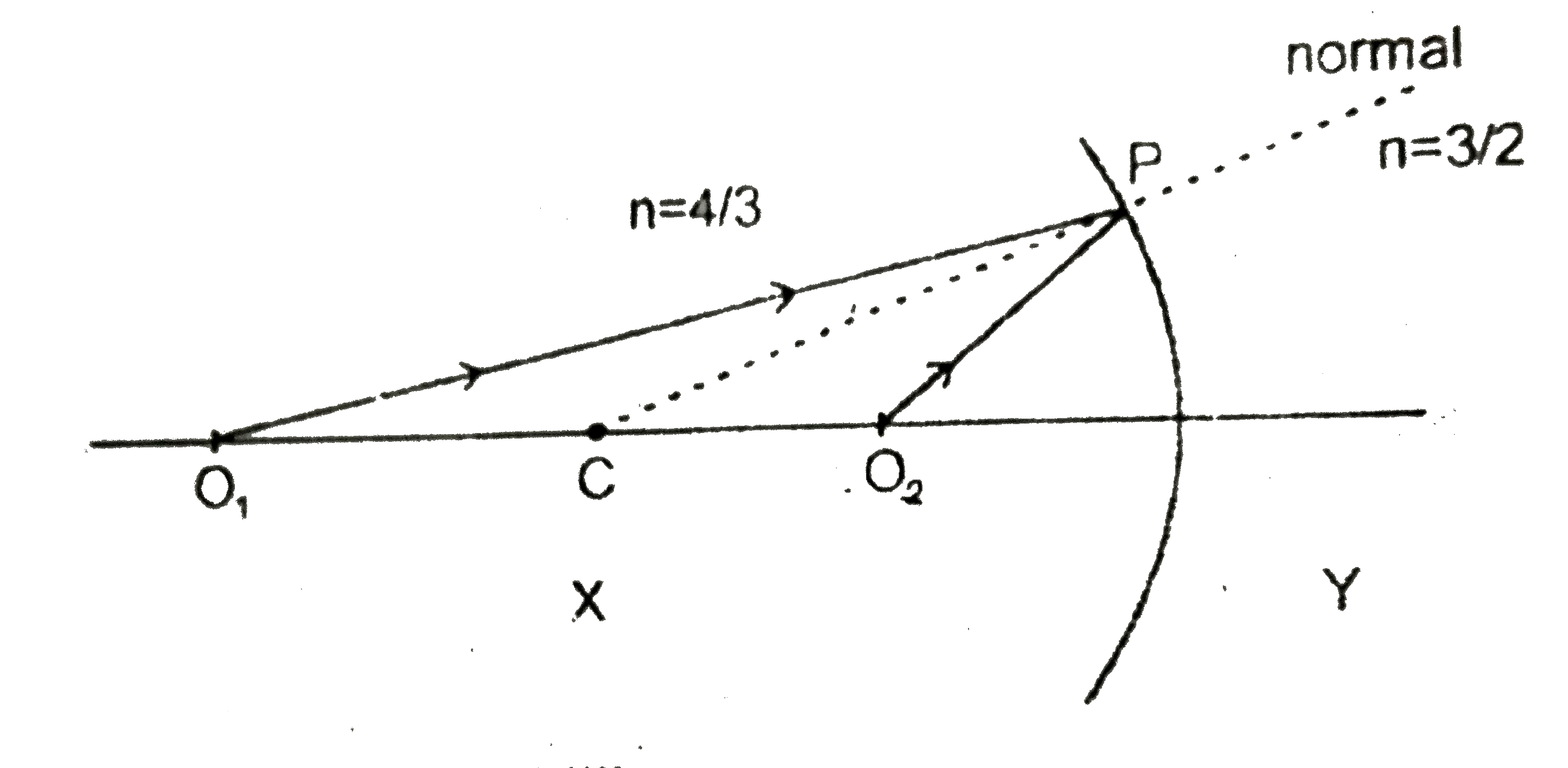
A concave spherical surface of radius of curvature `10 cm` separates two mediums `X` and `Y` of refractive indices `4//3` and `3//2` respectively. Centre of curvature of the surfaces lies in the medium `X`. An object is placed in medium `X`.

A

Image is always real

B

Image is real if the object distance is greater than `90`cm

C

Image is always virtual

D

Image is virtual only if the object distance is less then `90` cm

Text Solution

Verified by Experts

The correct Answer is:
C

(Moderate) Let there be two point objects `O_(1)` and `O_(2)`. Incident rays from `O_(1)` and `O_(2)` at point `P` shall both bend towards normal and hence the corresponding refracted rays shall intersect the principal axis in the left medium. Therefore image formed under given condition shall always be virtual.
Promotional Banner

Topper's Solved these Questions

  • TEST PAPERS

    RESONANCE ENGLISH|Exercise PART - II PHYSICS|106 Videos
  • SIMPLE HARMONIC MOTION

    RESONANCE ENGLISH|Exercise Advanced Level Problems|13 Videos
  • TEST SERIES

    RESONANCE ENGLISH|Exercise PHYSICS|130 Videos

Similar Questions

Explore conceptually related problems

A concave spherical surface of radius of curvature 100 cm separates two media of refractive indices 1.50 and (4)/(3) . An object is kept in the first medium at a distance of 30 cm from the surface. Calculate the position of the image.

A spherical surface of radius 30 cm separates two transparent media A and B with refractive indices 1'33 and 1.48 respectively. The medium A is on the convex side of the surface. Where should a point object be placed in medium A so that the paraxial rays become parallel after refraction at the surface ?

A convex surface of radius of curvature 40 cm separate two media of refractive indices (4)/(3) and 1.50. An object is kept in the first medium at a distance of 20 cm from the surface. Calculate the position of the image.

A convex refracting surface of radius of curvature 20 cm separates two media of refractive indices 4//3 and 1.60 . An object is placed in the first medium (mu = 4//3) at a distance of 200 cm from the refracting surface. Calculate the position of image formed.

A spherical convex surface separates object and image space of refractive index 1.0 and 4/3. If radius of curvature of the surface is 10cm, find its power.

A spherical convex surface separates object and image space of refractive index 1.0 and 4/3. If radius of curvature of the surface is 10cm, find its power.

A concave spherical refractive surface with radius R separates a medium of refractive index 5//2 from air. As an object is approaching the surface from far away from the surface along the central axis, its image

A spherical surface of radius R ssparates two media of refractive indices mu_(1) and mu_(1) as shown in figure., Where should an object be placed in medium 1 so that a real image is formed in medium 2 at the same distance?

A convex spherical refracting surface with radius R separates a medium having refractive index 5//2 from air. As an object is moved towards the surface from far away from the surface along the principle axis, its image

Figure below shows a parallel beam of monochromatic light incident on a convex spherical surface, radius of curvature R = 30 cm, which separates glass (refractive index - 1 6) from air. Find the position of the image formed due to refraction of light at this single spherical surface.

RESONANCE ENGLISH-TEST PAPERS-PHYSICS
  1. Two point objects are placed on principal axis of a thin converging le...

    Text Solution

    |

  2. Inside a solid glass sphere of radius R, a point source of light lies ...

    Text Solution

    |

  3. A concave spherical surface of radius of curvature 10 cm separates two...

    Text Solution

    |

  4. Choose the most appropriate graph of i(min)v//s A, for a light ray whi...

    Text Solution

    |

  5. A horizontal light ray passes through a prism (mu=1.5) of angle 4^(@)....

    Text Solution

    |

  6. Figure shows a object placed in front of a lens of focal length 10 cm,...

    Text Solution

    |

  7. A convex lens is cut into two parts in different ways that are arrange...

    Text Solution

    |

  8. The magnifying power of a telescope can be increased

    Text Solution

    |

  9. A red postage stamp is viewed in yellow (monochromatic) light. It appe...

    Text Solution

    |

  10. In a compound microscope

    Text Solution

    |

  11. An electromagnetic wave travelling through a transparent medium is giv...

    Text Solution

    |

  12. Two light waves travelling in same medium are given by E(1)=2sin(100pi...

    Text Solution

    |

  13. If young's double slit experiment is performed in water

    Text Solution

    |

  14. A point object is placed at a distance 20 cm from the focus of a conca...

    Text Solution

    |

  15. A small wooden rod of length 5mm is fixed at the bottom of the contain...

    Text Solution

    |

  16. A ray is incident on a sphere of refractive index sqrt(2) as shown in ...

    Text Solution

    |

  17. If the distance between two images formed by upper and lower part of t...

    Text Solution

    |

  18. The minimum magnifying power of a telescope is M. If focal length of i...

    Text Solution

    |

  19. The dispersive power of the material of a lens is 0.04 and the focal l...

    Text Solution

    |

  20. A thin prism of glass is placed in air and water respectively. If n(0)...

    Text Solution

    |

