Home
Class 12
MATHS
For positive integers K=1,2,3,……….n Let ...

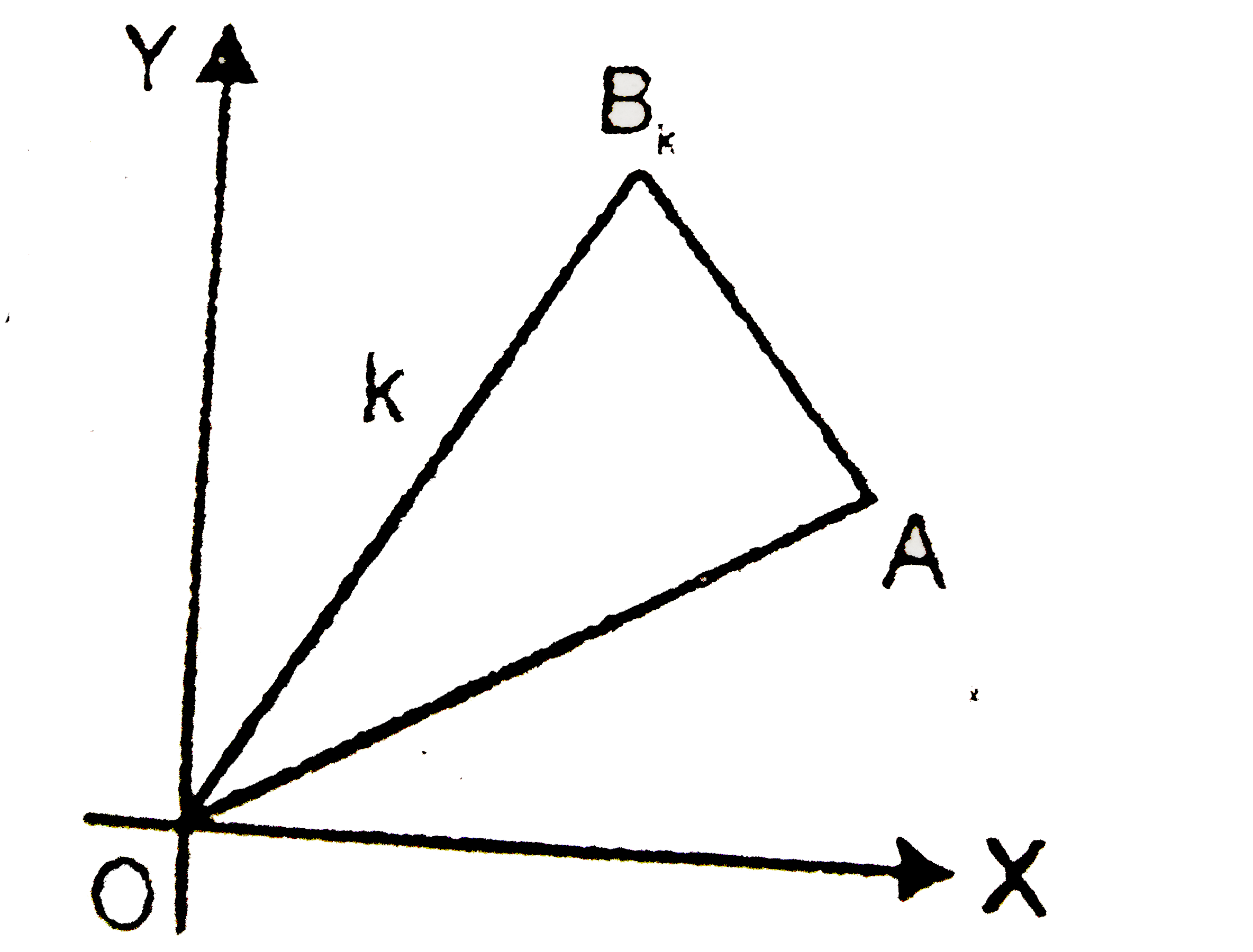
For positive integers `K=1,2,3,……….n` Let `S_(k)` denotes the area of `DeltaOAB_(k)` (where `O` is the origin) such that `/_AOB_(k)=(Kpi)/(2n),OA=1` and `OB_(K)=K`. The value of the `lim_(nto oo)1/(n^(2)).sum_(K=1)^(n)S_(K)` is

Text Solution

Verified by Experts

The correct Answer is:
0


`OB_(k)=k,/_AOB_(k)=(kpi)/(2n)`
`S_(k)=1/2k"sin"(kpi)/(2n)` (using `Delta=1/2 absintheta`)
`:.L=lim_(nrarroo)1/(n^(2))sum_(k=1)^(n)S_(k)=k/(2n^(2))sum_(k=1)^(oo)"sin"(kpi)/(2n)`
`=1/(2n)sum_(k=1)^(oo)k/n"sin"(kpi)/(2n)=1/2int_(0)^(1)x."sin"(pix)/2dx`
`=1/2[(-2)/(pi)xx"cos"(pix)/2|_(0)^(1)+2/(pi)int_(0)^(1)"cos"(pix)/2dx]`
`=1/2[0+2/(pi).2/(pi)("sin"(pix)/2)_(0)^(1)]=2/(pi)`
Promotional Banner

Topper's Solved these Questions

  • TEST PAPERS

    RESONANCE ENGLISH|Exercise Math|105 Videos
  • TEST PAPER

    RESONANCE ENGLISH|Exercise MATHEMATICS|48 Videos
  • TEST SERIES

    RESONANCE ENGLISH|Exercise MATHEMATICS|132 Videos

Similar Questions

Explore conceptually related problems

For positive integers k=1,2,3,....n,, let S_k denotes the area of triangleAOB_k such that angleAOB_k=(kpi)/(2n) , OA=1 and OB_k=k The value of the lim_(n->oo)1/n^2sum_(k-1)^nS_k is

The value of lim_(n->oo) sum_(k=1)^n log(1+k/n)^(1/n) ,is

The value of lim _( n to oo) sum _(k =1) ^(n) ((k)/(n ^(2) +n +2k))=

Evaluate ("lim")_(n rarr oo)sum_(k=1)^nk/(n^2+k^2)

Find the sum_(k=1)^(oo) sum_(n=1)^(oo)k/(2^(n+k)) .

The value of lim_(n->oo)sum_(k=1)^n(6^k)/((3^k-2^k)(3^(k+1)-2^(k+1)) is equal to

The value of \lim_{n \to \infty } sum_(k=1)^n (n-k)/(n^2) cos((4k)/n) equals to

If S_n=sum_(k=1)^n a_k and lim_(n->oo)a_n=a , then lim_(n->oo)(S_(n+1)-S_n)/sqrt(sum_(k=1)^n k) is equal to

Evaluate : sum_(k=1)^n (2^k+3^(k-1))

If a_(K)=(1)/(K(K+1)) for K=1, 2, 3....n , then (sum_(K=1)^(n)a_(K))^(2)=

RESONANCE ENGLISH-TEST PAPERS-MATHEMATICS
  1. Given lim(n->oo)((.^(3n)Cn)/(.^(2n)Cn))^(1/n) =a/b where a and b are r...

    Text Solution

    |

  2. lim(nrarroo)(1/(n+1)+1/(n+2)+…….+1/(6n))=kln6, then find the value of ...

    Text Solution

    |

  3. For positive integers K=1,2,3,……….n Let S(k) denotes the area of Delta...

    Text Solution

    |

  4. Number of solutions of the equation sec^(-1)((2)/((1)/(x)+x))+picospix...

    Text Solution

    |

  5. If lim(xrarr0)((cotx)(e^(x)-1)-cos^(2)x)/(sinx)=K,Kepsilonr then find ...

    Text Solution

    |

  6. The derivative of y = (1-x) (2-x)…(n-x) at x= 1 is

    Text Solution

    |

  7. If f(x)=|sinx-|cosx||, then the value of f^(')(x) at x=(7pi)/6 is

    Text Solution

    |

  8. The global maximum value of f(x)=(log)(10)(4x^3-12 x^2+11 x-3),x in [2...

    Text Solution

    |

  9. If 3(a+2c)=4(b+3d), then the equation a x^3+b x^2+c x+d=0 will have no...

    Text Solution

    |

  10. If 3f(cosx)+2f(sinx)=5x, then f^(')(cosx) is equal to (where f^(') den...

    Text Solution

    |

  11. "If "y=x^((x^(x)))," then "(dy)/(dx) is

    Text Solution

    |

  12. If f (x)=(4+x )^(n), n in N and f'(0) represents then r^(th) derivativ...

    Text Solution

    |

  13. Let f(x)=x/(1+x^2) and g(x)=(e^(-x))/(1+[x]) (where [.] denote greates...

    Text Solution

    |

  14. If the derivative of an odd cubic polynomial vanishes at two different...

    Text Solution

    |

  15. f (x)= {{:(3+|x-k|"," , x le k),(a ^(2) -2 + ( sin (x -k))/((x-k))"," ...

    Text Solution

    |

  16. Find the critical (stationary ) points of the function f(X)=(x^(5))/(2...

    Text Solution

    |

  17. If curve y=1-ax^(2) and y=x^(2) intersect orthogonally then a is

    Text Solution

    |

  18. If the relation between subnormal SN and subtangent ST on the curve, b...

    Text Solution

    |

  19. Find the point on the curve y=x^3-11 x+5 at which the tangent is y"...

    Text Solution

    |

  20. Find the equation of tangent to the hyperbola 16x^(2)-25y^(2)=400 perp...

    Text Solution

    |

