Home
Class 12
PHYSICS
Flux (ph) as a function of distance (r) ...

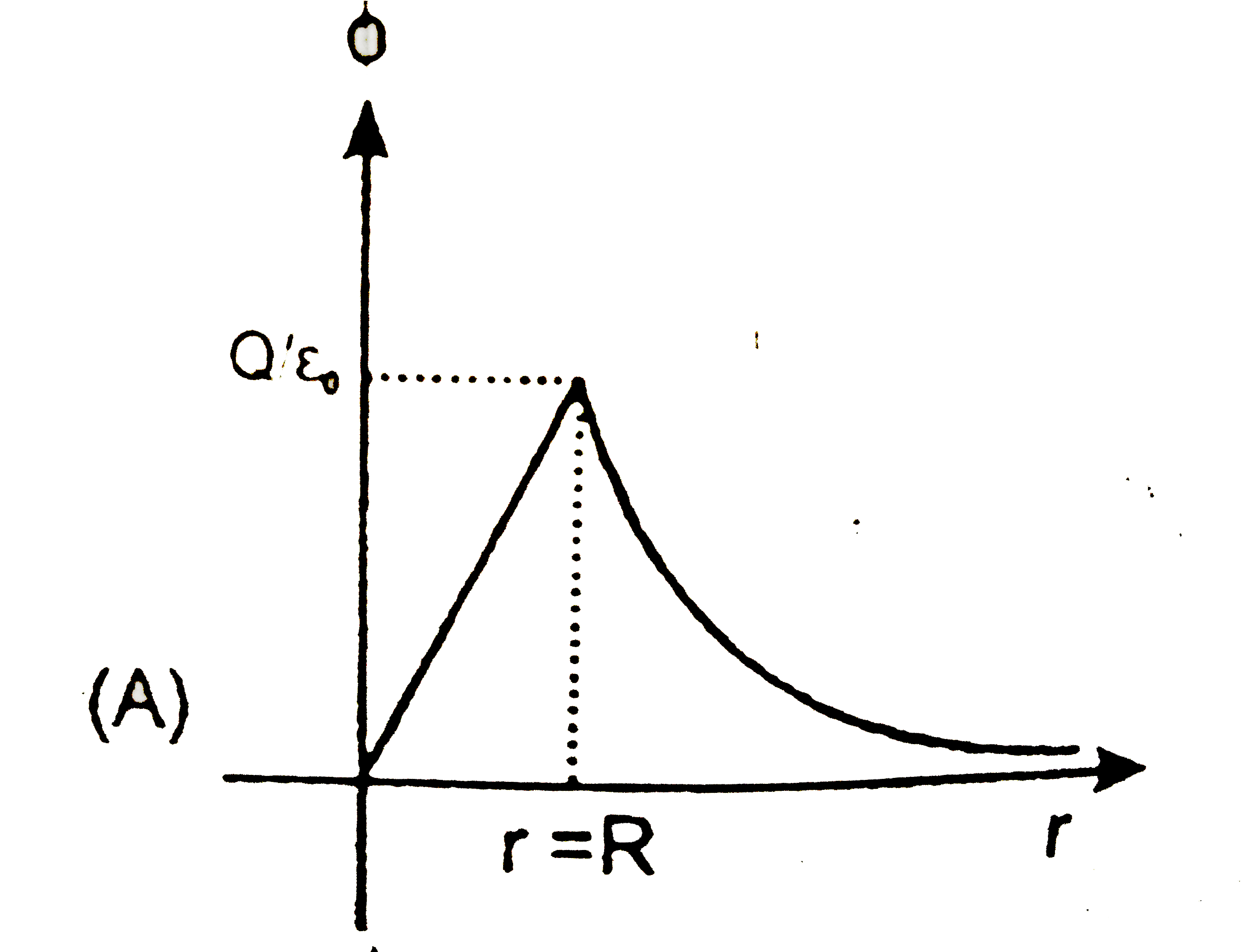
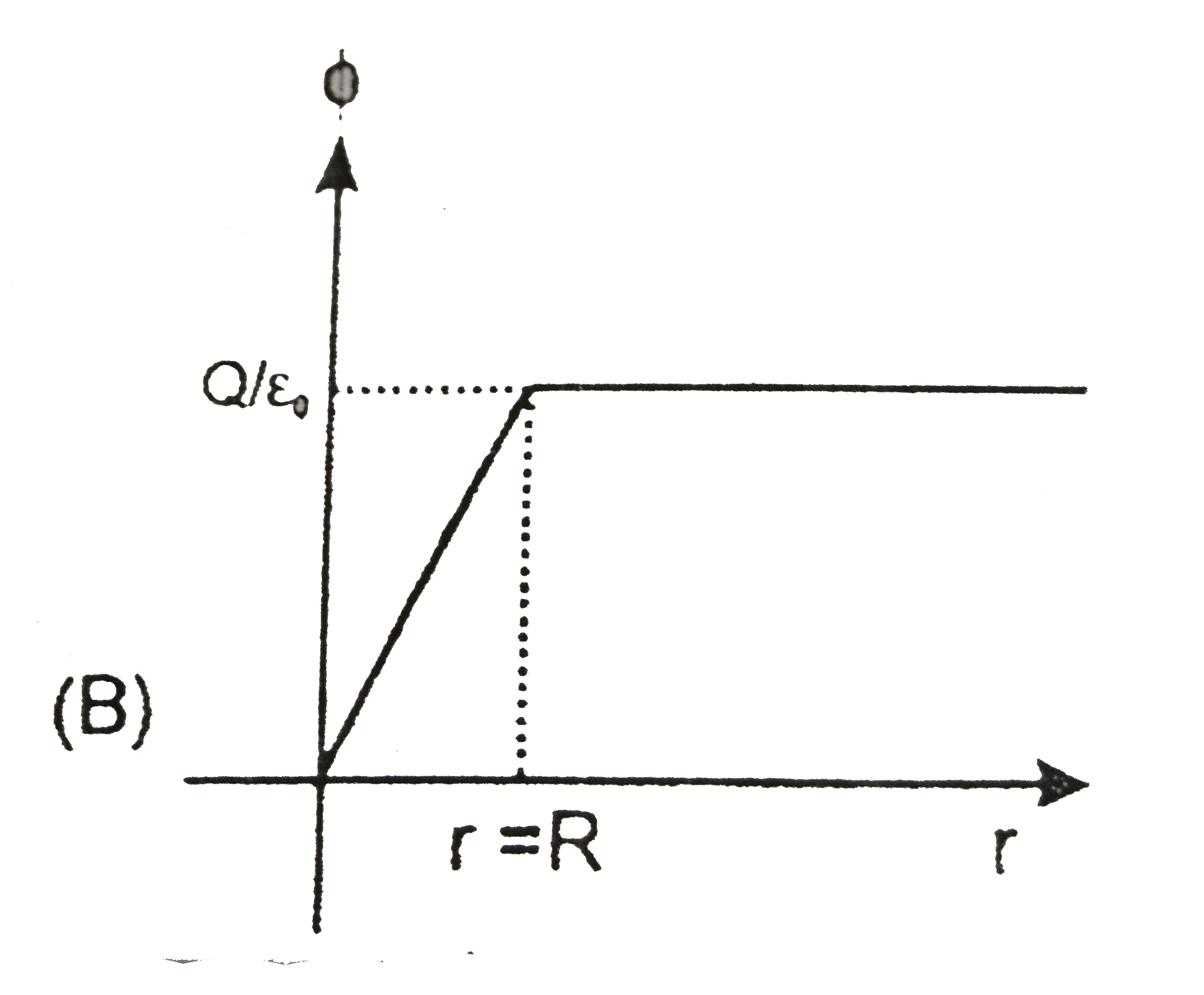
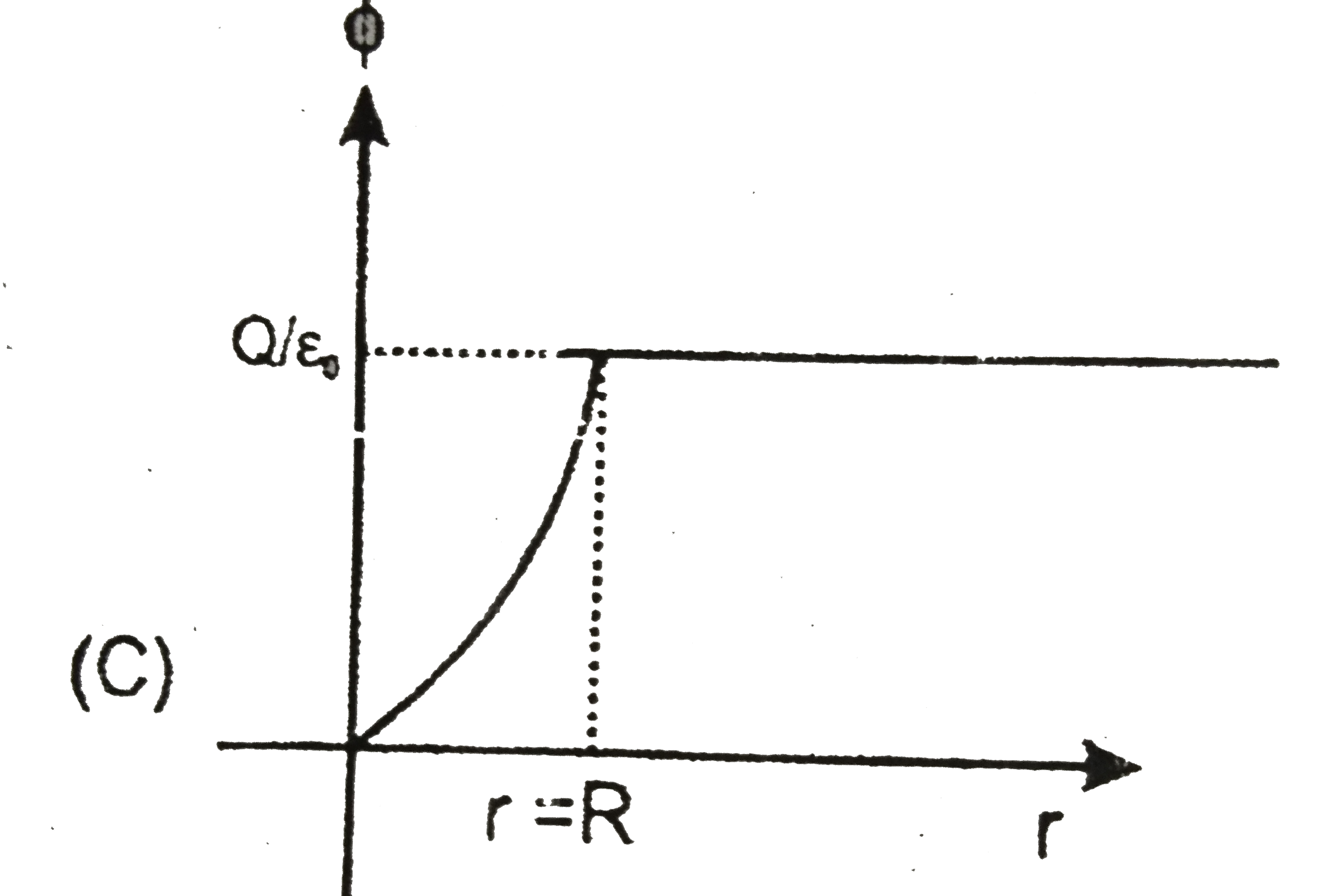
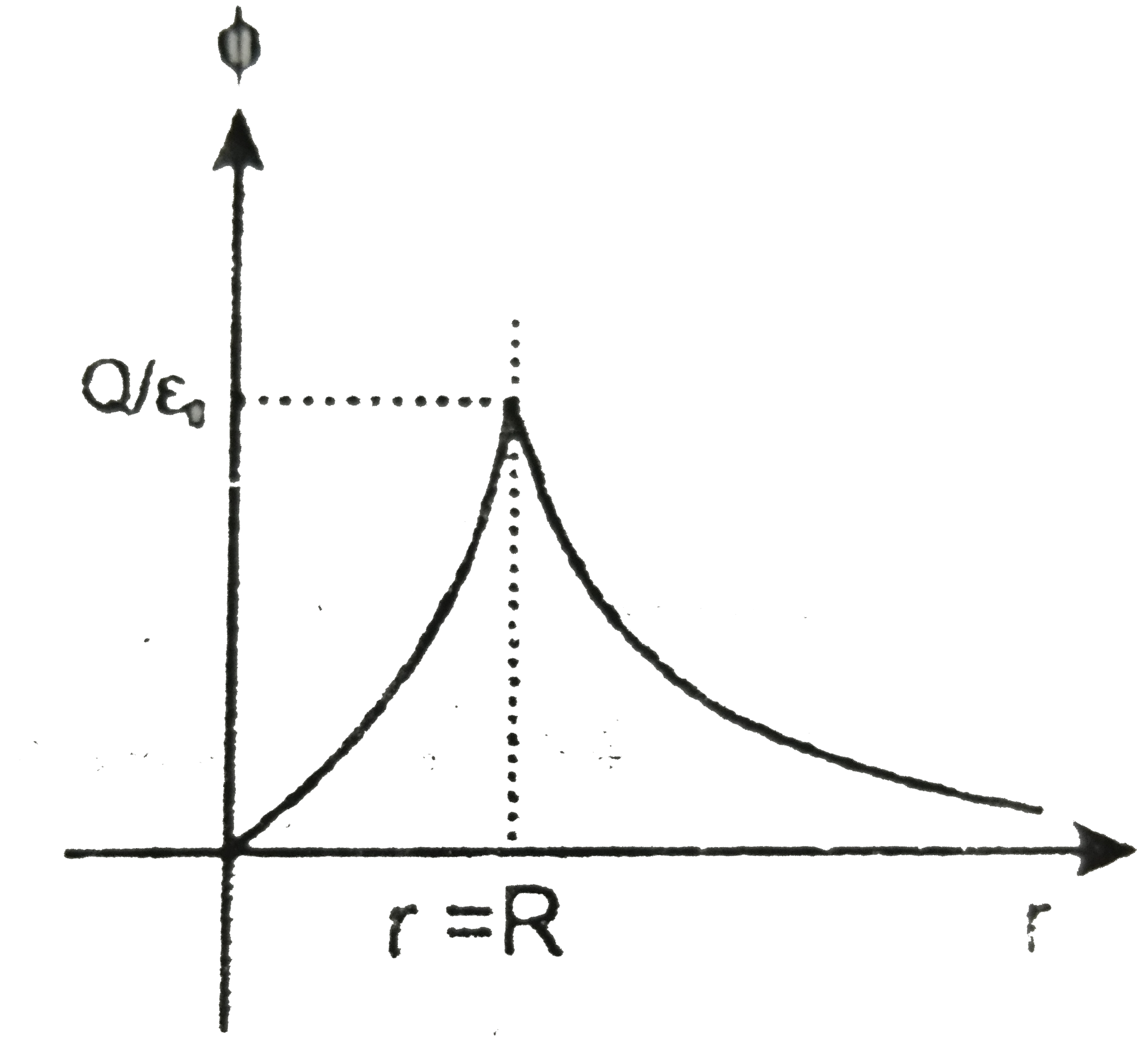
Flux `(ph)` as a function of distance `(r)` from centre of uniformly charged solid sphere of charge `Q` and radius `R`, is best represented by

A

B

C

D

(D)

Text Solution

AI Generated Solution

The correct Answer is:

To find the relationship between the electric flux (Φ) and the distance (r) from the center of a uniformly charged solid sphere of charge Q and radius R, we can use Gauss's Law. Let's go through the solution step by step: ### Step 1: Understanding Gauss's Law Gauss's Law states that the electric flux through a closed surface is equal to the charge enclosed (Q_enc) divided by the permittivity of free space (ε₀): \[ \Phi = \frac{Q_{\text{enc}}}{\epsilon_0} \] ### Step 2: Case 1 - Inside the Sphere (r < R) When we are inside the sphere (r < R), we need to find the charge enclosed (Q_enc) within a Gaussian surface of radius r. 1. The charge density (ρ) of the sphere can be calculated as: \[ \rho = \frac{Q}{\frac{4}{3}\pi R^3} \] 2. The volume of the Gaussian surface of radius r is: \[ V = \frac{4}{3}\pi r^3 \] 3. The charge enclosed (Q_enc) within this Gaussian surface is: \[ Q_{\text{enc}} = \rho \cdot V = \left(\frac{Q}{\frac{4}{3}\pi R^3}\right) \cdot \left(\frac{4}{3}\pi r^3\right) = Q \cdot \frac{r^3}{R^3} \] 4. Now, substituting Q_enc into Gauss's Law: \[ \Phi = \frac{Q \cdot \frac{r^3}{R^3}}{\epsilon_0} = \frac{Q}{\epsilon_0} \cdot \frac{r^3}{R^3} \] This shows that the flux (Φ) is proportional to \(r^3\) when \(r < R\). ### Step 3: Case 2 - Outside the Sphere (r ≥ R) When we are outside the sphere (r ≥ R), the entire charge Q is enclosed within the Gaussian surface. 1. The charge enclosed is simply Q. 2. Applying Gauss's Law: \[ \Phi = \frac{Q}{\epsilon_0} \] This indicates that the flux (Φ) is constant and does not depend on r when \(r \geq R\). ### Step 4: Summary of Results - For \(r < R\): \(\Phi \propto r^3\) - For \(r \geq R\): \(\Phi = \frac{Q}{\epsilon_0}\) (constant) ### Conclusion The relationship between the electric flux and the distance from the center of the uniformly charged solid sphere is best represented by a graph that shows: - A cubic relationship for \(r < R\) (increases as \(r^3\)) - A constant value for \(r \geq R\) Thus, the correct option is **C**. ---

To find the relationship between the electric flux (Φ) and the distance (r) from the center of a uniformly charged solid sphere of charge Q and radius R, we can use Gauss's Law. Let's go through the solution step by step: ### Step 1: Understanding Gauss's Law Gauss's Law states that the electric flux through a closed surface is equal to the charge enclosed (Q_enc) divided by the permittivity of free space (ε₀): \[ \Phi = \frac{Q_{\text{enc}}}{\epsilon_0} \] ...
Promotional Banner

Topper's Solved these Questions

  • TEST PAPERS

    RESONANCE ENGLISH|Exercise PART - II PHYSICS|106 Videos
  • SIMPLE HARMONIC MOTION

    RESONANCE ENGLISH|Exercise Advanced Level Problems|13 Videos
  • TEST SERIES

    RESONANCE ENGLISH|Exercise PHYSICS|130 Videos

Similar Questions

Explore conceptually related problems

Which graph best represents the variation of electric potential as a function of distance from the centre of a uniformly charged solid sphere of charge of radius R ?

Graph shows magnitude of electric field (E) , charge enclosed (q_("enclosed:)) within the concentic sphere and net flux (phi) through a concentric spherical Gaussian surface as a function of distance (r) from centre of a uniformly positive charged solid sphere of radius R. Choose the correct option (s):

The electrostatic potential of a uniformly charged thin spherical shell of charge Q and radius R at a distance r from the centre

The electric field intensity at a distance 20 cm from the centre of a uniformly charged non conducting solid sphere of radius 10 cm is E .Then what is the electric field intensity at a distance 5 cm from the centre it will be.....

A point charge of charge -q and mass m is released with negligible speed from a distance sqrt(3) R on the axis of a fixed uniformly charged ring of charge Q and radius R. Find out its velocity when it reaches it reaches at the centre of the ring.

Variation of electric potential due to npn-conducting (positively charged) solid sphere with distance from its centre is best represented as

A point charge Q is situated (outside) at a distance r from the centre of an uncharged conducting solid sphere of radius R. The potential due to induced charges (on the conductor) at a point B inside the conductor whose distance form the point charge is d is ______

A solid sphere of radius R is charged uniformly. The electrostatic potential V is plotted as a function of distance r from the centre of th sphere. Which of the following best represents the resulting curve?

The electric field due to uniformly charged sphere of radius R as a function of the distance from its centre is represented graphically by

STATEMENT 1: When a negative charge -q is released at a distance R from the centre and along the axis of a uniformly and positvely charged fixed ring of radius R, the negative charge does oscillation but not SHM. STATEMENT 2: The force on negative charge is always towards the centre of the ring but it is not proportional to the displacement from the centre of the ring.

RESONANCE ENGLISH-TEST PAPERS-PHYSICS
  1. The locus of the points (in the xy-plane) where the electric field due...

    Text Solution

    |

  2. Two equipotential spherical surface having potential 20V and 0V are as...

    Text Solution

    |

  3. Consider the four field patterns shown. Assuming there are no charge i...

    Text Solution

    |

  4. Flux (ph) as a function of distance (r) from centre of uniformly charg...

    Text Solution

    |

  5. A uniform electric field in positive x-direction on exists in space. A...

    Text Solution

    |

  6. A planet is made of two materials of density rho(1) and rho(2) as show...

    Text Solution

    |

  7. The potential energy function of a particle due to some gravitational ...

    Text Solution

    |

  8. A binary star has a time period 3 years (time period of earth is one y...

    Text Solution

    |

  9. Two planets A and B are revolving in circular orbits around a fixed su...

    Text Solution

    |

  10. An earth satellite is revolving in a circular orbit of radius a with v...

    Text Solution

    |

  11. The electric field in a region is radially outwards with magnitude E=a...

    Text Solution

    |

  12. A point charge Q is kept at point 'A' the flux through the inclined su...

    Text Solution

    |

  13. A sphere of radius R has a variable charge density rho(r)=rho(0)r^(n-1...

    Text Solution

    |

  14. If the electric field in a region is given as E=y^(2)hati+2xyhatj and ...

    Text Solution

    |

  15. The system of four point charges are arranged to be in equilibrium (se...

    Text Solution

    |

  16. A small block A of mass m=5kg and charge 2xx10^(-7)C is kept on a fixe...

    Text Solution

    |

  17. Two plane parallel conducting plates 1.5xx10^(-2)m apart are held hori...

    Text Solution

    |

  18. A small cork block of mass m=1kg having charge q=-1C placed on a rough...

    Text Solution

    |

  19. A 1kg ball is suspended in a uniform electric field with the help of a...

    Text Solution

    |

  20. Binary stars rotate under mutual gravitational force at separation 2(G...

    Text Solution

    |
