Home
Class 12
PHYSICS
Figure a) shows a spring of force consta...

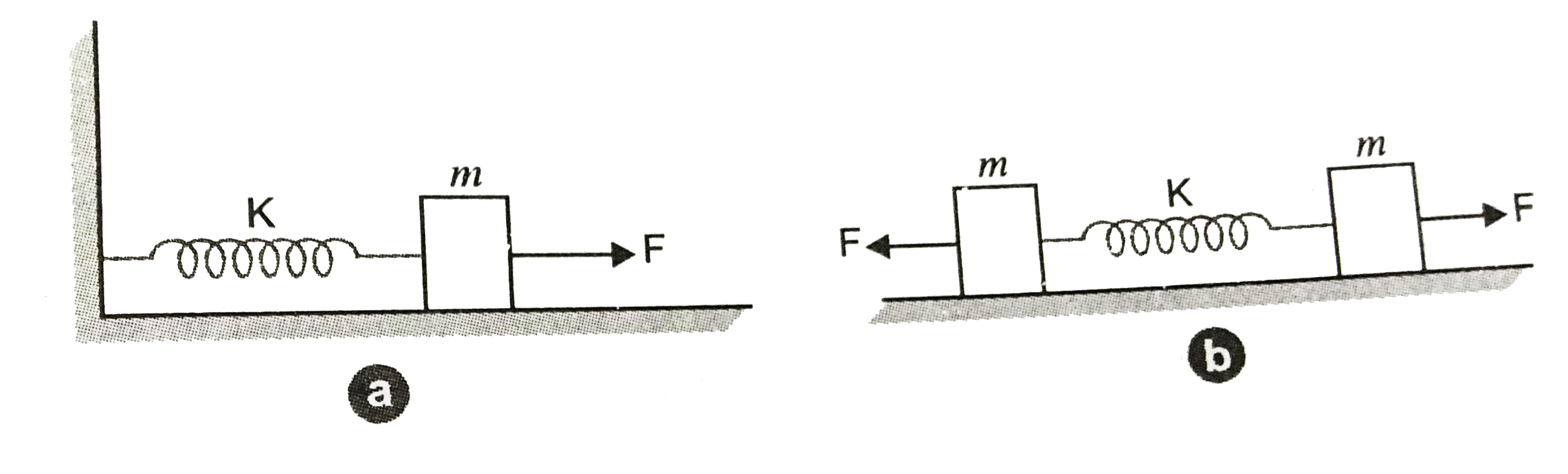
Figure a) shows a spring of force constant k clamped rigidly at once end and a mass m attached to its free end. A force F applied at the free end stretches the spring. Figure b) shows the same spring with both ends free and attached to a mass m at either end. Each end of the spring in figure is stretched by the same force F.
(a) What is the maximum extension of the spring in the two cases ?
(b) If the mass in figure and the two masses in figure are released free, what is the period of oscillation in each case?

Text Solution

Verified by Experts

The correct Answer is:

(a) Maximum extersion `= (F)/(K)` (for both cases)
(b) in fig. (a), `m` is the inertia factor and `k` is the spring factor.
`T = 2pisqrt(("inertia factor")/("spring factor"))` or `T = 2pisqrt((m)/(k))`
in Fig. (b), `m(d^(2)x_(1))/(dt^(2))=-kx` and `m(d^(2)x_(2))/(dt^(2)) = kx`
Change in length of spring `x = (x_(1) - x_(2))`
or `(d^(2)x)/(dt^(2)) = (d^(2))/(dt^(2)) (x_(1)-x_(2))` [Note that `I` is constant]
or `m(d^(2)x)/(dt^(2)) + 2kx = 0`
or `(d^(2)x)/(dt^(2)) + (2k)/(m)x = 0` or `(d^(2)x)/(dt^(2)) + omega^(2) = 0`
or `omega = sqrt((2k)/(m)) rArr T = (2pi)/(omega) = 2pisqrt((m)/(2k))`
Alternate : Reduced mass of the given two-boy system.
`mu = (m xx m)/(m + m) = (m^(2))/(2m) = (m)/(2)`
inertia factor `= (m)/(2)` and spring factor `= k`
`:.` Time period , `T = 2pisqrt((m//2)/(k)) = 2pisqrt((m)/(2k))`
Promotional Banner

Topper's Solved these Questions

  • SIMPLE HARMONIC MOTION

    RESONANCE ENGLISH|Exercise Exercise- 1, PART - I|25 Videos
  • SIMPLE HARMONIC MOTION

    RESONANCE ENGLISH|Exercise Exercise- 1, PART - II|36 Videos
  • SIMPLE HARMONIC MOTION

    RESONANCE ENGLISH|Exercise Solved Miscellaneous Problems|9 Videos
  • SEMICONDUCTORS

    RESONANCE ENGLISH|Exercise Exercise 3|88 Videos
  • TEST PAPERS

    RESONANCE ENGLISH|Exercise PHYSICS|784 Videos

Similar Questions

Explore conceptually related problems

Figure. (a) shows a spring of force constant k fixed at one end and carrying a mass m at the other end placed on a horizontal frictionless surface. The spring is stretched by a force F. Figure. (b) shows the same spring with both endsf free and a mass m fixed at each free end Each of the spring is streched by the same force F. The mass in case (a) and the masses in case (b) are then released. Which of the following statements are true?

A spring with one end attached to a mass and the other to a right support is stretched and released

An ideal spring with spring constant k is hung from the ceiling and a block of mass M is attached to its lower end. The mass is released with the spring initially unstretched. Then the maximum extension in the spring is

An ideal spring with spring constant k is hung from the ceiling and a block of mass M is attached to its lower end. The mass is released with the spring initially unstretched. Then the maximum extension in the spring is

A spring is stretched by applying a load to its free end. The strain produced in the spring is

A spring is stretched by applying a load to its free end. The strain produced in the spring is

Figure shows tow cases. In first case a spring (spring constant K) is pulled by two equal and opposite forces F at both ends and in second case is pulled by a force F at one end. Extensions (x) in the springs will be

Two springs have force constants k_(A) such that k_(B)=2k_(A) . The four ends of the springs are stretched by the same force. If energy stored in spring A is E , then energy stored in spring B is

When two spring balances joined at their free ends, are pulled apart, both show the same reading. Explain.

Two springs have their force constants in the ratio of 3:4 . Both the springs are stretched by applying equal force F. If elongation in first spring is x then elogation is second spring is

RESONANCE ENGLISH-SIMPLE HARMONIC MOTION -Board Level Exercise
  1. Define amplitude of S.H.M. ?

    Text Solution

    |

  2. Why the motion of a satellite around a planet cannot be taken as S.H.M...

    Text Solution

    |

  3. Is oscillation of a mass suspended by a spring simple harmonic ?

    Text Solution

    |

  4. Which of the following examples represents (nearby) shm and which repr...

    Text Solution

    |

  5. Fill in the blanks using appropriate word from the list at the end of ...

    Text Solution

    |

  6. A restoring force is a must for a body to execute S.H.M Explain, why

    Text Solution

    |

  7. A man is standing on a platform moving up and down as a S.H.M. will th...

    Text Solution

    |

  8. An air chamber of volume V has a neck area of cross section A into whi...

    Text Solution

    |

  9. Show that for a particle in linear SHM the average kinetic energy over...

    Text Solution

    |

  10. A man with a wrist watch on his hand falls from the top of a tower. Do...

    Text Solution

    |

  11. Time period of a particle in shm depends on the force constant k and m...

    Text Solution

    |

  12. Figure a) shows a spring of force constant k clamped rigidly at once e...

    Text Solution

    |

  13. (a) Define simple harmonic motion and derive, an expression for the pe...

    Text Solution

    |

  14. Answer the following question What is the inverse of frequency of osc...

    Text Solution

    |

  15. A simple pendulum of length L and having a bob of mass m is suspended ...

    Text Solution

    |

  16. Define resonance and resonance energy. What are the conditions for res...

    Text Solution

    |

  17. Explain damped harmonic oscillation and the equation of such oscillati...

    Text Solution

    |

  18. Explain damped harmonic oscillation and the equation of such oscillati...

    Text Solution

    |

  19. Write the expression for equivalent spring constant of (i) parallel ...

    Text Solution

    |

  20. Find equivalent spring constant for the system:

    Text Solution

    |
