Home
Class 12
PHYSICS
The right block in figure moces at a spe...

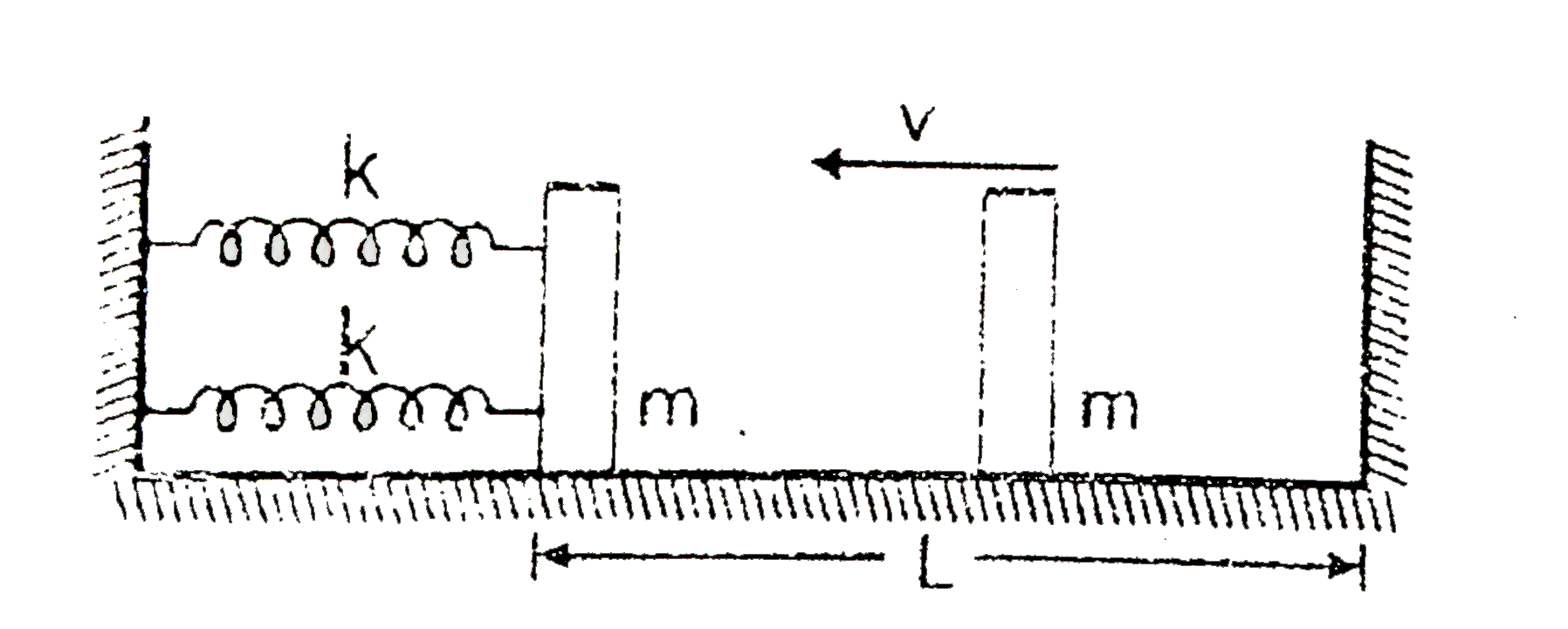
The right block in figure moces at a speed `V` towards the left block placed in equilibrium. All the surfaces are smooth and all the collisions are elastic. Find the time period motion. Neglect the width of the blocks.

A

`pisqrt((m)/(2k)) + (2L)/(v)`

B

`pisqrt((m)/(2k)) + (L)/(v)`

C

`pisqrt((m)/(2k)) - (L)/(v)`

D

`pisqrt((m)/(k)) + (L)/(v)`

Text Solution

Verified by Experts

The correct Answer is:
A

since all collision are elestic and total energy is conserved
Time period of motion of right block is `t_(1) = (2L)/(v)`.
Time period of motion of left block is `t_(2) = (1)/(2)2pisqrt((m)/(2k))`
So. Total time period `= (2L)/(v) + (1)/(2) [2pisqrt((m)/(2k))]`
Promotional Banner

Topper's Solved these Questions

  • SIMPLE HARMONIC MOTION

    RESONANCE ENGLISH|Exercise Exercise- 2, PART - II|1 Videos
  • SIMPLE HARMONIC MOTION

    RESONANCE ENGLISH|Exercise Exercise- 2, PART - III|12 Videos
  • SIMPLE HARMONIC MOTION

    RESONANCE ENGLISH|Exercise Exercise- 1, PART - II|36 Videos
  • SEMICONDUCTORS

    RESONANCE ENGLISH|Exercise Exercise 3|88 Videos
  • TEST PAPERS

    RESONANCE ENGLISH|Exercise PHYSICS|784 Videos

Similar Questions

Explore conceptually related problems

The left block in figure moves at a speed v towards the right block placed in equilibrium. All collisions to take place are elastic and the surfaces are frictionless. Show that motion of the two blocks are periodic. Find the time period of these periodic motions. Neglect the widths of the blocks.

A block is released from point A as shown in figure .All surfaces are smooth and there is no loss of mechnical energy anywhere. Find the time period of oscillation of block.

All surface are smooth in following figure. Find F , such that block remain stationary with respect to wedge.

Infinite blocks each of mass M are placed along a straight line with a distance d between each of them. At t = 0 the leftmost block is given a velocity V towards right. The coefficient of frication between any block and the surface is mu and all collisions are elastic. Let the total number of collisions be N then N is

The spring shown in figure is unstretched when a man starts pulling on the cord. The mass of the block is M . If the man exerts a constant force F , find (a) the amplitude and the time period of the motion of the block, (b) the energy stored in the spring when the block passes through the equilibrium position and (c) the kinetic energy of the block at this position.

The spring shown in figure is unstretched when a man starts pulling on the cord. The mass of the block is M . If the man exerts a constant force F , find (a) the amplitude and the time period of the motion of the block, (b) the energy stored in the spring when the block passes through the equilibrium position and (c) the kinetic energy of the block at this position.

In the figure, the block of mass m, attached to the spring of stiffness k is in correct with the completely elastic wall, and the compression in the spring is e. The spring is compressed further by e by displacing the block towards left and is then released. If the collision between the block and the wall is completely eleastic then the time period of oscillation of the block will be

All surfaces are smooth. Find the horizontal displacements of the block and wedge when the block slides down from top to bottom.

A small block oscillates back and forth on as smooth concave surface of radius R in figure. Find the time period of small oscillation.

In the adjoining figure, block A is of mass (m) and block B is of mass 2m. The spring has force constant k. All the surfaces are smooth and the system is released form rest with spring unstretched. Find the maximum extension in the spring and acceleration of block B at time of maximum extension .

RESONANCE ENGLISH-SIMPLE HARMONIC MOTION -Exercise- 2, PART - I
  1. Two discs, each having mass m, are attached rigidly to the ends of a v...

    Text Solution

    |

  2. Two springs, each of spring constant k, are attached to a block of mas...

    Text Solution

    |

  3. The right block in figure moces at a speed V towards the left block pl...

    Text Solution

    |

  4. The bob of a simple pendulum of length L is released at time t = 0 fro...

    Text Solution

    |

  5. The period of small oscillations of a simple pendulum of length l if i...

    Text Solution

    |

  6. A simple pendulum , a physical pendulum, a torsional pendulum and a sp...

    Text Solution

    |

  7. A rod of mass M and length L is hinged at its one end and carries a pa...

    Text Solution

    |

  8. A particle moves on the X-axis according to the equation x=x0 sin^2ome...

    Text Solution

    |

  9. The amplitide of a particle due to superposition of following S.H.Ms. ...

    Text Solution

    |

  10. Two particles P and Q describe S.H.M. of same amplitude a, same freque...

    Text Solution

    |

  11. A street car moves rectilinearly from station A to the next station B ...

    Text Solution

    |

  12. A particle is oscillating in a stright line about a centre of force O,...

    Text Solution

    |

  13. Assuming all the surfaces to be smoth, if the time period of motion of...

    Text Solution

    |

  14. A particle of mass m is attached with three springs A,B and C of equal...

    Text Solution

    |

  15. In the figure shown mass 2m is at rest and in equilibrium. A particle ...

    Text Solution

    |

  16. For given spring mass system, if the time period of small oscillations...

    Text Solution

    |

  17. For the arrangement shown in figure, the spring is initially compresse...

    Text Solution

    |

  18. A 1kg block is executing simple harmonic motion of amplitude 0.1 m on ...

    Text Solution

    |

  19. The period of oscillation of a simple pendulum of length L suspended f...

    Text Solution

    |

  20. Figure shown the kinetic energy K of a pendulum versus. its angle thet...

    Text Solution

    |

