Home
Class 12
PHYSICS
In the figure shown mass 2m is at rest a...

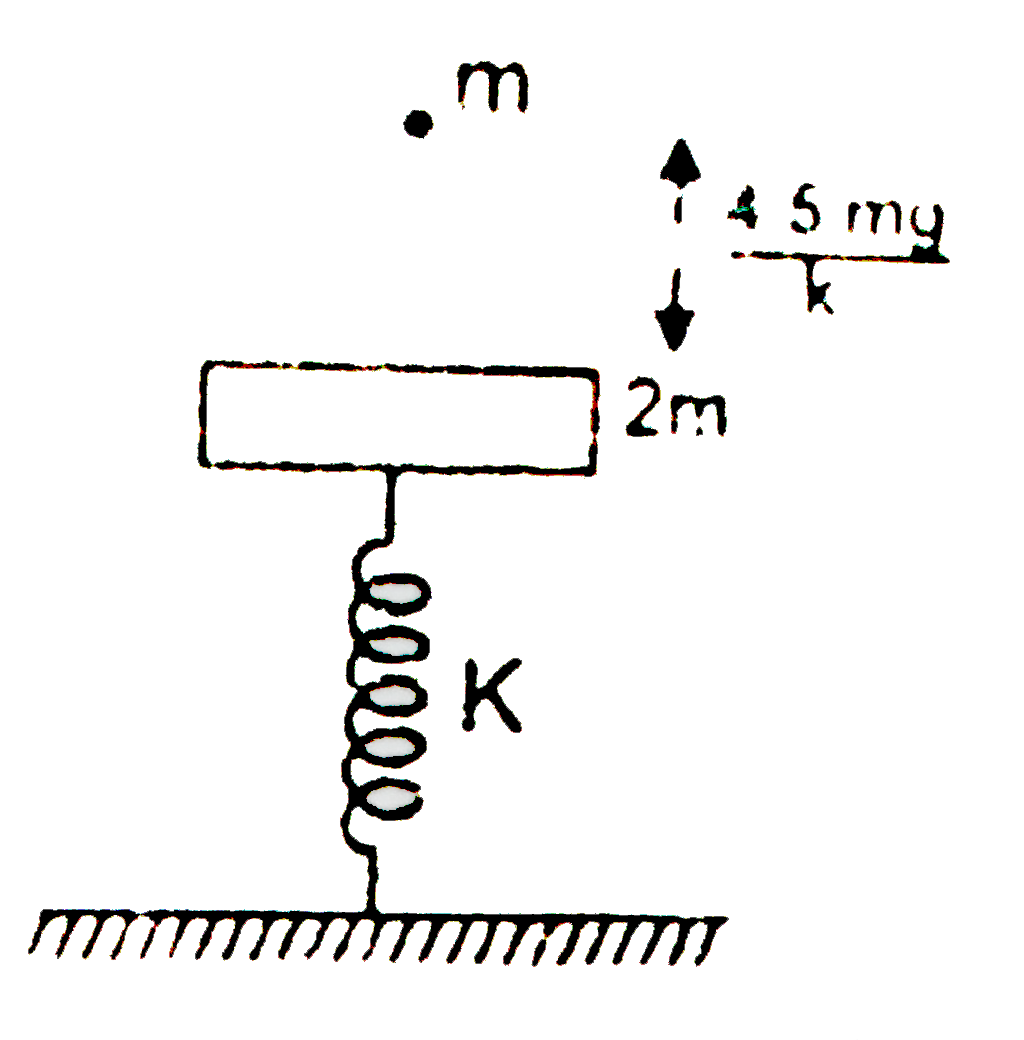
In the figure shown mass `2m` is at rest and in equilibrium. A particle of mass `m` is released from height `(4.5mg)/(k)` from plate. The particle sticks to the plate. Neglecting the duration of collision. Starting from the when the particles sticks to plate to the time when the spring is in maximum compression for the first time is `2pisqrt((m)/(ak))` then find `a`.

Text Solution

Verified by Experts

The correct Answer is:
3

Velocity of the narticle just before collision
`u = sqrt(2g xx (4.5 mg)/(K))`
`u = 3gsqrt((m)/(K))`
Now it collides with the plate.
Now just after collision velocity of systeam of plate `+` particle
`mu = 3mv`
`rArr V = (u)/(3) = gsqrt((m)/(K))`
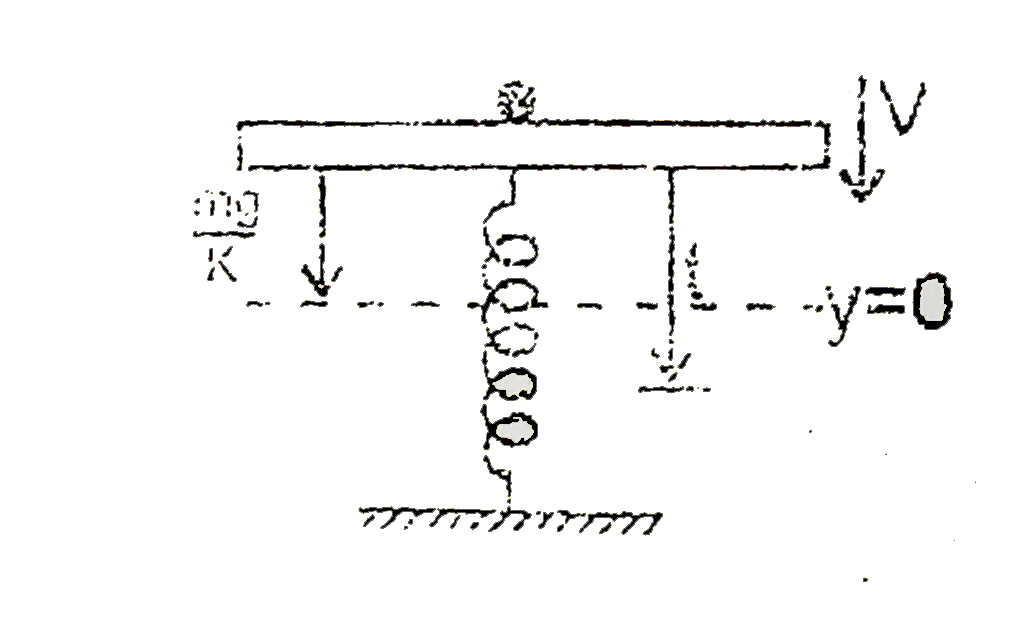
Now system perform 's `SHM` with time period `T = 2pisqrt((3m)/(K))`and mean position as `(mg)/(K)` distance below the point of collision.
Let the equation of motion be.
`y = A sin(omegat + phi)`
for `t = 0 y = ng//K`
`(mg)/(K) = Asinphi ....(1)`
Now for amplitude
`V = omegasqrt(A^(2) - x^(2))`
`gsqrt((m)/(K)) = sqrt((K)/(3m)) sqrt(A^(2) - (m^(2)g^(2))/(K^(2))) , (sqrt(3)(mg)/(K))^(2) = A^(2) -(m^(2)g^(2))/(K^(2))`
`A = (2mg)/(K) ....(2)`
By `(1)` & `(2)`
`T = 2pisqrt((3m)/(K))`
`X = (A)/(2)` to `x = 0 rArr t = (T)/(12)`
`x = 0` to `x = A rArr t = T//4`
total time `= (T)/(12) + (T)/(4) = (2pi)/(3)sqrt((3m)/(K)) = 2pisqrt((m)/(3k)) :. a = 3`
Promotional Banner

Topper's Solved these Questions

  • SIMPLE HARMONIC MOTION

    RESONANCE ENGLISH|Exercise Exercise- 2, PART - II|1 Videos
  • SIMPLE HARMONIC MOTION

    RESONANCE ENGLISH|Exercise Exercise- 2, PART - III|12 Videos
  • SIMPLE HARMONIC MOTION

    RESONANCE ENGLISH|Exercise Exercise- 1, PART - II|36 Videos
  • SEMICONDUCTORS

    RESONANCE ENGLISH|Exercise Exercise 3|88 Videos
  • TEST PAPERS

    RESONANCE ENGLISH|Exercise PHYSICS|784 Videos

Similar Questions

Explore conceptually related problems

In the figure shown, mass 2m connected with a spring of force constant k is at rest and in equilibrium. A particle of mass m is released from height 4.5 mg//k from 2m . The particle stick to the block. Neglecting the duration of collision find time from the release of m to the moment when the spring has maximum compression.

In the figure shown, mass 2m connected with a spring of force constant k is at rest and in equilibrium. A partical of mass m is released from height 4.5 mg//k from 2m . The partical stick to the block. Neglecting the duration of collision find time from the release of m to the moment when the spring has maximum compression.

A particle starts from rest. Its acceleration is varying with time as shown in the figure. When the particle comes to rest, its distance from its starting point is

A particle of mass m and charge q is released from rest in uniform electric field of intensity E. Calculate the kinetic energy it attains after moving a distance y between the plates.

In an ideal pulley particle system, mass m_2 is connected with a vertical spring of stiffness k . If mass m_2 is released from rest, when the spring is underformed, find the maximum compression of the spring.

A particle of mass m is released from rest and follow a particle part as shown Assuming that the displacement of the mass from the origin is small which graph correctly depicts the position of the particle as a function of time?

A point particle of mass m is released from a distance sqrt(3)R along the axis of a fixed ring of mass M and radius R as shown in figure. Find the speed of particle as it passes through the centre of the ring.

A block of mass m is released from a height h from the top of a smooth surface. There is an ideal spring of spring constant k at the bottom of the track. Find the maximum compression in the spring (Wedge is fixed)

A particle of mass m is driven by a machine that delivers a constant power k watts. If the particle starts from rest the force on the particle at time t is

A particle of mass M starting from rest undergoes uniform acceleration. If the speed acquired in time T is V, the power delivered to the particle is -

RESONANCE ENGLISH-SIMPLE HARMONIC MOTION -Exercise- 2, PART - I
  1. The bob of a simple pendulum of length L is released at time t = 0 fro...

    Text Solution

    |

  2. The period of small oscillations of a simple pendulum of length l if i...

    Text Solution

    |

  3. A simple pendulum , a physical pendulum, a torsional pendulum and a sp...

    Text Solution

    |

  4. A rod of mass M and length L is hinged at its one end and carries a pa...

    Text Solution

    |

  5. A particle moves on the X-axis according to the equation x=x0 sin^2ome...

    Text Solution

    |

  6. The amplitide of a particle due to superposition of following S.H.Ms. ...

    Text Solution

    |

  7. Two particles P and Q describe S.H.M. of same amplitude a, same freque...

    Text Solution

    |

  8. A street car moves rectilinearly from station A to the next station B ...

    Text Solution

    |

  9. A particle is oscillating in a stright line about a centre of force O,...

    Text Solution

    |

  10. Assuming all the surfaces to be smoth, if the time period of motion of...

    Text Solution

    |

  11. A particle of mass m is attached with three springs A,B and C of equal...

    Text Solution

    |

  12. In the figure shown mass 2m is at rest and in equilibrium. A particle ...

    Text Solution

    |

  13. For given spring mass system, if the time period of small oscillations...

    Text Solution

    |

  14. For the arrangement shown in figure, the spring is initially compresse...

    Text Solution

    |

  15. A 1kg block is executing simple harmonic motion of amplitude 0.1 m on ...

    Text Solution

    |

  16. The period of oscillation of a simple pendulum of length L suspended f...

    Text Solution

    |

  17. Figure shown the kinetic energy K of a pendulum versus. its angle thet...

    Text Solution

    |

  18. The bob of a simple pendulum executes SHM in water with a period t. Th...

    Text Solution

    |

  19. A solid sphere of radius R is floating in a liquid of density sigma wi...

    Text Solution

    |

  20. If the angular frequency of small oscillations of a thin uniform verti...

    Text Solution

    |

