Home
Class 12
PHYSICS
Rate of increment of energy in an induct...

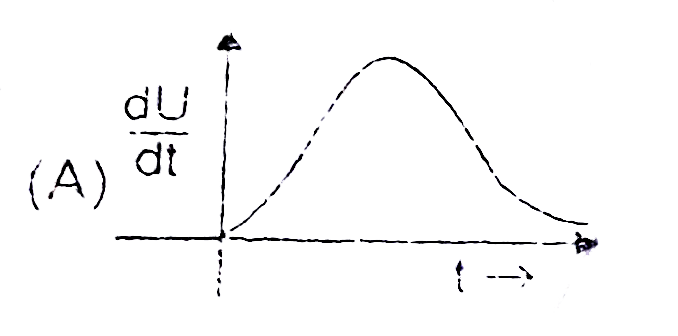
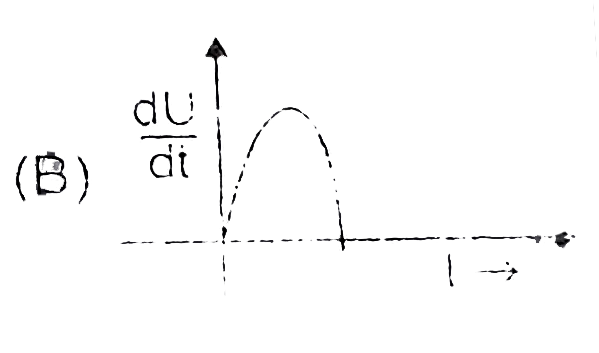
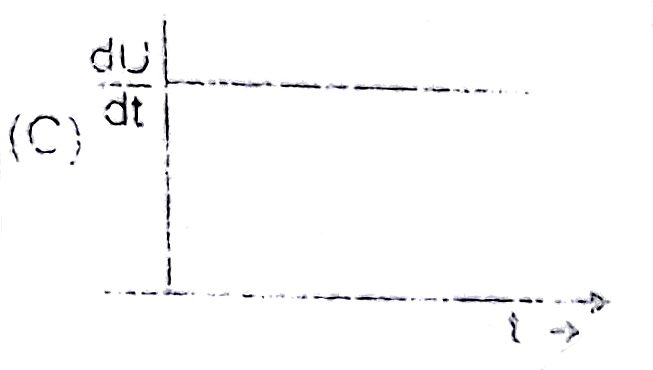
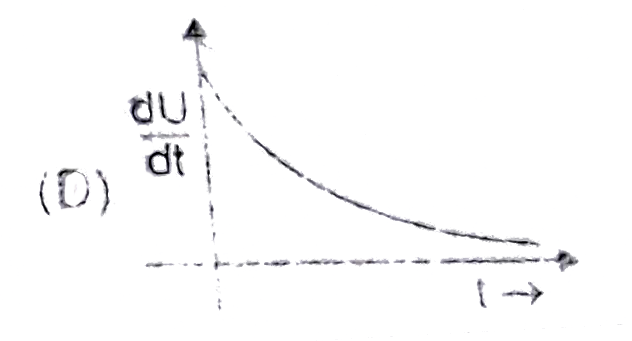
Rate of increment of energy in an inductor with time in series RL circuit getting charged with battery of EMF Eis best represented by:

A

B

C

D

Text Solution

Verified by Experts

The correct Answer is:
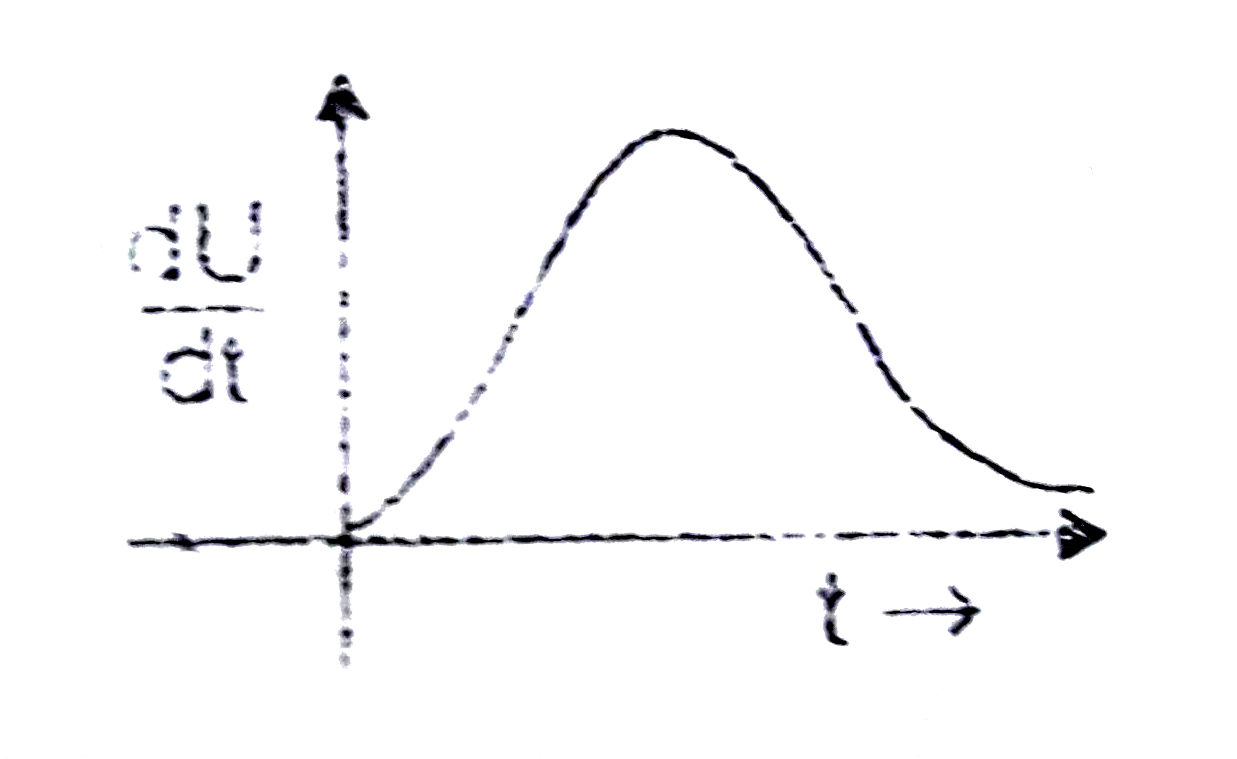
A

Rate of increment of energy in inductor =`(dU)/(dt)=d/(dt)(1/2Li^(2))=Li(di)/(dt)`
Current in the inductor at time `t` is:`i=i_(0)(1-e^(-t/tau))` and `(di)/(dt)=i_(0)/taue^(-t/tau)`
`(dU)/(dt)=(Li_(0))/tau e^(-t/tau)(1-e^(-t/tau))`
`(dU)/(dt)=0` at `t=0` and `t=oo`
Hence `E` is best represented by:
Promotional Banner

Topper's Solved these Questions

  • ELECTROMAGNETIC INDUCTION

    RESONANCE ENGLISH|Exercise Exercis-2 PART 2|17 Videos
  • ELECTROMAGNETIC INDUCTION

    RESONANCE ENGLISH|Exercise Exercis-2 PART 3|10 Videos
  • ELECTROMAGNETIC INDUCTION

    RESONANCE ENGLISH|Exercise Exercis-1 PART 2|51 Videos
  • ELECTRODYNAMICS

    RESONANCE ENGLISH|Exercise Advanced level problems|31 Videos
  • ELECTROSTATICS

    RESONANCE ENGLISH|Exercise HLP|40 Videos

Similar Questions

Explore conceptually related problems

When a battery is connected across a series combination of self inductance L and resistance R , the variation in the current i with time t is best represented by

As shown in the figure, a battery of emf is connected to an inductor L and resistance R in series. The switch is closed at . The total charge that flows from the battery, between t=t_e and t=2t_e ( t_e is the time constant of the circuit) is:

A constant current exists in an inductor coil connected to a battery. The coil is short circuited and the battery is removed. Show that the charge flown through the coil after the short circuiting is the same as that which flows in one time constant before the short circuiting.

In an LR circuit connected to a battery, the rate at which energy is stored in the inductor is plotted against time during the growth of current in the circuit. Which of the following best represents the resulting curve?

Consider the RL circuit in Fig. When the switch is closed in position 1 and opens in position 2 , electrical work must be performed on the inductor and on the resistor. The energy stored in the inductor is for the resistor energy appears as heat. a. What is the ratio of P_(L)//P_(R ) of the rate at which energy is stored in the inductor to the rate at which energy is dissipated in the resistor? b. Express the ratio P_(L)//P_(R ) as a function of time. c. If the time constant of circuit is t , what is the time at which P_(L) = P_(R ) ?

As shown in the figur a battery of emf in is conneced to an inductor L and resistance R in series . The swith is closed at t =0 . The total charge that flows form the battery between t 0 and t= t_(c) ( t_(c) is the time constant of the circuit )is :

As shown in the figure, a battery of emf epsilon is connected to an inductor L and resistance R in series. The switch is closed at t=0 . The total charge that flows from the battery, between t=t_e and t=2t_e ( t_e is the time constant of the circuit) is:

An inductor (L =20 mH) , a resistor ( R = 100 Omega) and a battery (epsilon = 10 V) are connected in series. After along time the circuit is short- circuited and then the battery is disconnected. Find the current in the circuit 1ms after short- circuiting.

A 1.5 mu F capacitor is charged to 20 V. The charging battery is then disconnected , and a 15 mH coil is connected in series with the capacitor so that LC oscillations occur. Write the equation for variation of charge on capacitor and current in the inductor with time taking the instant at which inductor is connected to the capacitor as t=0.

A 1.5 mu f capacitor is charged to 20 V. The charging battery is then disconnected and a 15 mH coil is connected in series with the capacitance so that LC oscillations occur. Write the equation for variation of charge on capacitor and current in the inductor with time taking at the instant at which inductor is connected to the capacitor at t = 0

