Home
Class 12
PHYSICS
A copper wire ab of length l, resistance...

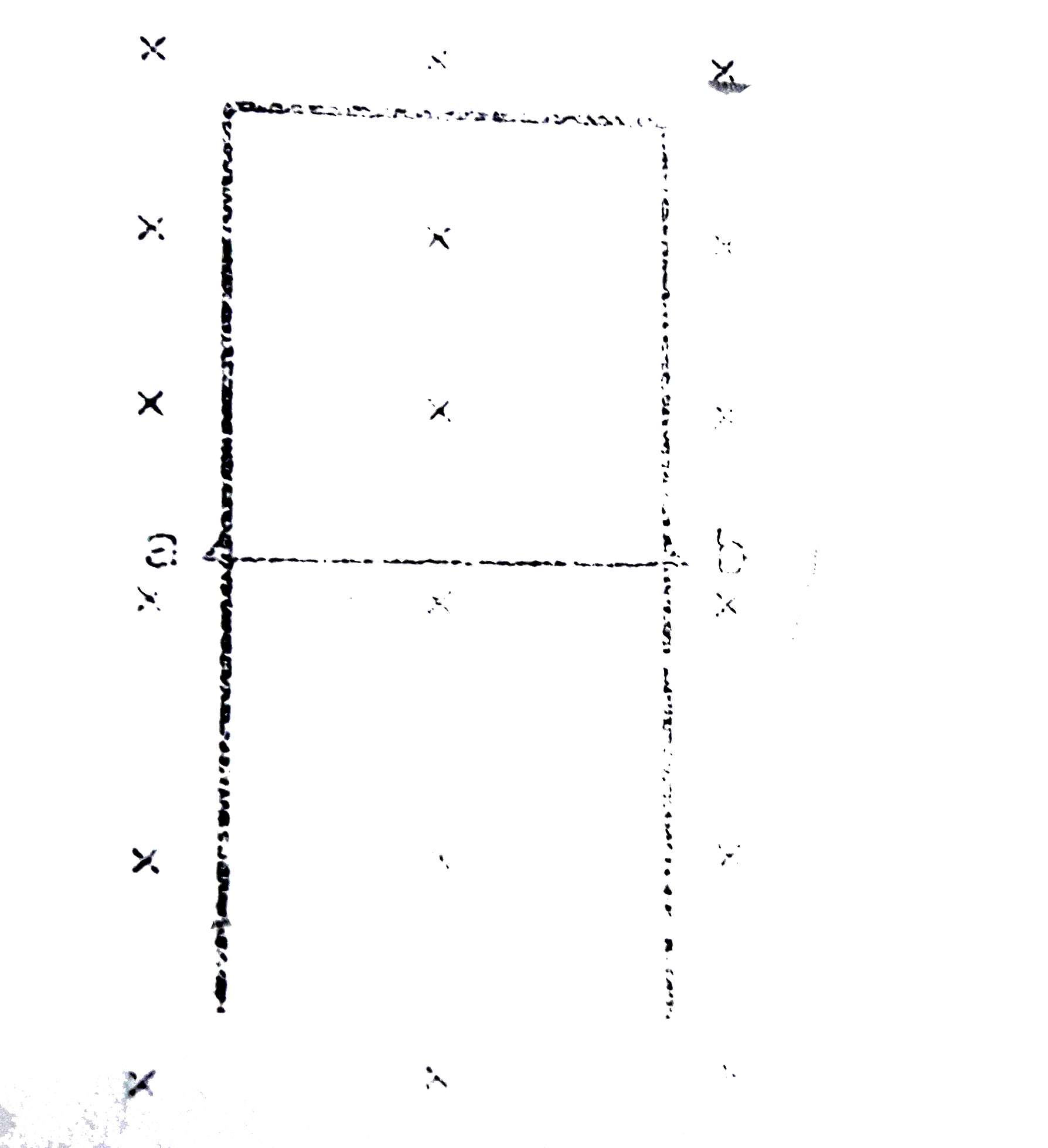
A copper wire `ab` of length `l`, resistance `r` and mass `m` starts sliding at `t=0` down a smooth, vertical, thick pair of connected condcuting rails as shown in figure.A uniform magnetic field `B` exists in the space in a direction perpendicular to the plane of the rails which options are correct.

A

The magnitude and direction of the induced current in the wire when speed of the wire `v` is `(vBl)/r`, `a` to b

B

The downward acceleration of the wire at this instant `g-(B^(2)l^(2))/(mr)v`.

C

The velocity of the wire as a function of time `v_(m)(1-e^(-"gt"//v_(m)))`(where `v_(m)=(mgr)/(B^(2)l^(2)))`

D

The displacement of the wire as a function of time `v_(m)t-v_(m)^(2)/"g" (1-e^(-"gt"//v_(m)))`(where `v_(m)=(mgr)/(B^(2)l^(2)))`

Text Solution

Verified by Experts

The correct Answer is:

A, B, C, D

(A)`i=(BvL)/r(a "to"b)` , (B)`mg-(B^(2)l^(2)v)/r=m(dv)/(dt) therefore "acc"^(n)=(dv)/(dt)=g-(B^(2)l^(2)v)/(mr)`
`mg-Bil=(Bl(Bv_(m)l))/r,v_(m)=(mgr)/(B^(2)l^(2))`
( C)` underset(0)overset(v)int(bv)/(g-(B^(2)l^(2)v)/(mr))=underset(0)overset(t)int(bt) therefore v=v_(m)(1-e^((-"gt")/v_(m)))` (D) `(ds)/(dt)=v underset(0)overset(s)intds=underset(0)overset(t)intv_(m)(1-e^((-"gt")/v_(m)))dt`
`s=v_(m)t-(1-e^((-"gt")/v_(m))) rArr ` (g) Heat produced per sec=`i^(2)r=((B^(2)V_(m)^(2)l^(2))/r^(2))r=mgv_(m)`
Promotional Banner

Topper's Solved these Questions

  • ELECTROMAGNETIC INDUCTION

    RESONANCE ENGLISH|Exercise Exercis-2 PART 4|6 Videos
  • ELECTROMAGNETIC INDUCTION

    RESONANCE ENGLISH|Exercise Exercis-3 PART 1|18 Videos
  • ELECTROMAGNETIC INDUCTION

    RESONANCE ENGLISH|Exercise Exercis-2 PART 2|17 Videos
  • ELECTRODYNAMICS

    RESONANCE ENGLISH|Exercise Advanced level problems|31 Videos
  • ELECTROSTATICS

    RESONANCE ENGLISH|Exercise HLP|40 Videos

Similar Questions

Explore conceptually related problems

A conducting wire xy of lentgh l and mass m is sliding without friction on vertical conduction rails ab and cd as shown in figure. A uniform magnetic field B exists perpendicular to the plane of the rails, x moves with a constant velocity of

A conducting wire xy of lentgh l and mass m is sliding without friction on vertical conduction rails ab and cd as shown in figure. A uniform magnetic field B exists perpendicular to the plane of the rails, x moves with a constant velocity of

Figure shows a wire sliding on two parallel, conducting rails placed at a separation L . A magnetic field B exists in a direction perpendicular to the plane of the rails. What force is necessary to keep the wire moving at a constant velocity V ?

Shows a wire sliding on two parallel, conducting rails placed at a separaton l. A magnetic feld B exists in a direction perpendicular to the plane of the rails. What force is necessary to keep the wire moving at a constatn velocity v ?

A wire cd of length l and mass m is sliding without friction on conducting rails ax and by as shown. The verticle rails are connected to each other with a resistance R between a and b . A uniform magnetic field B is applied perpendicular to the plane abcd such that cd moves with a constant velocity of

Two parallel long smooth conducting rails separated by a distance l are connected by a movable conducting connector of mass m . Terminals of the rails are connected by the resistor R and the capacitor C as shown in figure. A uniform magnetic field B perpendicular to the plane of the rail is switched on. The connector is dragged by a constant force F . Find the speed of the connector as a function of time if the force F is applied at t = 0 . Also find the terminal velocity of the connector.

A wire carrying current l, bent in the form of a quarter circle is held at rest on a smooth table with two threads as shown. A uniform magnetic field exists in the region direction into the plane select the correct alternatives

A conducting light string is wound on the rim of a metal ring of radius r and mass m . The free end of the string is fixed to the ceiling. A vertical infinite smooth conducting plane is always tangent to the ring as shown in the figure. A uniform magnetic field Bis applied perpendicular to the plane of the ring. The ring is always inside the magnetic field. The plane and the strip are connected by a resistance R . When the ring is released, find a. the curent in the resistance R as as function of time. b. the terminal velocity of the ring.

A wire of mass m and length l can slide freely on a pair of fixed, smooth.vertical rails (figure).A magnetic field B exists in the region in the direction perpendicular to the plane of the rails.The rails are connected at the top end by an initially unchanged capacitor of capacitance C .Find the velocity of the wire at any time (t) after released.Neglecting any electric resistance.(initial velocity of wire is zero)

Figure shows a wire of resistance R sliding on two parallel, conducting fixed thick rails placed at a separation l. A magnetic fild B exist in a direction perpendicular to the plane of the rails. The wire is moving with a constant velocity v. Find current through the wire
