Home
Class 12
PHYSICS
A 0.5m long metal rod PQ completes the ...

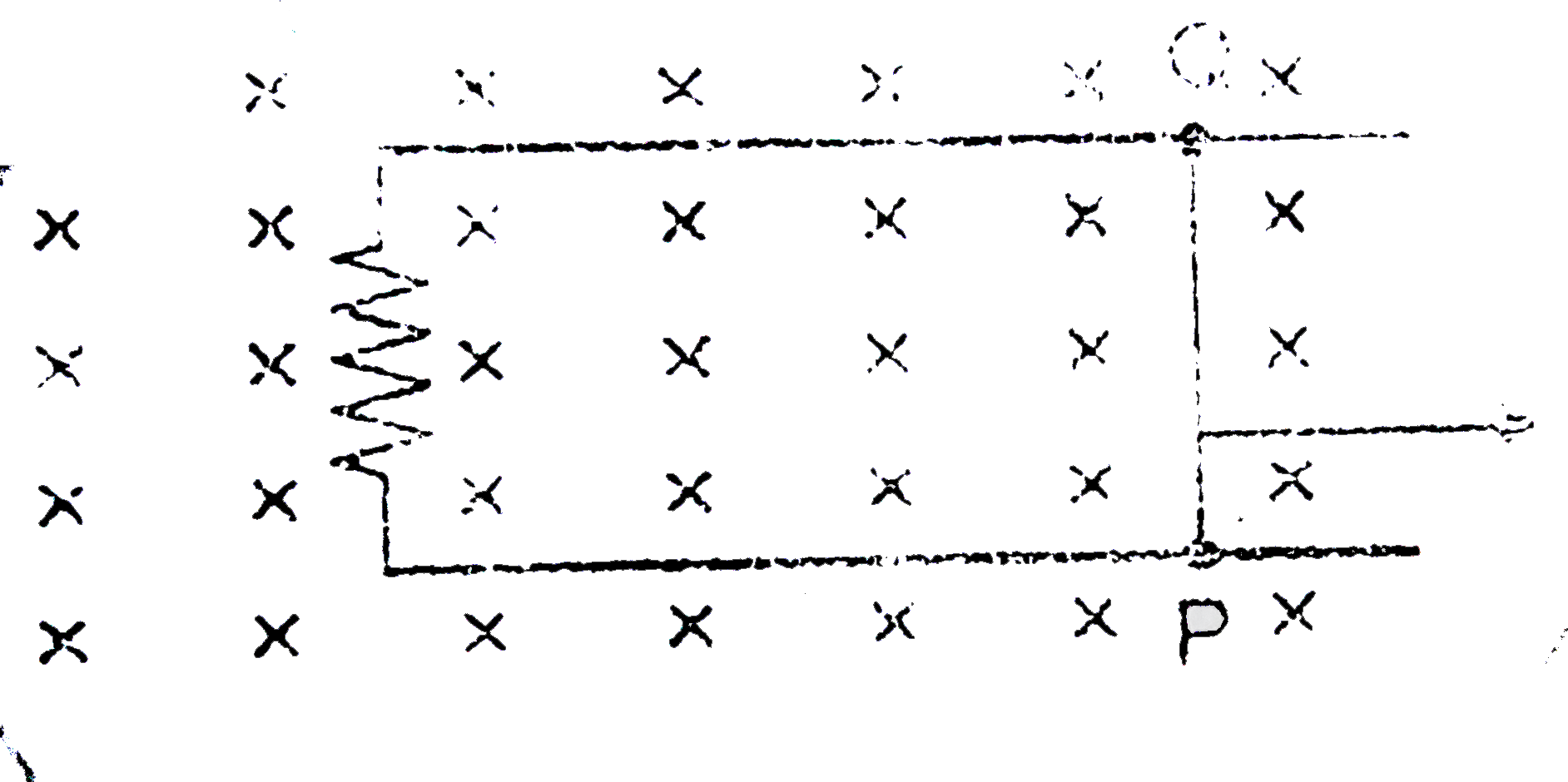
A `0.5m` long metal rod `PQ` completes the circuit as shown in the figure. The area of the circuit is perpendicular to the magnetic field of flux density `0.15 T`. If the resistance of the total circuit is `3Omega` calculate the force needed to move the rod in the direction as indicated with a constant speed of `2 ms^(-1)`

Text Solution

Verified by Experts

`F=(B^(2)L^(2)v)/R=((0.15)^(2)(0.5)^(2)xx2)/3=0.00375 N`
Promotional Banner

Topper's Solved these Questions

  • ELECTROMAGNETIC INDUCTION

    RESONANCE ENGLISH|Exercise A.l.P|19 Videos
  • ELECTROMAGNETIC INDUCTION

    RESONANCE ENGLISH|Exercise Exercis-3 PART 2|16 Videos
  • ELECTRODYNAMICS

    RESONANCE ENGLISH|Exercise Advanced level problems|31 Videos
  • ELECTROSTATICS

    RESONANCE ENGLISH|Exercise HLP|40 Videos

Similar Questions

Explore conceptually related problems

As shown in figure, a metal rod completes the circuit. The circuit area is perpendicular to a magnetic field with B = 0.15 T . If the resistance of the total circuit is 3 Omega , how large a force is needed to move the rod as indicated with a constant speed of 2 m/s?

As shown in the figure a metal rod makes contact and complete the circuit. The circuite is perpendicular to the magnetic field with B=0.15 tesla. If the resistance is 3Omega force needed to move the rod as indicated with a constant speed of 2m//sec is

The figure shows a metal rod (PQ), which makes contact and complete the circuit. The circuit is perpendicular to the magnetic field with B=1 T. If the resistance is 2 Omega , then force required to move the rod and indicated with a constant speed of 2m/s is

A metallic rod completes its circuit as shown in the figure. The circuit is normal to a magnetic field of B=0.15 tesla. If the resistances of the rod is 3Omega the force required to move the rod with a constant velocity of 2m//sec is- A. 3.75xx10^(-3) N B. 3.75 xx10^(-2) N C. 3.75 xx10^(2) N D. 3.75 xx10^(-4) N

A metal rod of length l cuts across a uniform magnetic field B with a velocity v. If the resistance of the circuit of which the rod forms a part is r, then the force required to move the rod is

A wire of length 1 m is moving at a speed of 2 ms^(-1) perpendicular to its length and a homogeneous magnetic field of 0.5T . The ends of the wire are joined to a circuit of resistance 6 Omega . The rate at which work is being done to keep the wire moving at constant speed is

A circuit area 0.01m^(2) is kept inside a magnetic field which is normal to its plane. The magentic field changes form 2 tesla 1 tesla to in 1 millisecond. If the resistance of the circuit is 2omega . The rate of heat evolved is

A metal rod of length 2 m is rotating with an angualr velocity of 100 "rads"^(-1) in plane perpendicular to a uniform magnetic field of 0.3 T. The potential difference between the ends of the rod is

There is a pair of fixed, parallel rails of negligible resistance in a horizontal plane, at a distance of L = 10 cm. The rails are connected, at one of their ends to an ideal battery of EMF 0.5 V, as shown in the figure. The system is placed in a vertically downward and perpendicular magnetic field of magnetic induction B = 1T. A metal rod of resistance R=10Omega is placed perpendicularly on the rails. The rod placed perpendicularly on the rails. The rod and rails are frictionless. The magnitude of force, which is to be exerted on the rod in order to move it with a constant speed of order to move it with a constant speed of 1ms^(-1) in the direction shown, is

The conducting rod ab shown in figure makes contact with metal rails ca and db . The apparatus is in a uniform magnetic field 0.800 T , perpendicular to the plane of the figure. (a) Find the magnitude of the emf induced in the rod when it is moving toward the right with a speed 7.50 m//s . (b) In what direction does the current flow in the rod? (c) If the resistance of the circuit abdc is 1.50 Omega (assumed to be constant), find the force (magnitude and direction) required to keep the rod moving to the right with a constant speed of 7.50 m//s . You can ignore friction. (d) Compare the rate at which mechanical work is done by the force (Fu) with the rate at which thermal energy is developed in the circuit (I^2R) .
