Home
Class 12
PHYSICS
(a) State Lanz's law. Give one example t...

(a) State Lanz's law. Give one example to illustrate this law. "The Lenz's law is a consequence of the principle of conservation of energy." Justify this statement.
(b) Deduce a expression for the mutual inductance of two long coaxial solenoids but having different radii and different number of turns.

Text Solution

Verified by Experts
(a)Lenz's law:It states that the direction of induced current or `emf` in a circuit is always such that it opposes the cause which produces it.
It gives the direction of current or `emf` induced in a circuit.
Lenz's law is in accordance with the principles of conservation of energy.In electromagnetic induction, the electrical energy (in the form of induced current or induced `e.m.f`) is obtained at the expense of mechanical energy.
(b)Coefficient of mutual induction:The coefficient of mutual induction or mutual inductance of two coils is numerically equal to the amount of magnetic flux linked with one coil when unit current flows through the neighbouring coil.
It is denoted by `M`.Its `SI` unit is weber/ampere.
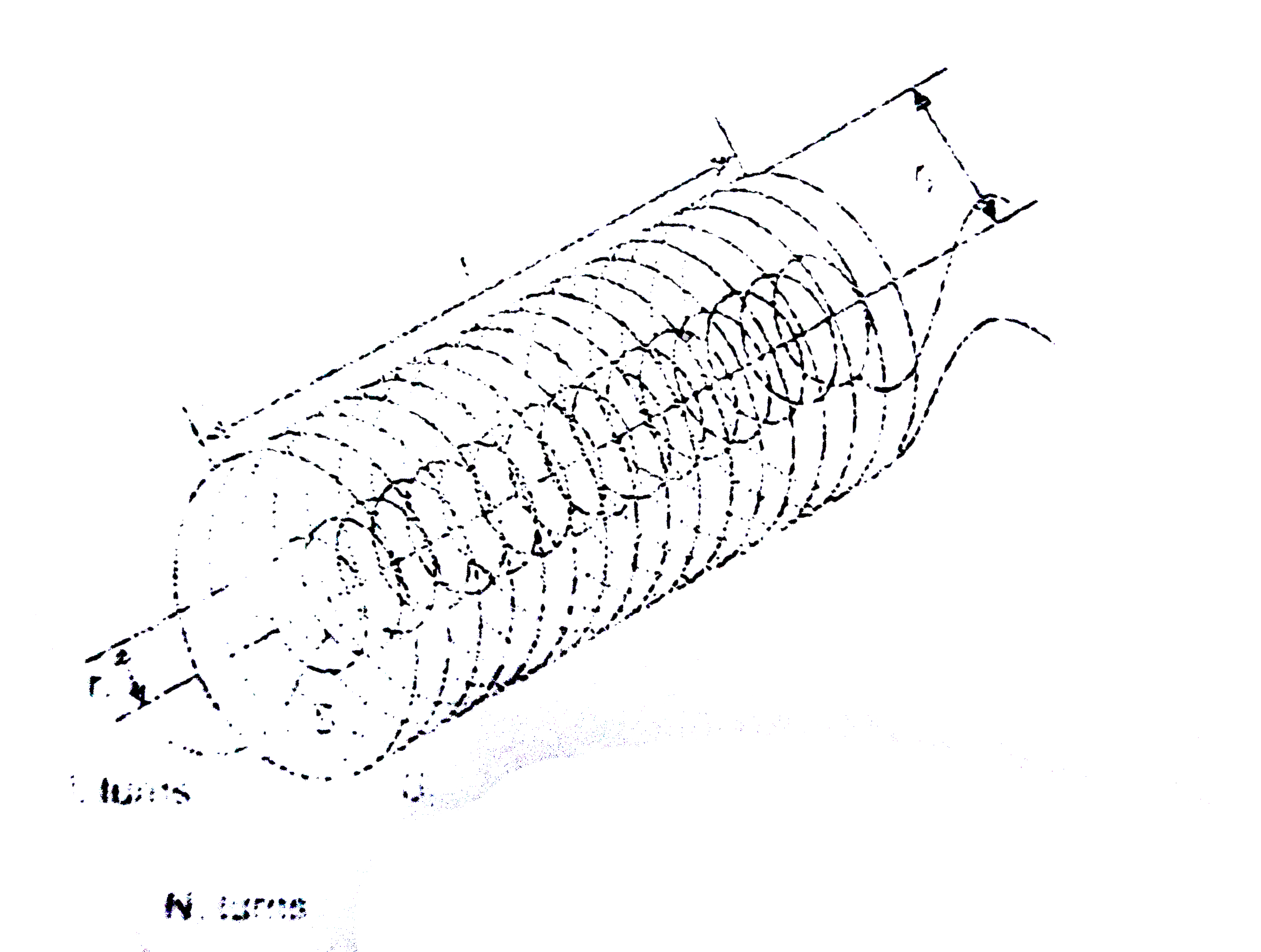
Mutual inductance of two long coaxial solenoids:Consider the following fig.Which shows two long coaxial solenoids each of length `l` let the radius of the inner solenoid `S_(1)` be `r_(1)` and the number of turns per unit length be `n_(1)`
The corresponding quantities for the outer solenoid `S_(2)` are `r_(2)` and `n_(2)` respectively. Let `N_(1)` and `N_(2)`, be the total number of turns of coils `S_(1)` and `S_(2)` respectively.
`N_(1)phi_(1)=M_(12)I_(2)` ..(1)
where `M_(12)` is called the mutual inductance of solenoid `S_(1)` with respect to solenoid `S_(2)`.The magnetic field due to the current `I_(2)` in `S_(2)` is `mu_(0)n_(2)l_(2)`.The resulting flux linkage with coil `S_(1)` is `N_(1)phi_(1)=(n_(1)l)(pir^(2))(mu_(0)n_(2)I_(2))=mu_(0)n_(1)n_(2)pir_(1)^(2)lI_(2)`..(2)
where `n_(1)l` is the total number of turns in solenoid `S_(1)` From eq.(1) and (2) we get
`M_(12)I_(2)=mu_(0)n_(1)n_(2)pir_(1)^(2)lI_(2)`
or `M_(12)=mu_(0)n_(1)n_(2)pir_(1)^(2)l`...(3)
Now consider the reverse case a current `I_(1)` is passed through the solenoid `S_(1)` and the flux linkage with coil `S_(2)` is
`N_(2)phi_(2)=M_(21)I_(1)` ..(4)
Where `M_(21)`,is called the mutual inductance of solenoid `S_(2)` with respect to solenoid `S_(1)`.The flux due to the current `I_(1)` in `S_(1)` can be assumed to be confined only inside `S_(1)`, Since the solenoids are very long.Thus, flux linkage with solenoid `S_(2)` is
`N_(2)phi_(2)=(n_(2)l)(pir_(1)^(2))(mu_(0)nl_(1)^(2))`...(5)
Where `n_(2)l` is the total number of turns of `S_(2)`.
From eq.(4) and (5), we get
`M_(21)=mu_(0)n_(1)n_(2)pir_(1)^(2)l`...(6)
From eq (3) and (4), we get
`M_(12)=M_(21)=M`(say)
Therefore `M=mu_(0)n_(1)n_(2)pir^(2)l`
Promotional Banner

Topper's Solved these Questions

  • ELECTROMAGNETIC INDUCTION

    RESONANCE ENGLISH|Exercise A.l.P|19 Videos
  • ELECTROMAGNETIC INDUCTION

    RESONANCE ENGLISH|Exercise Exercis-3 PART 2|16 Videos
  • ELECTRODYNAMICS

    RESONANCE ENGLISH|Exercise Advanced level problems|31 Videos
  • ELECTROSTATICS

    RESONANCE ENGLISH|Exercise HLP|40 Videos

Similar Questions

Explore conceptually related problems

Define mutual inductance between two long coaxial solenoids. Find out the expression for the mutual of inner solenoid of length 1 having the radius r_(1) and the number of turns n_(1) per unit length due to the second other solenoid of same length and n_(2) number of turns per unit length.

When two coherent sources interact with each other, there will be production of alternate bright and dark fringes on the screen . Young's double-slit experiment domonstrates the idea of making two coherent sources. For better visibility, one has to choose proper amplitude for the sources. The phenomena is good enough to satisfy the conservation of energy principle. The pattern formed in YDSE is of uniform thickness and is nicely placed on a long distance screen. Law of convervation of energy is satisfied because

(a) State and explain Kirchhoff's law. (b) Describe an experiment to verify it. (c) Give two examples to illustrate Kirochhoff's law.

