Home
Class 12
PHYSICS
(i) with the help of a labelled diagram...

(i) with the help of a labelled diagram, describe briefly the underlying principle and working of a stepup transformer.
(ii) Write any two sources of energy loss in a transformer. (iii) A step-up transformed converts a low input voltage into a high output voltage. Does it violate law of conservation of energy ? Explain.

Text Solution

Verified by Experts
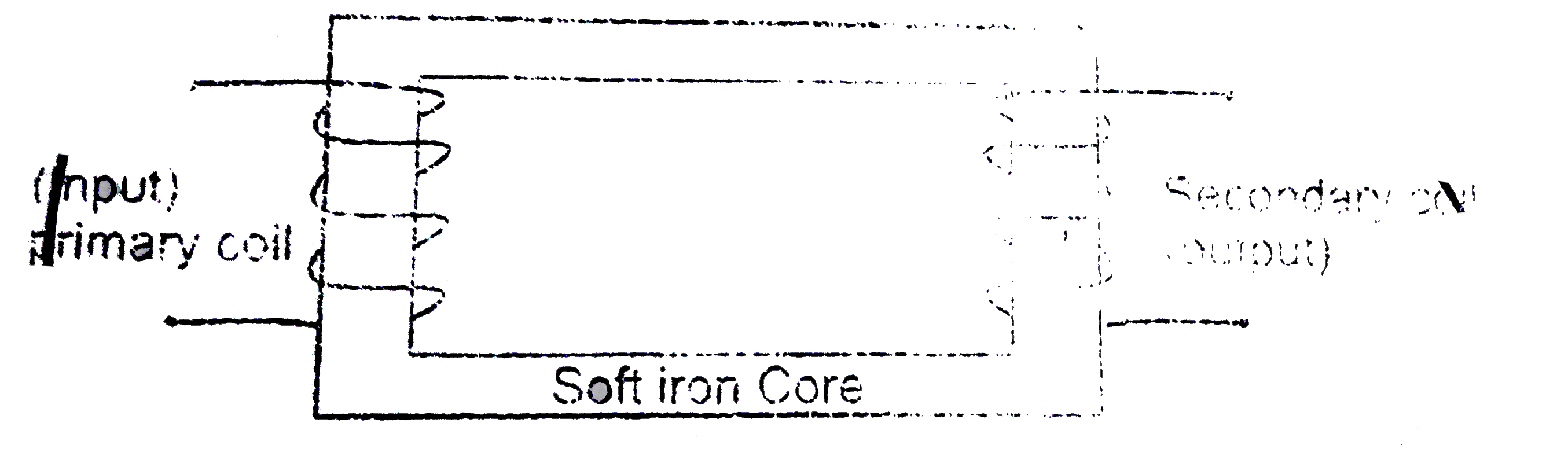
Transformer: A transformer is an electrical device which used to change an alternating voltage.A transformer which increases the `a.c.` voltages is called a step up transformer.A transformer which decreases the `a.c.` voltage is called step down transformer.
Principle:A transformer is based on the principle of mutual induction. (i.e. whenever the amount of magnetic flux linked with a coil changes, the `emf` is induced in the neighbouring coil.)
Construction:A transformer consists of two sets of coils form each other.They are bounded on soft iron core.One of the coils called the primary coil has The othr coil is called the secondary coil has `Ns` tuns.The primary coil is the input coil and secodary coil is the output coil of transformer.Working:When an alternating voltage is applied to the primary coill, the resulting current products a alternating coil and induces an `emf` in it.The value of `emf` depends on the number of turns in the secondary coil.We consider an ideal transformer.Let `phi` be the flux in each turn in the core at time `t` due to current in primary coil when voltage `V_(p)` is applied.Then induced `emf` Vs in the secondary coil is
`therefore V_(S)=-N_(S)(dphi)/(dt)`...(1)
and `therefore V_(P)=-N_(P)(dphi)/(dt)`...(2)
Dividing (1) by (2) we get
`V_(S)/V_(P)=N_(S)/N_(P)`....(3)
If the transformer is assumed to be `100%` efficient.Then power input is equal to power output
`therefore I_(P)V_(P)=I_(S)V_(S)`
`I_(P)/I_(S)=V_(S)/V_(P)`..(4)
Form (3) and (4), we have
`I_(P)/I_(S)=V_(S)/V_(P)=N_(S)/N_(P)`
(ii) In the case of direct current, there is no change of magnetic flux.So there is no induced `emf`.Thus the transformer cannot be used to step-up `d.c` voltage
Promotional Banner

Topper's Solved these Questions

  • ALTERNATING CURRENT

    RESONANCE ENGLISH|Exercise A.L.P|10 Videos
  • ALTERNATING CURRENT

    RESONANCE ENGLISH|Exercise EXAMPLE|40 Videos
  • ALTERNATING CURRENT

    RESONANCE ENGLISH|Exercise Exercise -3 Part-2|3 Videos
  • ATOMIC PHYSICS

    RESONANCE ENGLISH|Exercise Advanved level problems|17 Videos

Similar Questions

Explore conceptually related problems

Assertion : A step-up transformer changes a low voltage into a high voltage. Reason : This violate the law of conservation of energy.

(a) Derive the relationship between the peak and the rms value of current in an a.c. circuit. (b) Describe briefly, with the help of a labelled diagram, working of a step-up transformer. A step-up transformer converts a low voltage into high voltage. Does it not violate the principal of conservation of energy? Explain.

Explain briefly, with the help of a labelled diagram, the basic principle of working of an a.c. generator. In an a.c. generator, coil of N turns and area A rotating with a constant angular speed ω in a uniform magnetic field B. Write the expression for the emf produced. A 100-turn coil of area 0.1m^(2) rotates at half a revolution per second. It is placed in a magnetic field 0.01 T perpendicular to the axis of rotation of the coil. Calculate the maximum voltage generated in the coil.

With the help of labelled diagram, state the underlying principle of a cylclotron. Explain clearly how it works to accelerate the charged particles to high energies. Show that cyclotron frequency is independent of energy of the particle. Is there an upper limit on the enregy acquired by the particle? Give reason.

Draw a schematic diagram of a step-up transformer . Explain its working principle . Deduce the expression for the secondary to primary voltage in terms of the number of turns in the two coils . In an ideal transformer , how is this ratio related to the currents in the two coils ?

Draw a schematic arrangement for winding of primary and secondary coil in a transformer when the two coils are wound on top of each other. (ii) State the underlying principle of a transformer and obtain the expression for the ratio of secondary to primary voltage in terms of the (a) number of secondary and primary windings and (b) primary and secondary currents. (iii) Write the main assumption involved in deriving the above relations. (iv) Write any two reasons due to which energy losses may occur in actul transformers.

(a) Draw the diagram of a device which is used to decrease high S voltage into a AC voltage and state its working principle. Write four sources of energy loss in this device. (b) A small town with a demand of 1200 kW of electric power at 220 V is situated 20 Km away from an electric plant generating power at 440V. The resistance of the two wire line carrying power is 0.5 Omega per km. The town gets the power from the line through a 4000-220 V step-down transformer at s sub-station in the town. Estimate the line power loss in the from of heat.

A thermal power plant produed electric power of 600kW at 4000V, which is to be transported to a place 20 km away form the power plant for consumer's usage. It can be transported either directly with a cable of large current carrying capacity or by sing a combination of step-up and step-down transfprmers at the two ends. THe drawback of the direct transmission is the large energy dissipation. In the method wsing transformers, the dissipatiion is much smaller. In this method a step-up transformers is used at the plant side so that the current is reduced to a smaller value. At the consumers'end, a step-down transformer is used to supply power to the consumers at the specified lower voltage. It is reasonable to assume that the power cable is purely resostive and the transformers are ideal with power factor unity. All the currents and voltagementioned are values. In the method using the transformers assume that the ratio of the number of turns in the primary to that in the secondary in the step-up transformer is 1:10 if the power to the consumers has to be supplied at 200V, the ratio of the number of turns in the primary to that in the secondary in the step-down transformer is

The Betatron was the first important machine for producing high energy electrons. The action of the betatron depends on the same fundamental principle as that of the transformer in which an alternating current applied to a primary coil induces an altermating current usually with higher or lower voltage in the secondary coil. In the betatron secondary coil is replaced by a doughnut shaped vacuum chamber.Electron produced in the doughnut from a hot filament, are given a preliminary acceleration by the application of an electric field having potential difference of 20 kV to 70 kV , when an alternating magnetic field is applied parallel to the axis of the tube, two effects are produced (1) an electromotive force is produced in the electron orbit by the changing magnetic flux that gives an additional energy to the electrons (2) a radial force is produced by the action of magnetic field whose direction is perpendicular to the electron velocity. Which keeps the electron moving in a circular path. Conditions are arranged such that the increasing magnetic field keeps the electron in a circular orbit of constant radius. The mathematical relation between the betatron parameters to ensure the above condition is called BETATRON condition. If the orbit radius of the circular path traced by the electron is R , magnetic field is B , speed of the electron is v , mass of the electron is m , charge on the electron is e and phi is the flux within the orbit of radius R . Then answer the following questions based on the above comprehension. What is the value of (d(m|vecv|))/(dt) ?

The Betatron was the first important machine for producing high energy electrons. The action of the betatron depends on the same fundamental principle as that of the transformer in which an alternating current applied to a primary coil induces an altermating current usually with higher or lower voltage in the secondary coil. In the betatron secondary coil is replaced by a doughnut shaped vacuum chamber.Electron produced in the doughnut from a hot filament, are given a preliminary acceleration by the application of an electric field having potential difference of 20 kV to 70 kV , when an alternating magnetic field is applied parallel to the axis of the tube, two effects are produced (1) an electromotive force is produced in the electron orbit by the changing magnetic flux that gives an additional energy to the electrons (2) a radial force is produced by the action of magnetic field whose direction is perpendicular to the electron velocity. Which keeps the electron moving in a circular path. Conditions are arranged such that the increasing magnetic field keeps the electron in a circular orbit of constant radius. The mathematical relation between the betatron parameters to ensure the above condition is called BETATRON condition. If the orbit radius of the circular path traced by the electron is R , magnetic field is B , speed of the electron is v , mass of the electron is m , charge on the electron is e and phi is the flux within the orbit of radius R . Then answer the following questions based on the above comprehension. What is the tangential force acting on the electron ?

RESONANCE ENGLISH-ALTERNATING CURRENT-Exercise -3 Part-3
  1. What do you mean by the impedance of LCR-circuit

    Text Solution

    |

  2. The instantaneous current from an a.c. source is l = 5 sin (314t) ampe...

    Text Solution

    |

  3. (i) with the help of a labelled diagram, describe briefly the underly...

    Text Solution

    |

  4. Given below are two electric circuits A and B Calculate the ratio of...

    Text Solution

    |

  5. In a series LCR circuit, the voltages across an inductor, a capacitor ...

    Text Solution

    |

  6. The current drawn by the primary of a transformer, which steps down 20...

    Text Solution

    |

  7. Explain the term 'inductive reactance'.Show graphically the variation ...

    Text Solution

    |

  8. Explain the term 'capacitive reactance'.Show graphically the variation...

    Text Solution

    |

  9. Derive an expression for the impedance of an a.c. circuit consisting...

    Text Solution

    |

  10. An inductor 200 mH, capactior 500 mu F, resistor 10 ohm are connected ...

    Text Solution

    |

  11. The instantaneous current and voltage of an a.c. circuit are given by ...

    Text Solution

    |

  12. A coil Q is connected to low voltage bulb B and placed near another co...

    Text Solution

    |

  13. A series LCR circuit is connected to an ac source having voltage v=v(m...

    Text Solution

    |

  14. In a series LCR circuit connected to an ac source of variable frequenc...

    Text Solution

    |

  15. In an alternating circuit applied voltage is 200V, if R=8W X(L)=X(C)=6...

    Text Solution

    |

  16. Derive the expression for the instantaneous value of the emf induced ...

    Text Solution

    |

  17. Why is the use of A.C. voltage preferred over D.C. voltage? Give two r...

    Text Solution

    |

  18. A voltage V = V(0)sinomegat is applied to a series LCR circuit. Derive...

    Text Solution

    |

  19. In an alternating circuit applied voltage is 200V if R=8W X(L)=X(C)=6O...

    Text Solution

    |

  20. Draw a curve for showing variation in alternating current with frequen...

    Text Solution

    |

