Home
Class 12
CHEMISTRY
Boron exist in different allotropic form...

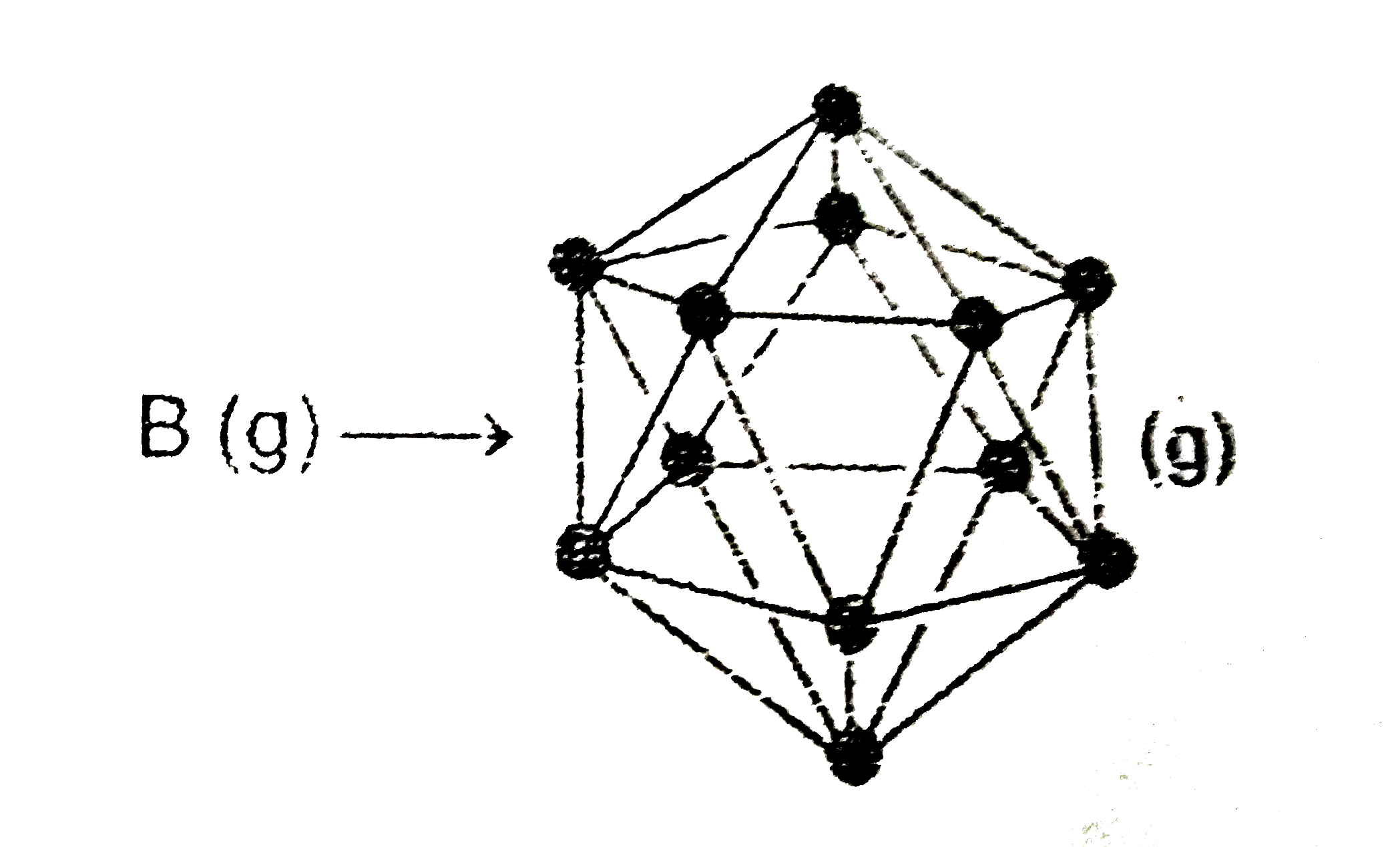
Boron exist in different allotropic forms. All allotropic form contains icosahedral units (icosahedral is regular shape with 12 corner & 20 faces) with boron atoms at all 12 corners and all bonds are equivalent.

Calculate heat evolved at constant pressure (in KJ) per mole of boron atoms undergoing above change it `DeltaH_(BE)(B-B) =200 KJ//"mol"`. Report you answer after dividing by 100

Text Solution

Verified by Experts

The correct Answer is:

5

Heat evolved per mol of 'B' atoms `=(5)/(2)xx 200=500 KJ`
Promotional Banner

Topper's Solved these Questions

  • THERMODYNAMICS

    RESONANCE ENGLISH|Exercise exercise-3 part-III Advanced level Solutions (STAGE-I)|6 Videos
  • THERMODYNAMICS

    RESONANCE ENGLISH|Exercise exercise-3 part-III Advanced level Solutions (STAGE-II)|38 Videos
  • THERMODYNAMICS

    RESONANCE ENGLISH|Exercise exercise-3 part-1 Advanced level Solutions|30 Videos
  • TEST SERIES

    RESONANCE ENGLISH|Exercise CHEMISTRY|50 Videos

Similar Questions

Explore conceptually related problems

One of the allotropic form of boron is alpha - rhombohedral boron. Number of faces and corners in its basic building B_(12) icosahedral unit are:

The small size and high charge of Al^(3+) ion gives it a high charge density which is responsible for its tendency to show (a) covalency in its compounds in the gaseous state (b) high hydration energy which stabilizes its compounds in solution, and (c) high lattice energy of its compounds in the solid state. Thus aluminium can forms both covalent and ionic bond. Like halides of boron, halides of aluminium do not show back bonding because of increase in size of aluminium. Actually aluminium atoms complete their octets by forming dimers. Thus chloride and bromide of aluminium exist as dimers, both in the vapour state and in polar-solvents like benzene while the corresponding boron halides exists as monomer. In boron trihalides the extent of back bonding decreases with increases with increase in size of halogens and thus lewis acid character increases. All BX_(3) are hydrolysed by water but BF_(3) shows a different behaviour. Which of the following statements about anhydrous aluminium chloride is correct ?

The small size and high charge of Al^(3+) ion gives it a high charge density which is responsible for its tendency to show (a) covalency in its compounds in the gaseous state (b) high hydration energy which stabilizes its compounds in solution, and (c) high lattice energy of its compounds in the solid state. Thus aluminium can forms both covalent and ionic bond. Like halides of boron, halides of aluminium do not show back bonding because of increase in size of aluminium. Actually aluminium atoms complete their octets by forming dimers. Thus chloride and bromide of aluminium exist as dimers, both in the vapour state and in polar-solvents like benzene while the corresponding boron halides exists as monomer. In boron trihalides the extent of back bonding decreases with increases with increase in size of halogens and thus lewis acid character increases. All BX_(3) are hydrolysed by water but BF_(3) shows a different behaviour. Which of the following reaction is incorrect ?

Oxygen is of vital importance for all of us . Oxygen enters the body via the lungs and is transported to the tissues in our body by blood . There it can deliver energy by the oxidation of sugars. C_(6)H_(12)O_(6) + 6O_(2) rarr 6CO_(2) + 6H_(2)O This reaction releases 400 KJ of energy per mole of oxygen O_(2) uptake by blood is at four heme (Hm) group in this protein hemoglobin (Hb). Free Hm consists of an Fe^(2+) giving HmO_(2) complex. Carbon monoxides can be complexed similarily giving a Hm CO complex . CO is poison as it bonds more strongly to Hm than O_(2) does. The equilibrium constant K_(f) for the reaction: Hm+ CO hArr HCO " "........(i) is 1000 times larger than the equilibrium constant K_(2) for the reaction: Hm + CO_(2) hArr HmO_(2)" " ........(ii) Each Hb molecules can take up four molecules of O_(2) absorbs a fraction of this amount, depending on the oxygen pressure , as shown in figure1 (curve 1) . Also shown are the curve (2) and (3) for blood with two kinds of dificient Hb . These occur in patients with certain hereditary diseases. Relevant data , O_(2) pressure in lungs is 15 KPa , in the muscles it is 2KPa . The maximum flow of blood through heart and lungs is 4 xx 10^(-4)m^(-3)s^(-1) . The red cells in blood occupy 40% of the volume, inside the cells the concentration of Hb has a molar mass of 64 kg "mol"^(-1) R=8.314 J "mol"^(-1) K^(-1) , T=298k . Using the relation between K and the standard Gibbs energy DeltaG^(@) for a reaction, calculated the difference between the DeltaG^(@) values for the home reactions (i) and (ii).

RESONANCE ENGLISH-THERMODYNAMICS-exercise-3 part-2 Advanced level Solutions
  1. Fixed amount of an ideal mono atomic gas contained in a sealed rigid v...

    Text Solution

    |

  2. Which of the following statement(s) is/are true?

    Text Solution

    |

  3. From the following data, mark the option(s) where DeltaH is correctly ...

    Text Solution

    |

  4. The value of DeltaH("transition") of C (graphite) rarr C (diamond) is ...

    Text Solution

    |

  5. Which of the following statement(s) is/are false?

    Text Solution

    |

  6. For the reaction Ag(2)O(s) to 2Ag(s)+1/2 O(2)(g) the value of triangle...

    Text Solution

    |

  7. Select the correct enthalpy at corresponding temperature using followi...

    Text Solution

    |

  8. Two moles of a perfect gas undergo the following processes: a. A rev...

    Text Solution

    |

  9. The enthalpy of combustion of mol. Wt. 180 glucose is -2808 KJ "mol"^(...

    Text Solution

    |

  10. A sample of certain mas s of an ideal polyatomic gas is expanded agai...

    Text Solution

    |

  11. The heat of combustion of acetylene is 312 Kcal . If heat of formatio...

    Text Solution

    |

  12. Boron exist in different allotropic forms. All allotropic form contain...

    Text Solution

    |

  13. 1 mol of an idel gas is allowed to expand isothermally at 27^(@)C til...

    Text Solution

    |

  14. Concerete is produced from a mixture of cement , water, sand and small...

    Text Solution

    |

  15. Concrete is produced form a mixture of cement, water and small stones....

    Text Solution

    |

  16. Concerete is produced from a mixture of cement , water, sand and small...

    Text Solution

    |

  17. The accompanying diagram represents a reversible cannot cycle for an i...

    Text Solution

    |

  18. The accompanying diagram represents a reversible cannot cycle for an i...

    Text Solution

    |

  19. The accompanying diagram represents a reversible cannot cycle for an i...

    Text Solution

    |

  20. Match column-I to column-II standard entropy in KJ/k-molar at 25^(@)C ...

    Text Solution

    |
