Home
Class 11
CHEMISTRY
Na(2)SO(4).10H(2)O(s)hArrNa(2)SO(4).5H(2...


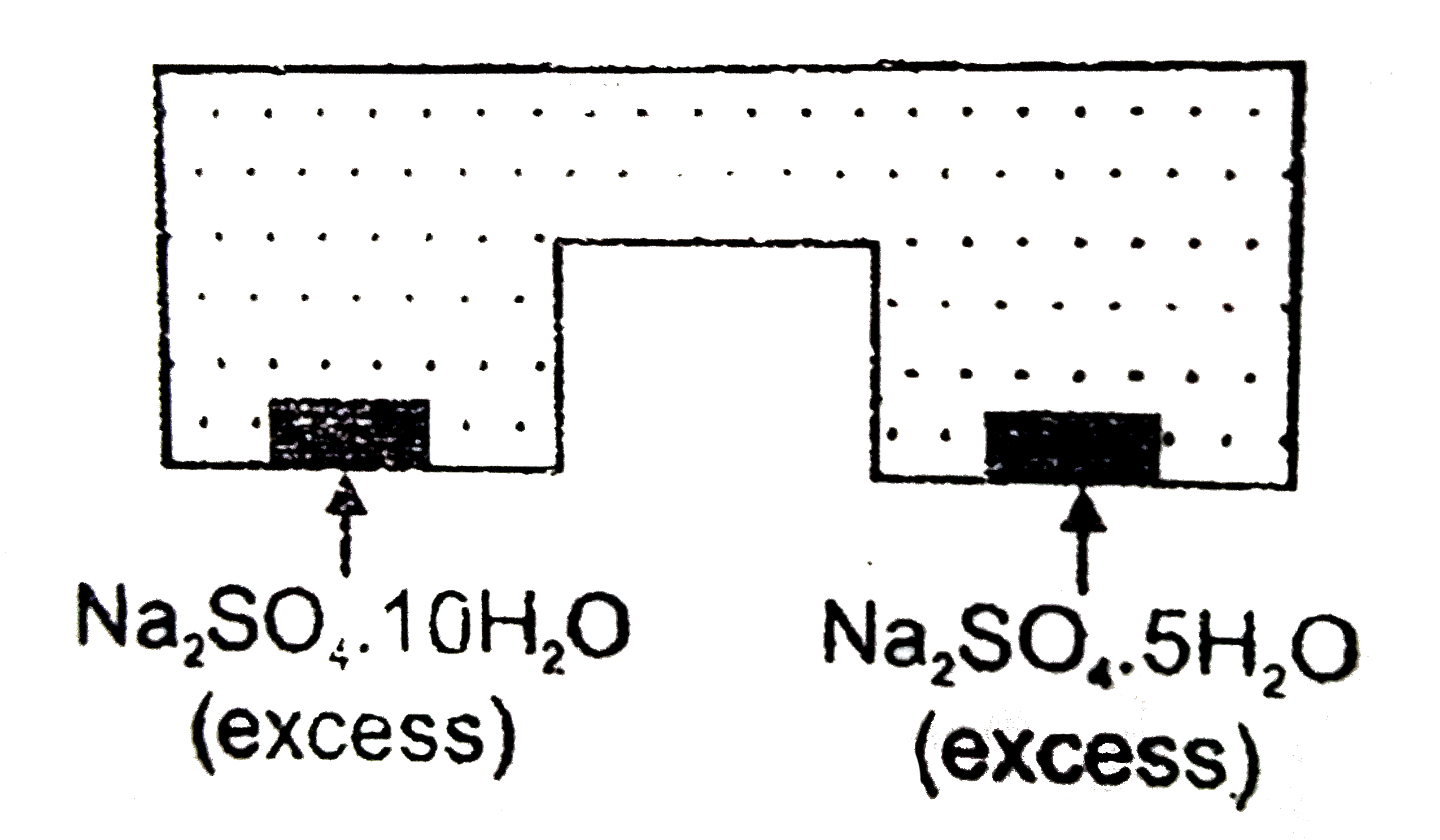
`Na_(2)SO_(4).10H_(2)O(s)hArrNa_(2)SO_(4).5H_(2)O(g) K_(P)=2.43xx10^(-8)` atm^(5) incorrect statement is-

A

If partial pressure of `H_(2)O` in container is `3.5xx10^(-2)` atm amount of `Na_(2)SO_(4).5H_(2)O` decreases.

B

If `P_(H_(2))O=2.5xx10^(-2)` atm then amount of `Na_(2)SO_(4).5H_(2)O` should increases.

C

If `P_(H_(2))O=3xx10^(-2)` atm then both side does not get altered.

D

If `Na_(2)SO_(4).5H_(2)O` is completely removed then partial pressure of `H_(2)O` increases at equilibrium.

Text Solution

Verified by Experts

The correct Answer is:

D
Promotional Banner

Topper's Solved these Questions

  • CHEMICAL EQUILIBRIUM

    RESONANCE ENGLISH|Exercise Exercise-2 (Part-2)|22 Videos
  • CHEMICAL EQUILIBRIUM

    RESONANCE ENGLISH|Exercise Exercise-2 (Part-3)|33 Videos
  • CHEMICAL EQUILIBRIUM

    RESONANCE ENGLISH|Exercise Exercise-1 (Part-2)|87 Videos
  • CHEMICAL BONDING

    RESONANCE ENGLISH|Exercise ORGANIC CHEMISTRY(Fundamental Concept )|6 Videos
  • D & F-BLOCK ELEMENTS & THEIR IMPORTANT COMPOUNDS

    RESONANCE ENGLISH|Exercise Match the column|1 Videos

Similar Questions

Explore conceptually related problems

(a) CuSO_(4).5H_(2)O(s)hArrCuSO_(4).3H_(2)O(s)+2H_(2)O(g) K_(p)=4xx10^(-4)atm^(2) (b) Na_(2)SO_(4).10H_(2)O(s)hArrNa_(2)SO_(4).5H_(2)O(s)+5H_(2)O(g) K_(p)=2.43xx10^(-8) atm^(5) (c) Na_(2)S_(2)O_(3).5H_(2)O(s)hArrNa_(2)S_(2)O_(3).2H_(2)O(s)+3H_(2)O(g) K_(p)=6.4xx10^(-5) atm^(3) What is order of vapour pressure and relative humidity respectively.

From the data given below which of the following reactant is most effective drying agent at 0^(@)C . Given P_(H_(2)O)^(@)=4.58 mm at 0^(@)C . i. SrCl_(2).6H_(2)O(s) hArr SrCl_(2).2H_(2)O(s)+4H_(1)O(g), K_(p)=6.9xx10^(-12) atm^(4) ii. Na_(2)SO_(4).10H_(2)O(s) hArr Na_(2)SO_(4)(s)+10H_(2)O(g), K_(p)=4.08xx10^(-25) atm^(10) iii. Na_(2)HPO_(4). 12H_(2)O(s) hArr Na_(2)HPO_(4). 7H_(2)O(s)+5H_(2)O(g), K_(p)=5.525xx10^(-13) atm^(5)

CuSO_(4).5H_(2)O(s)hArrCuSO_(4).3H_(2)O(s)+2H_(2)O(s) K_(P)=0.4xx10^(-3) atm^(2) Which of following sttement are correct:

For equilibrium ZnSO_(4).7H_(2)O(s)hArrZnSO_(4).2H_(2)O(s)+5H_(2)O(g) K_(P)=56.25xx10^(-10) atm^(5) and vapour pressure of water is 22.8 torr at 298K.ZnSO_(4).7H_(2)O(s) is efflorescent (lose water) when relative humidity is [5sqrt56.25=2.23]

Equilibrium constant for the following equilibrium is given at 0^(@)C . Na_(2)HPO_(4) . 12H_(2)O(s) hArrNa_(2)HPO_(4) . 7H_(2)O(s) + 5H_(2)O(g) K_(p) = 31.25xx10^(-13) . At equilibrium what will be partial pressure of water vapour:

For the equilibrium CuSO_(4)xx5H_(2)O(s)hArrCuSO_(4)xx3H_(2)O(s) + 2H_(2)O(g) K_(p) = 2.25xx10^(-4)atm^(2) and vapour pressure of water is 22.8 torr at 298 K. CuSO_(4) . 5H_(2)O(s) is efflorescent (i.e., losses water) when relative humidity is :

Na_(2)CrO_(4)+HCl to H_(2)Cr_(2)O_(7)+Na_(2)SO_(4)

Na_(2)CrO_(4)+HCl to H_(2)Cr_(2)O_(7)+Na_(2)SO_(4)

CuSO_(4).5H_(2)O(s)hArrCuSO_(4). 3H_(2)O(s)+2H_(2)O(g), K_(p)=4xx10^(-4)atm^(2) If the vapour pressure of water is 38 toor then percentage of relatative humidity is :(Assume all data at constant temperture)

H_(2)underline(S_(2))O_(8)+H_(2)O to H_(2)SO_(4)+H_(2)O_(2)

RESONANCE ENGLISH-CHEMICAL EQUILIBRIUM-Exercise-2 (Part-1)
  1. If for 2A(2)B(g)hArr2A(2)(g)+B(2)(g),K(P)="TOTAL PRESSURE" ("at equili...

    Text Solution

    |

  2. Ammonia gas at 15 atm is introduced in a rigid vessel at 300 K. At equ...

    Text Solution

    |

  3. Attainment of the equilibrium A(g)hArr2C(g)+B(g)gave the following gra...

    Text Solution

    |

  4. A 10 L "container at" 300K "contains" CO(2) "gas at pressure of" 0.2 "...

    Text Solution

    |

  5. Two solid A "and" B are present in two different container having same...

    Text Solution

    |

  6. To the system, LaCl(3)(s)+H(2)O(g) hArr LaClO(s)+2HCL(g)-"Heat" alre...

    Text Solution

    |

  7. Some quantity of water is contained in a container as shown in figure....

    Text Solution

    |

  8. The equilibrium constant for, 2H(2)S(g)hArr2H(2)(g)+S(2)(g) "is" 0.011...

    Text Solution

    |

  9. For reaction, assuming large volume of water. H(2)O(l)hArrH(2)O(g) ,...

    Text Solution

    |

  10. Na(2)SO(4).10H(2)O(s)hArrNa(2)SO(4).5H(2)O(g) K(P)=2.43xx10^(-8) atm^(...

    Text Solution

    |

  11. For equilibrium ZnSO(4).7H(2)O(s)hArrZnSO(4).2H(2)O(s)+5H(2)O(g) K(P...

    Text Solution

    |

  12. In the Haber process for the industrial manufacturing of ammonia invol...

    Text Solution

    |

  13. Addition of water to which of the following equilibria causes it to sh...

    Text Solution

    |

  14. Consider the reactions (i) PCl(5)(g) hArr PCl(3)(g)+Cl(2)(g) (ii) ...

    Text Solution

    |

  15. Solid A "and" B are taken in a closed container at a certain temperatu...

    Text Solution

    |

  16. For a system at equilibrium some changes are made which is reported by...

    Text Solution

    |

  17. In one experiment, certain amount of NH(4)I(s) was heated rapidly in a...

    Text Solution

    |

  18. A(s)hArrB(g)+C(g) K(P)=40atm^(2) X(s)hArrB(g)+E(g) Above equilibri...

    Text Solution

    |

  19. X(s)hArrY(g)+2Z(g) A(s)hArrY(g)+B(g) Consider both these equilibri...

    Text Solution

    |

  20. 1-butyne and 1, 3-butadiene are :

    Text Solution

    |
