Home
Class 11
CHEMISTRY
At 300 K, the reactions satisfying the f...

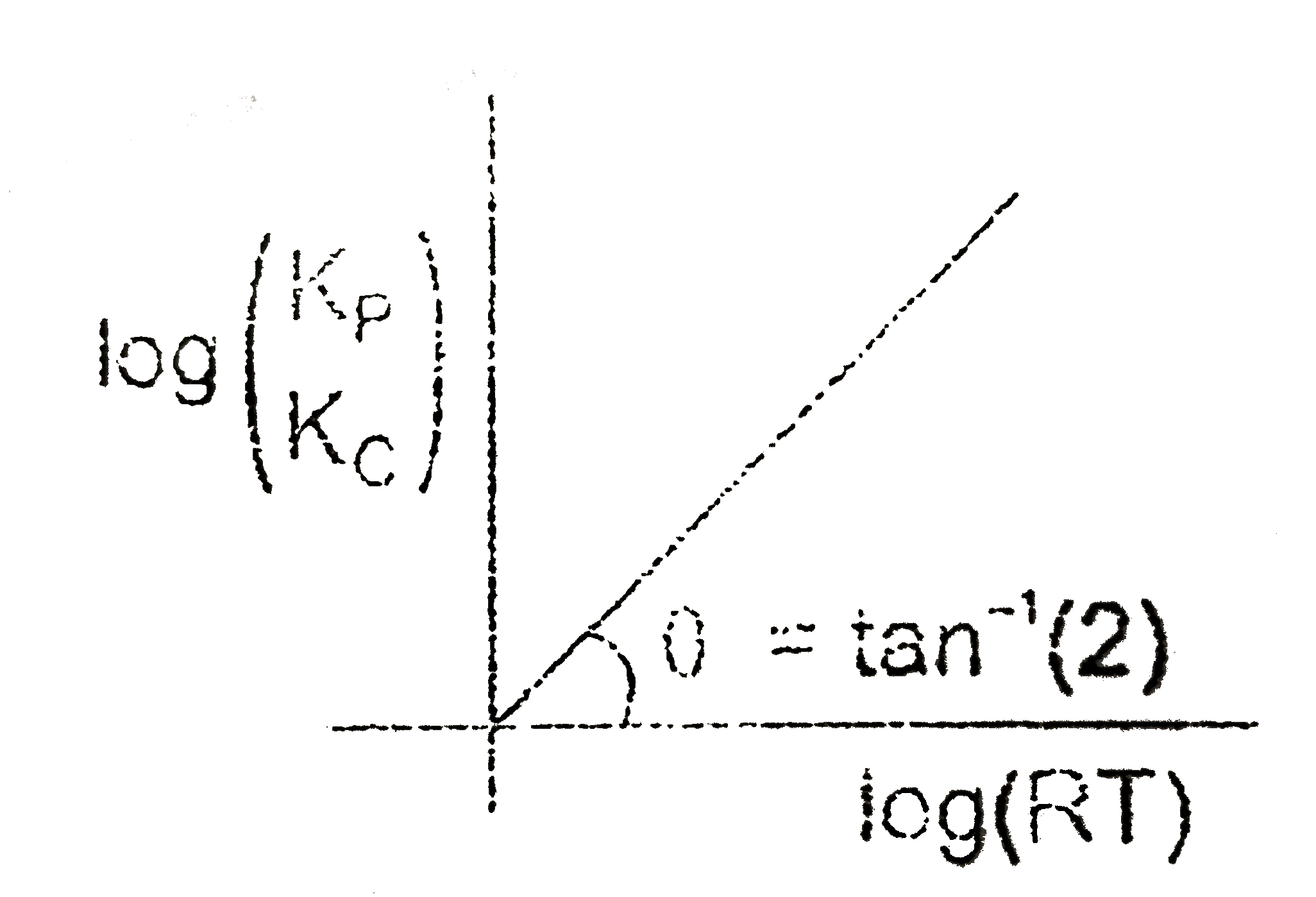
At `300 K`, the reactions satisfying the following graph is:

A

`A(s)hArr2B(g)`

B

`2A(g)hArrB(g)+3C(g)`

C

`A(s)hArrB(g)+C(g)`

D

`2A(g)hArrB(g)`

Text Solution

Verified by Experts

The correct Answer is:
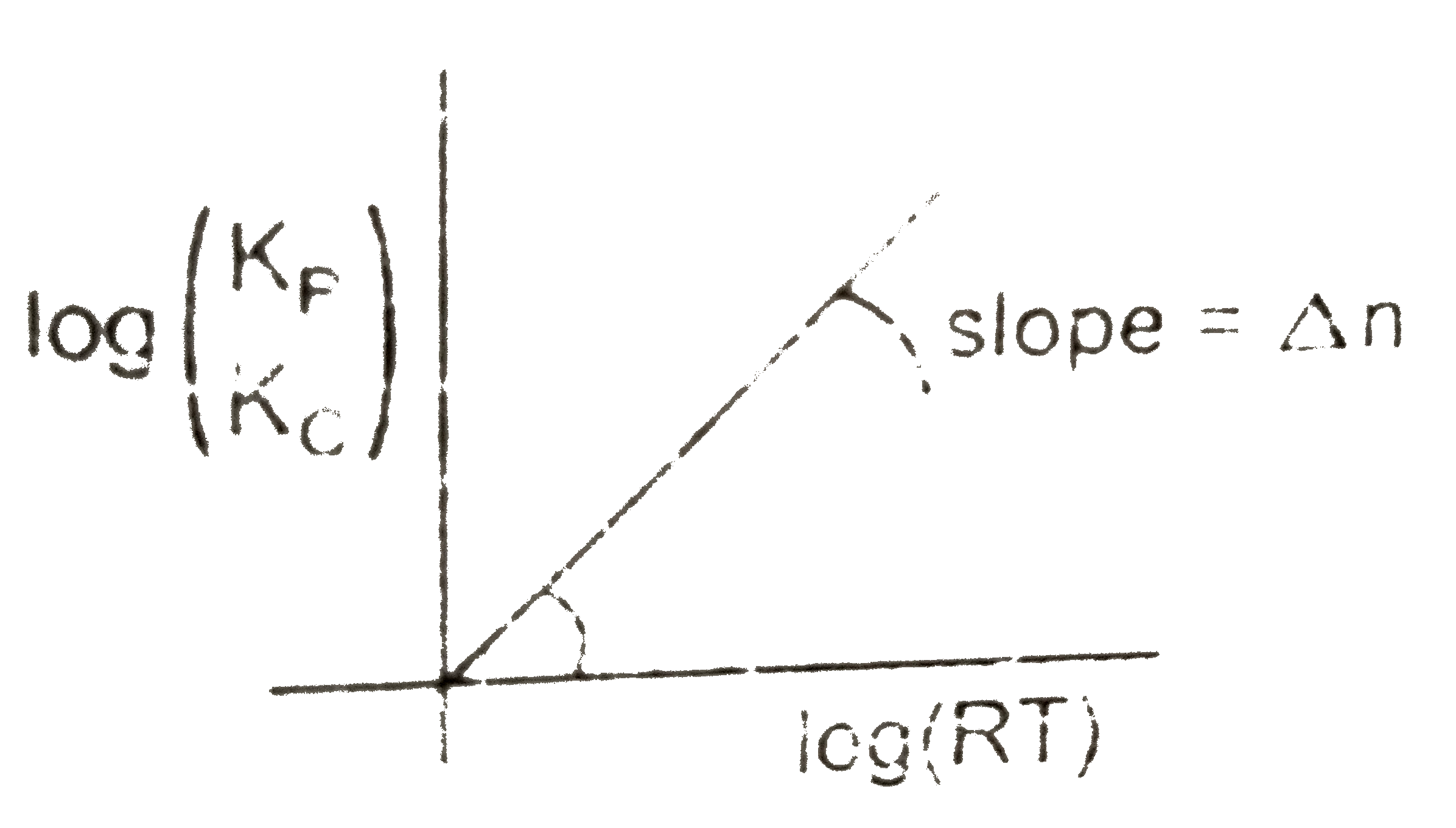
A, B, C

Relation between `K_(P) "&" K_(C)`
`K_(P)=K_(C)(RT)^(Deltan)`
`therefore "log"(K_(P))/(K_(C))=(Deltan)"log"(RT)`
Promotional Banner

Topper's Solved these Questions

  • CHEMICAL EQUILIBRIUM

    RESONANCE ENGLISH|Exercise Exercise-2 (Part-4)|6 Videos
  • CHEMICAL EQUILIBRIUM

    RESONANCE ENGLISH|Exercise Exercise-3 (Part-1)|6 Videos
  • CHEMICAL EQUILIBRIUM

    RESONANCE ENGLISH|Exercise Exercise-2 (Part-2)|22 Videos
  • CHEMICAL BONDING

    RESONANCE ENGLISH|Exercise ORGANIC CHEMISTRY(Fundamental Concept )|6 Videos
  • D & F-BLOCK ELEMENTS & THEIR IMPORTANT COMPOUNDS

    RESONANCE ENGLISH|Exercise Match the column|1 Videos

Similar Questions

Explore conceptually related problems

Liquid oxygen at 50 K is heated to 300 K at constant pressure of 1 atm . The rate of heating is constant. Which of the following graphs represents the variation of temperature with time?

An acid reacts with glycerine to form complex and equilibrium is established. If the heat of reaction at constant volume for this reaction is 1200 cal more than at constant pressure and the temperature is 300 K, then which of the following expression is true?

The activation energy of a reaction can be determined from the slope of which of the following graphs ?

A first order reaction is 50% complete in 50 minutes at 300 K and the same reaction is again 50% complete in 25 minutes at 350K Calculate activation energy of the reaction.

In the reaction PCl_(5)(g)hArrPCl_(3)(g)+Cl_(2)(g) a graph in plotted to show the variation of rate of forward and backward reactions against time. Which of the following is correct? QgtK Q=K QltK

The energy change accompanying the equilibrium reaction A hArr B is -33.0 kJ mol^(-1) . Assuming that pre-exponential factor is same for forward and backward reaction answer the following: The equilibrium constant k for the reaction at 300 K

For the given reaction A(s) + B (g) harrC(g)+2D(s) reaction quotient at any instant is 0.40 at 300K and 0.60 at 500K then which of the following is correct?

The temperature dependence of the rate of a chemical reaction is given by arrhenius equation, k = Ae^(-Ea//RT) . Which of the following graphs will be a striaght line?

The standard Gibbs energies (Delta_(f)G^(Theta)) for the formation of SO_(2)(g) and SO_(3)(g) are -300.0 and -371.0 kJ mol^(-1) at 300K , respectively. Calculate DeltaG and equilibrium constant for the following reaction at 300K :

The rate constant of a first order reaction is 10^(-3) m i n^(-1) at 300K . The temperature coefficient of the reaction is 2. What is the rate constant of the reaction at 350K approximately ?

RESONANCE ENGLISH-CHEMICAL EQUILIBRIUM-Exercise-2 (Part-3)
  1. If log(K(C))/(K(P))-log[(1)/(RT)]=0, then above is true for the follow...

    Text Solution

    |

  2. The reaction for which K(P)=K(C) is satisfied

    Text Solution

    |

  3. At 300 K, the reactions satisfying the following graph is:

    Text Solution

    |

  4. N(2)O(4)(g)hArr2NO(2)(g),K(C)=4. This reversible reaction is studied g...

    Text Solution

    |

  5. A 2 lit vessel is filled by 1 mole of each gas A "&" B. If K(C) for re...

    Text Solution

    |

  6. The equilibrium constant for some reactions are given below against ea...

    Text Solution

    |

  7. For the reaction, SnO(2)(s)+2H(2)(g) hArr Sn(l)+2H(2)O(g) the equilibr...

    Text Solution

    |

  8. The equation alpha=(D-d)/((n-1)d) is correctly matched for: (alpha is ...

    Text Solution

    |

  9. If reaction A+BhArrC+D, taken place in 5 liter close vessel, the rate ...

    Text Solution

    |

  10. Consider equilibrium H(2)O(l)hArrH(2)O(g). Choose the correct directio...

    Text Solution

    |

  11. Consider the following equilibrium 2AB(g)hArrA(2)(g)+B(2)(g) The v...

    Text Solution

    |

  12. Vapour density of equilibrium PCI(5)(g)hArrPCI(3)(g)+CI(2)(g) is decre...

    Text Solution

    |

  13. CuSO(4),5H(2)O(s)hArrCuSO(4)(s)+5H(2)O(g)K(P)=10^(-10) "moles of" CuSO...

    Text Solution

    |

  14. CuSO(4).5H(2)O(s)hArrCuSO(4).3H(2)O(s)+2H(2)O(s) K(P)=0.4xx10^(-3) atm...

    Text Solution

    |

  15. Each question contains STATEMENT-1 (Assertion) and STATEMENT-2( Reason...

    Text Solution

    |

  16. 1 mole each of H(2)(g) "and" I(2)(g) are introduced in a 1L evacuated ...

    Text Solution

    |

  17. For the reaction PCl(5(g))hArrPCl(3(g))+Cl(2(g)), the forward reactio...

    Text Solution

    |

  18. Which of the following reaction will shift in forward direction. When ...

    Text Solution

    |

  19. Which of the following will not affect the value of equilibrium consta...

    Text Solution

    |

  20. If the volume of the racion flask is reduced to half of its initial va...

    Text Solution

    |

