
Home
Class 11
CHEMISTRY
The reaction(s) leading to the formation...

The reaction(s) leading to the formation of 1, 3, 5 -trimethylbenzene is (are)

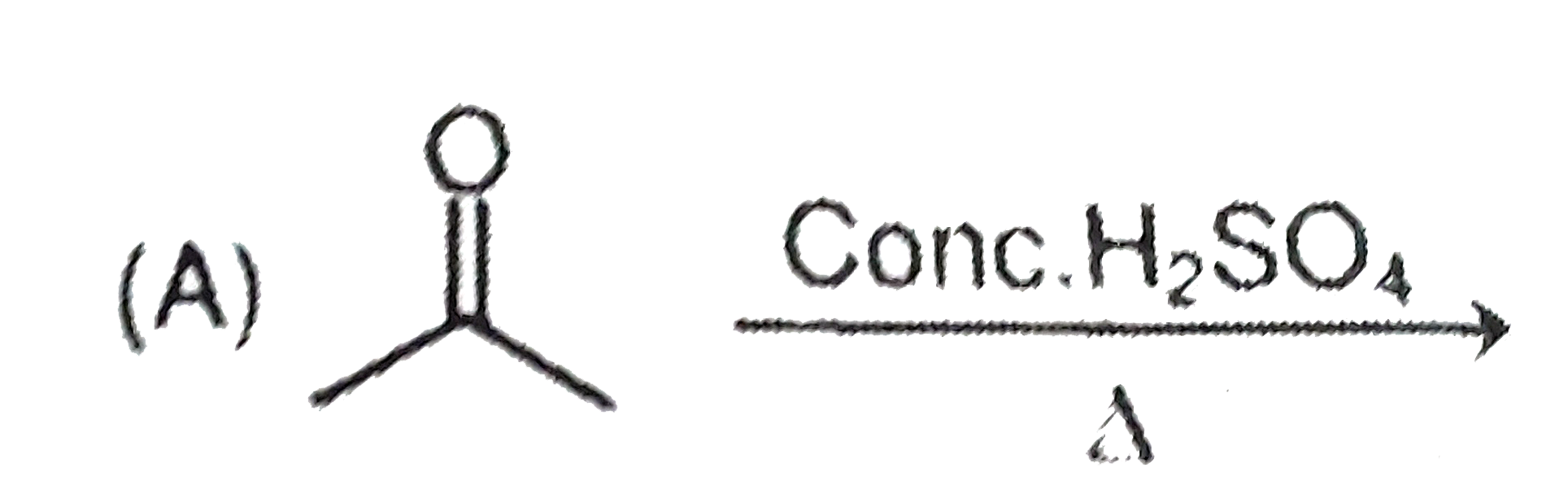
A

B

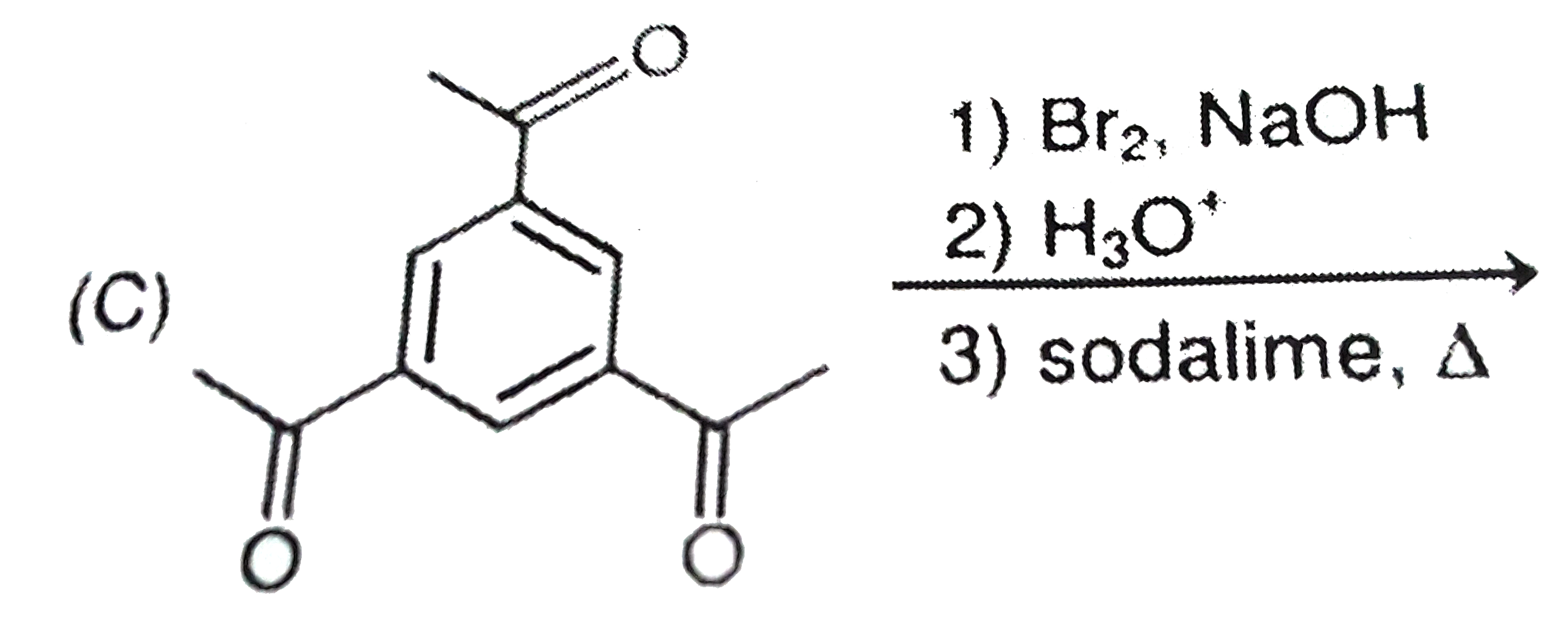
C

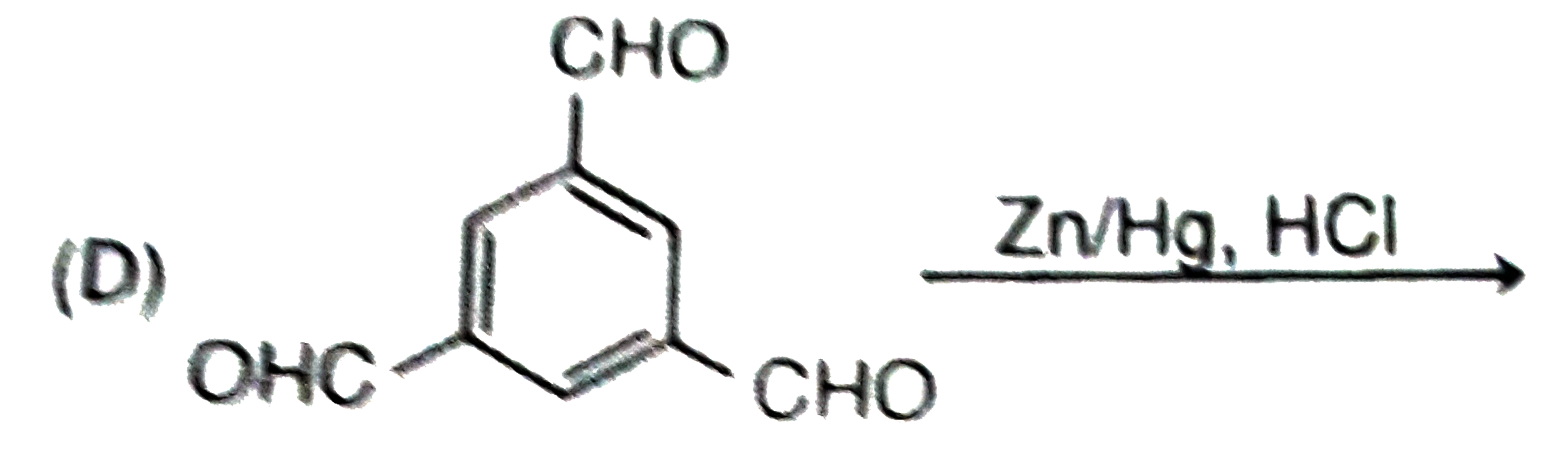
D

Text Solution

AI Generated Solution

The correct Answer is:

To determine the reactions that lead to the formation of 1,3,5-trimethylbenzene, we will analyze the provided options step by step. ### Step-by-Step Solution: 1. **Understanding the Structure of 1,3,5-Trimethylbenzene**: - The molecular structure of 1,3,5-trimethylbenzene consists of a benzene ring with three methyl (CH₃) groups attached at the 1st, 3rd, and 5th positions. 2. **Analyzing Option A**: - **Reagents**: Acetone treated with concentrated H₂SO₄ and heat. - **Reaction**: Three moles of acetone (CH₃COCH₃) undergo dehydration in the presence of concentrated sulfuric acid. This leads to the formation of benzene with three methyl groups at the specified positions. - **Conclusion**: This reaction successfully yields 1,3,5-trimethylbenzene. **(Correct)** 3. **Analyzing Option B**: - **Reagents**: Acetylene heated in an iron tube at 873 K. - **Reaction**: Three moles of acetylene (C₂H₂) undergo coupling reactions when heated, leading to the formation of 1,3,5-trimethylbenzene. - **Conclusion**: This reaction also yields 1,3,5-trimethylbenzene. **(Correct)** 4. **Analyzing Option C**: - **Reagents**: A compound with acetyl groups at the 1st, 3rd, and 5th positions treated with Br₂ and NaOH, followed by H₃O⁺ and soda lime. - **Reaction**: The haloform reaction occurs, where the acetyl groups are converted, and soda lime treatment removes CO₂. However, this does not lead to the formation of 1,3,5-trimethylbenzene. - **Conclusion**: This reaction does not yield the desired product. **(Incorrect)** 5. **Analyzing Option D**: - **Reagents**: A compound with aldehyde groups at the 1st, 3rd, and 5th positions treated with Zn/Hg and HCl. - **Reaction**: This is a Clemmensen reduction, which converts the aldehyde groups (CHO) into methyl groups (CH₃). - **Conclusion**: This reaction yields 1,3,5-trimethylbenzene. **(Correct)** ### Final Conclusion: The reactions that lead to the formation of 1,3,5-trimethylbenzene are found in options A, B, and D. Therefore, the correct answers are A, B, and D.
Promotional Banner

Topper's Solved these Questions

  • AROMATIC COMPOUNDS

    RESONANCE ENGLISH|Exercise PART-II JEE MAIN|19 Videos
  • AROMATIC COMPOUNDS

    RESONANCE ENGLISH|Exercise JEE(MAIN) ONLINE PROBLEM|16 Videos
  • AROMATIC COMPOUNDS

    RESONANCE ENGLISH|Exercise PART IV- COMPREHENSION|13 Videos
  • ATOMIC STRUCTURE

    RESONANCE ENGLISH|Exercise ORGANIC CHEMISTRY(Fundamental Concept )|16 Videos

Similar Questions

Explore conceptually related problems

Reaction of with RMgX lead to formation of

Reaction of with RMgX leads to formation of

Combination of two AO s lead to the formation of .

Which one is the appropriate reaction conditions leading to the formation of C_(2)H_(5)Cl ?

The reaction conditions leading to the best yield of C_2H_5Cl are

The correct sequence of spermatogenetic stages leading to the formation of sperms in a mature human testis is

The correct sequence of spermatogenetic stages leading to the formation of sperms in a mature human testis is

Write briefly about the two processes leading to the formation of new species.

The correct sequence of spermatogenetic stages leading to the formation of sperms in a mature human testis is :-

RESONANCE ENGLISH-AROMATIC COMPOUNDS -Exercise -3 Part-I
  1. The major product of the following reaction is :

    Text Solution

    |

  2. Amongst the compounds given, the one that would form a brilliant color...

    Text Solution

    |

  3. In the following reaction, the products formed is(are)

    Text Solution

    |

  4. The major product(s) of the following is (are):

    Text Solution

    |

  5. P and Q are isomers of dicarboxylic acid C(4)H(4)O(4). Both decolorize...

    Text Solution

    |

  6. In the following reaction, sequences V and W are respectively.

    Text Solution

    |

  7. The reactivity of compound Z with different halogens under appropriat...

    Text Solution

    |

  8. The the identification of beta-napthol using dye test, it is necessary...

    Text Solution

    |

  9. Match the four starting materials (P,Q,R,S) gien in List-I with the co...

    Text Solution

    |

  10. Among the following, the number of reaction(s) that produce(s) benzal...

    Text Solution

    |

  11. The major product U in the following reactions is

    Text Solution

    |

  12. In the following reactions, the major product W is:

    Text Solution

    |

  13. The product(s) of the following reactions sequence is(are)

    Text Solution

    |

  14. The correct statement(s) about of the following reaction sequence is(a...

    Text Solution

    |

  15. The major product of the following reaction is

    Text Solution

    |

  16. The reaction of compounf P with CH(3)MgBr (excess) in (C(2)H(5)(2)O fo...

    Text Solution

    |

  17. The reaction of compounf P with CH(3)MgBr (excess) in (C(2)H(5)(2)O fo...

    Text Solution

    |

  18. The reaction(s) leading to the formation of 1, 3, 5 -trimethylbenzene ...

    Text Solution

    |

  19. Aniline reacts with mixed acid conc. HNO(3) and conc. H(2)SO(4) at 288...

    Text Solution

    |

  20. In the following reaction sequence, the amount of D (in g) formed from...

    Text Solution

    |
