Home
Class 11
CHEMISTRY
In the following reaction sequence, the ...

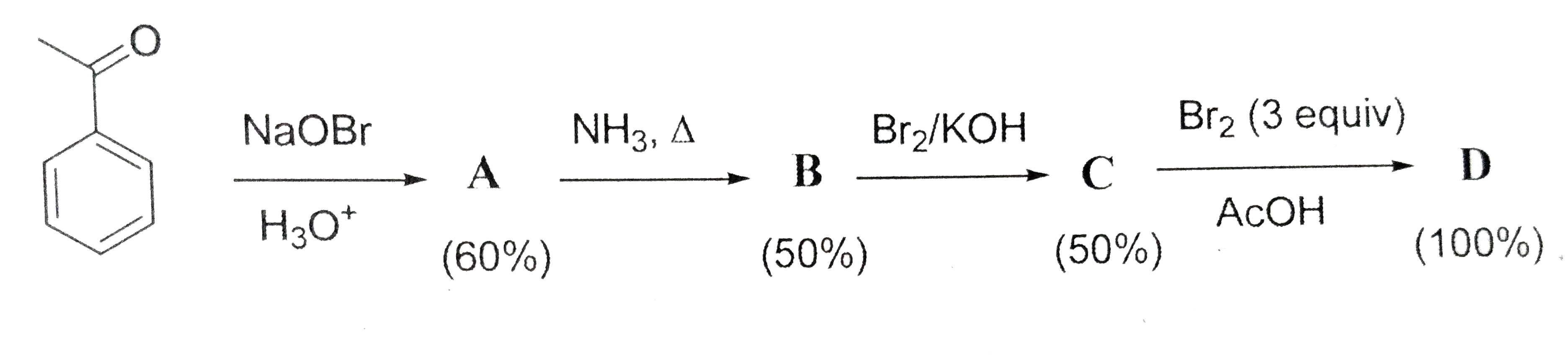
In the following reaction sequence, the amount of D (in g) formed from 10 moles of acetophenone is ____. (Atomic weights in g `mol^(-1)` : H = 1, C = 12, N = 14, O = 16, Br = 80. The yield (%) corresponding to the product in each step is given in the parenthesis)

Text Solution

Verified by Experts

The correct Answer is:

D
Promotional Banner

Topper's Solved these Questions

  • AROMATIC COMPOUNDS

    RESONANCE ENGLISH|Exercise PART-II JEE MAIN|19 Videos
  • AROMATIC COMPOUNDS

    RESONANCE ENGLISH|Exercise JEE(MAIN) ONLINE PROBLEM|16 Videos
  • AROMATIC COMPOUNDS

    RESONANCE ENGLISH|Exercise PART IV- COMPREHENSION|13 Videos
  • ATOMIC STRUCTURE

    RESONANCE ENGLISH|Exercise ORGANIC CHEMISTRY(Fundamental Concept )|16 Videos

Similar Questions

Explore conceptually related problems

Match the following : (Mass number : H=1 , C=12 , N=14 , O=16)

The mass percentage of nitrogen in histidine is "_________________" . [Atomic mass H=1,C =12, N = 14, O =16]

How many moles of O are present in 4.9 g of H_(3) PO_(4) ? (Atomic weight of P, O and H = 31, 16, 1 )

Calculate the molecular mass of the Mg_3N_2 . Given atomic mass of Na = 23, H = 1, O = 16, C = 12, N = 14, Mg = 24, S = 32

Calculate the molecular mass of the N_2SO_4 . 10H_2O Given atomic mass of Na = 23, H = 1, O = 16, C = 12, N = 14, Mg = 24, S = 32

Calculate the percentage of nitrogen in urea NH_2CONH_2 . Given : R.M.M. of N = 14, C = 12 , O = 16, H = 1 ?

Consider the following reactions. Molecular weight of the product would increase by [Assuming that mol. Wt. of C=12, O=16, H=1 and D=2]

The net enthalpy change of a reaction is the amount of energy required to break all the bonds in reactant molecules minus amount of energy required to form all the bonds in the product molecules. What will be the enthalpy change for the following reaction ? H_(2) (g) + Br_(2) (g) rarr 2HBr (g) . Given that, bond energy of H_(2), Br_(2) and HBr is 435 kJ mol^(-1), 192 kJ mol^(-1) and 368 kJ mol^(-1) respectively

Calculate the mole fraction of water in a sodium hydroxide solution which has 80 g of NaOH and 54g of H_(2)O . [Relative atomic masses : Na = 23, O = 16, H = 1]

Ammonia prepared by treating ammonium sulphate with calcium hydroxide is completely used NiCl_2.6H_2O to form a stable coordination compound. Assume that both the reactions are 100% complete. If 1584 g of ammonium sulphate and 952 g of NiCl_2.6H_2O are used in the preparation, the combined weight (in grams) of gypsum and the nickel - ammonia coordination compound thus produced is _____. (Atomic weights in g mol^(-1) : H=1,N=14,O=16 , S=32, Cl=35.5 , Ca=40 , Ni=59)

RESONANCE ENGLISH-AROMATIC COMPOUNDS -Exercise -3 Part-I
  1. The major product of the following reaction is :

    Text Solution

    |

  2. Amongst the compounds given, the one that would form a brilliant color...

    Text Solution

    |

  3. In the following reaction, the products formed is(are)

    Text Solution

    |

  4. The major product(s) of the following is (are):

    Text Solution

    |

  5. P and Q are isomers of dicarboxylic acid C(4)H(4)O(4). Both decolorize...

    Text Solution

    |

  6. In the following reaction, sequences V and W are respectively.

    Text Solution

    |

  7. The reactivity of compound Z with different halogens under appropriat...

    Text Solution

    |

  8. The the identification of beta-napthol using dye test, it is necessary...

    Text Solution

    |

  9. Match the four starting materials (P,Q,R,S) gien in List-I with the co...

    Text Solution

    |

  10. Among the following, the number of reaction(s) that produce(s) benzal...

    Text Solution

    |

  11. The major product U in the following reactions is

    Text Solution

    |

  12. In the following reactions, the major product W is:

    Text Solution

    |

  13. The product(s) of the following reactions sequence is(are)

    Text Solution

    |

  14. The correct statement(s) about of the following reaction sequence is(a...

    Text Solution

    |

  15. The major product of the following reaction is

    Text Solution

    |

  16. The reaction of compounf P with CH(3)MgBr (excess) in (C(2)H(5)(2)O fo...

    Text Solution

    |

  17. The reaction of compounf P with CH(3)MgBr (excess) in (C(2)H(5)(2)O fo...

    Text Solution

    |

  18. The reaction(s) leading to the formation of 1, 3, 5 -trimethylbenzene ...

    Text Solution

    |

  19. Aniline reacts with mixed acid conc. HNO(3) and conc. H(2)SO(4) at 288...

    Text Solution

    |

  20. In the following reaction sequence, the amount of D (in g) formed from...

    Text Solution

    |
