Home
Class 11
CHEMISTRY
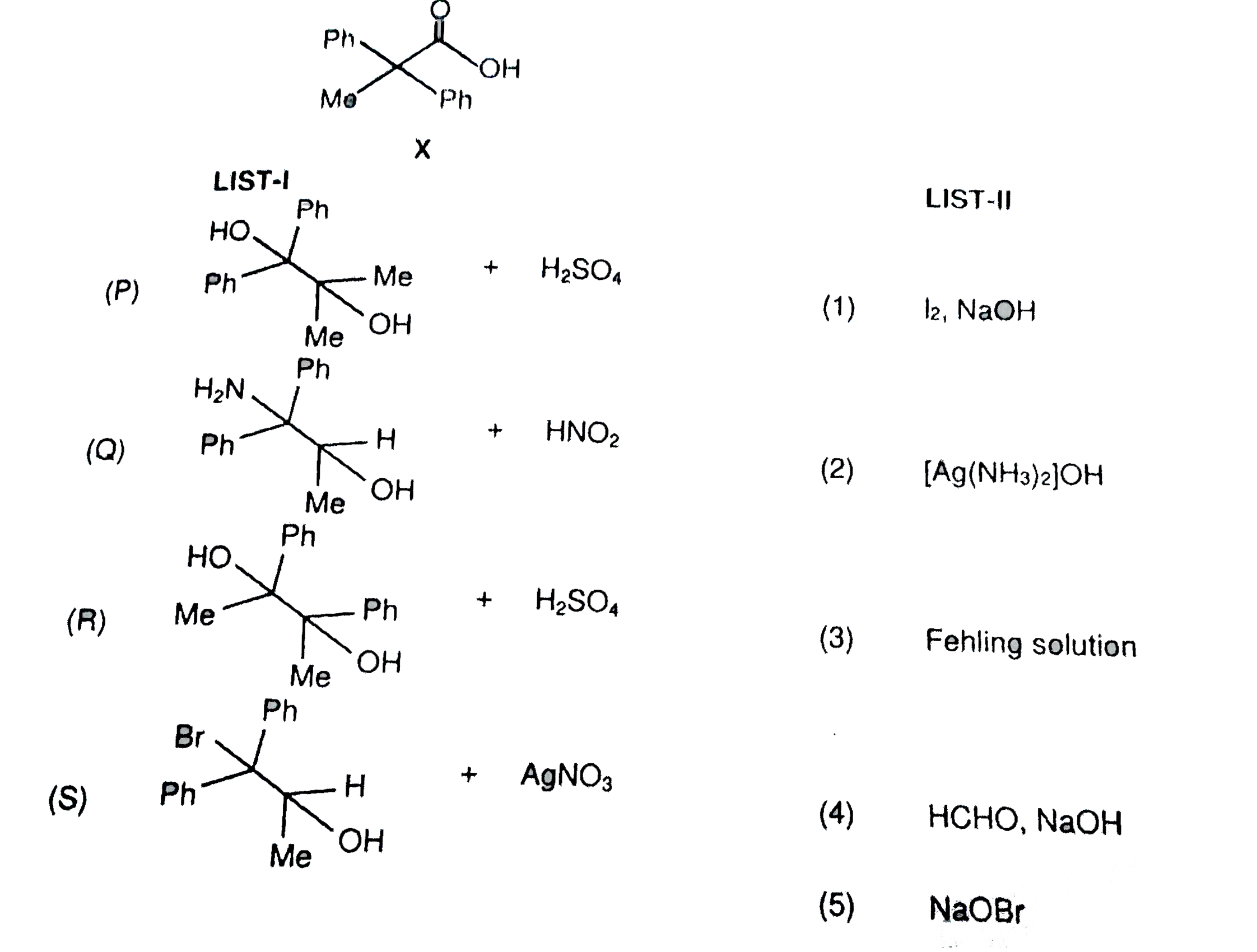
The desired product X can be prepared by...

The desired product X can be prepared by reacting the major product of the reaction in LIST-1 with one or more appropriate reagents in LIST-II (Given . Order of migratory aptitude : aryl gt alkyl gt hydrogen )

A

P`to`1 , Q`to`2,3 , R`to`1,4 , S`to`2,4

B

P`to`1,5 , Q`to`3,4 , R`to`4,5 , S`to`3

C

P`to`1,5 , Q`to`3,4 , R`to`5 , S`to`2,4

D

P`to`1,5 , Q`to`2,3 , R`to`1,5 , S`to`2,3

Text Solution

Verified by Experts

The correct Answer is:

D
Promotional Banner

Topper's Solved these Questions

  • ORGANIC REACTION MECHANISMS-IV

    RESONANCE ENGLISH|Exercise Exercise-3 Part-2 JEE (MAIN ) OFFLINE PROBLEMS|10 Videos
  • ORGANIC REACTION MECHANISMS-IV

    RESONANCE ENGLISH|Exercise Exercise-3 Part-2 JEE (MAIN ) ONLINE PROBLEMS|10 Videos
  • ORGANIC REACTION MECHANISMS-IV

    RESONANCE ENGLISH|Exercise Exercise-2 Part-4|8 Videos
  • ORGANIC REACTION MECHANISMS - II

    RESONANCE ENGLISH|Exercise APSP Part - 3|22 Videos
  • PERIODIC TABLE & PERIODICITY

    RESONANCE ENGLISH|Exercise ORGANIC CHEMISTRY(BASIC CONCEPTS)|27 Videos

Similar Questions

Explore conceptually related problems

An alkyl isocyanide can be prepared as a major product by which of the following reaction?

LIST-I contains reactions and LIST-II contains major products.

Read the following paragraph and answer the questions given below , Stable equilibrium is of various types . Mechanical equilibrium is achieved when all particles are at rest and total potential energy of the system is minimum . At any stage where particles are at rest but the system is not at stable equilibrium as it can reduce its potential energy by reverting to another position, is called metastable equilibrium . Thermal equilibrium is result from the absence of temperature gradients in the system. Chemical equilibrium is obtained when no further reaction occurs between reacting substances, i.e forward and reverse rates of reaction are equal. when steam with solid iron at high temperature Fe_3O_4(s) and hydrogen gas are produced . But the reaction never goes to completion. this is because as the products are formed the reaction proceeds in reverse direction and when rate of reverse reaction is equal to rate of forward reaction , the concentration of reactants and products become constant and equilibrium is reached. When a matchbox is balanced on its edge, it is unstable and will tumble to a more stable position resting on its face so as to acquire minimum potential energy. This is an example of

Read the following paragraph and answer the questions given below , Stable equilibrium is of various type . Mechanical equilibrium is achieved when all particles are at rest and total potential energy of the system is minimum . At any stage where particles are at rest but the system is not at stabel equilibrium as it can reduce its potential energy by reverting to another position, is called metastable equilibrium . Thermal equilibrium is result from the absence of temperature gradients in the system. chemical equilibrium is obtained when no further reaction occurs between reacting substances, i.e forward and reverse rates of reaction are equal. when steam with solid iron at high temperature Fe_3O_4(s) and hydrogen gas are produced . But the reaction never goes to completion. this is because as the products are formed the reaction proceeds in reverse direction and when rate of reverse reaction is equal to rate of forward reaction , the concentration of reactants and products become constant and equilibrium is reached. The correct expression for equilibrium constant of the reaction, taken as an example of chemical equilibrium in the above passage is

It we see the reaction of methane with halogen, the rate determining step for chlorination is, endothermic reaction of the chlorine atom with methane to form methyl radical and a molecule of HCl. So free radical is the intermediate of the reaction. Formation of free radical depends upon the energy required to break a bond between a hydrogen atom and a carbon atom. Chlorination of propane and Bromination of propane. when compared it is found that bromination is more selective than chlorination. The probability factor for 3^(@),2^(@),1^(@)H atom is 5.0:3.8:1.0 at 25^(@)C for chlorination. Isobutane when reacts with chlorine in presence of ultra violet radiations yield 2 products primary hydrogen substituted and 3^(@) hydrogen substituted Find their % in product mixture

Stabilities of alkanes can be compared by converting these compounds to a common product and comparing the amount of the heat given off. One possiblitiy would be to measure the heat of combustion from converting alkenes to xo_(2) and H_(2)O . The heats of combustion are of large values and measuring small difference in these large numbers is difficult. Alkene of the lowest heat of combustion among isomeric alkenes is of the lowest energy and is most stable. Th stability of alkenes is often compared by meansuring the ehat of hydrogenation 9 heat given off, Delta H_(h)^(@) during catalytic hydrogenation. The heat of hydrogenation is in smal number, which provides more accurate energy difference. For a compound containing more than one double bond, Delta_(h)^(@) is the sum of heat of hydrogenation of individual double bonds. For non - conjugated diens, this additive relatioship is found to hold. For conjugated dienes, however, the measured value is slightly lower than expected. Cumulated dienes, which are even less stable than non - conjugated dienes. The more stable is the alkene, lower is the heat of combustion and heat of hydrogenation. More highly substituted double bonds are usually more stable. In case of cyclokanes, compounds having higher angle strin are less stable. If the heat of hydrogenation of cyclooctene is about 23 k cal mo^(-1) , what would be the probable DeltaH_(b) or 1,3,5,7- cyclooctatetraene ?

Read the following paragraph and answer the questions given below , Stable equilibrium is of various types . Mechanical equilibrium is achieved when all particles are at rest and total potential energy of the system is minimum . At any stage where particles are at rest but the system is not at stable equilibrium as it can reduce its potential energy by reverting to another position, is called metastable equilibrium . Thermal equilibrium is result from the absence of temperature gradients in the system. Chemical equilibrium is obtained when no further reaction occurs between reacting substances, i.e forward and reverse rates of reaction are equal. When steam with solid iron at high temperature Fe_3O_4(s) and hydrogen gas are produced . But the reaction never goes to completion. This is because as the products are formed the reaction proceeds in reverse direction and when rate of reverse reaction is equal to rate of forward reaction , the concentration of reactants and products become constant and equilibrium is reached. The primary objective of the passage is

Stabilities of alkanes can be compared by converting these compounds to a common product and comparing the amount of the heat given off. One possibility would be to measure the heat of combustion from converting alkenes to CO_(2) and H_(2)O . The heats of combustion are of large values and measuring small difference in these large numbers is difficult. Alkene of the lowest heat of combustion among isomeric alkenes is of the lowest energy and is most stable. Th stability of alkenes is often compared by meansuring the ehat of hydrogenation 9 heat given off, Delta H_(h)^(@) during catalytic hydrogenation. The heat of hydrogenation is in smal number, which provides more accurate energy difference. For a compound containing more than one double bond, Delta_(h)^(@) is the sum of heat of hydrogenation of individual double bonds. For non - conjugated diens, this additive relatioship is found to hold. For conjugated dienes, however, the measured value is slightly lower than expected. Cumulated dienes, which are even less stable than non - conjugated dienes. The more stable is the alkene, lower is the heat of combustion and heat of hydrogenation. More highly substituted double bonds are usually more stable. In case of cyclokanes, compounds having higher angle strin are less stable. In which of the following is Delta H^_(h)^(@) the maximum ?

Stabilities of alkanes can be compared by converting these compounds to a common product and comparing the amount of the heat given off. One possibility would be to measure the heat of combustion from converting alkenes to CO_(2) and H_(2)O . The heats of combustion are of large values and measuring small difference in these large numbers is difficult. Alkene of the lowest heat of combustion among isomeric alkenes is of the lowest energy and is most stable. Th stability of alkenes is often compared by meansuring the ehat of hydrogenation 9 heat given off, Delta H_(h)^(@) during catalytic hydrogenation. The heat of hydrogenation is in smal number, which provides more accurate energy difference. For a compound containing more than one double bond, Delta_(h)^(@) is the sum of heat of hydrogenation of individual double bonds. For non - conjugated diens, this additive relatioship is found to hold. For conjugated dienes, however, the measured value is slightly lower than expected. Cumulated dienes, which are even less stable than non - conjugated dienes. The more stable is the alkene, lower is the heat of combustion and heat of hydrogenation. More highly substituted double bonds are usually more stable. In case of cyclokanes, compounds having higher angle strin are less stable. Which statement is false ?

RESONANCE ENGLISH-ORGANIC REACTION MECHANISMS-IV-Exercise-3 Part-1
  1. Identify (X),(Y) and (Z) in the following synthetic scheme and write t...

    Text Solution

    |

  2. Identify the set of reagents/ reaction condition ‘X’ and ‘Y’ in the fo...

    Text Solution

    |

  3. How many structures of F is possible?

    Text Solution

    |

  4. Which of the reagents on reaction with cyclohexanol gives best yield o...

    Text Solution

    |

  5. Match the following (one term in column-I may match with more than one...

    Text Solution

    |

  6. In the following reaction sequence , product I,J and L are formed , K ...

    Text Solution

    |

  7. In the following sequence, product I, ,J and L are formed. K represent...

    Text Solution

    |

  8. In the following sequence, product I,J and L are formedK represents a ...

    Text Solution

    |

  9. The total number of alkenes possible by dehydrobromination of 3-bromo-...

    Text Solution

    |

  10. An acyclic hydrocarbon P, having molecular fromula C(6)H(10) gave acet...

    Text Solution

    |

  11. An acyclic hydrocarbon P, having molecular formula C6H10 , gave aceton...

    Text Solution

    |

  12. The major product (H) in the given reaction sequence is : CH3-CH2-CO...

    Text Solution

    |

  13. Match the chemical conversion in List-I with the approprotae reagents ...

    Text Solution

    |

  14. In the following reactions : Compound X is

    Text Solution

    |

  15. In the following reactoins The major compound Y is

    Text Solution

    |

  16. The number of hydroxyl group(s) in Q is overset(H^(+))underset("hea...

    Text Solution

    |

  17. The desired product X can be prepared by reacting the major product of...

    Text Solution

    |

  18. LIST-I contains reactions and LIST-II contains major products.

    Text Solution

    |
