Home
Class 11
CHEMISTRY
An unknown compound decolorizes bromine ...

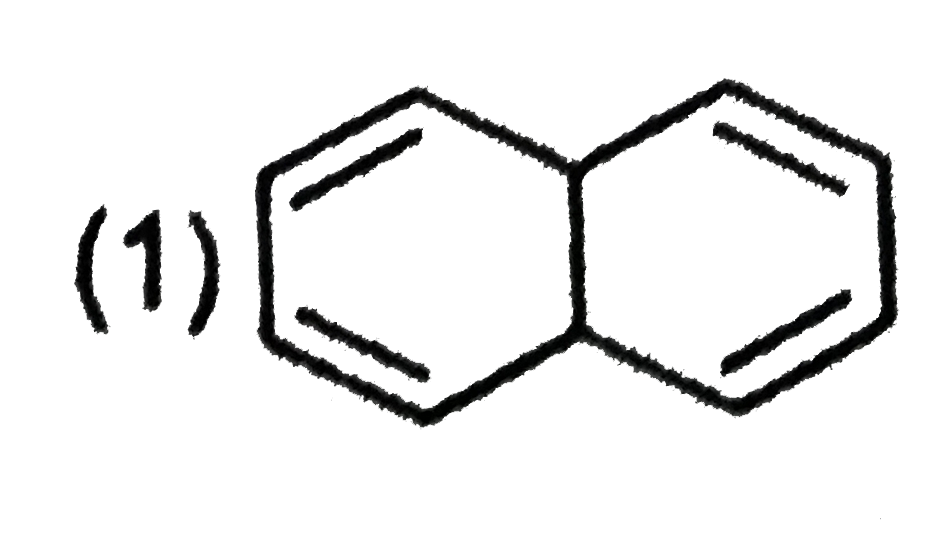
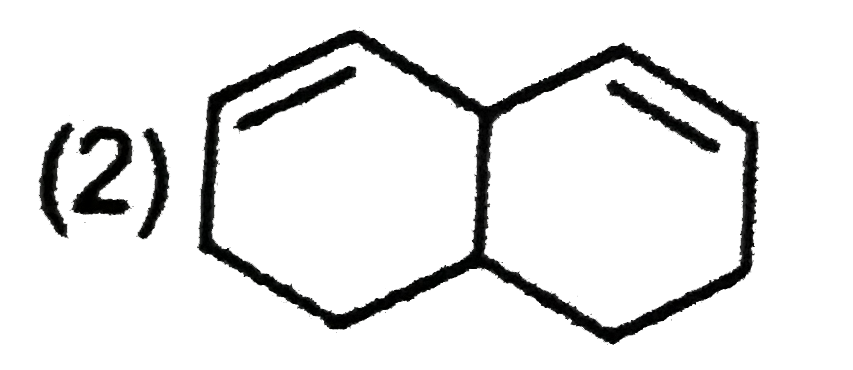
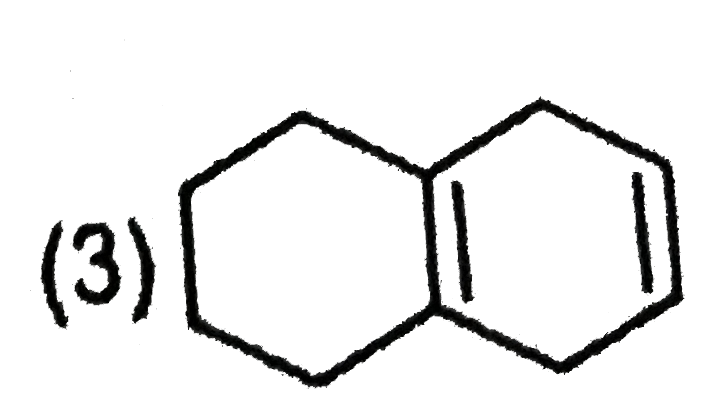
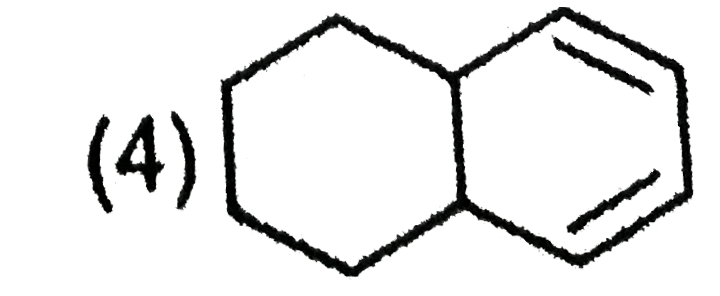
An unknown compound decolorizes bromine in carbon tetrachloride, and it undergoes catalytic reduction to give decalin. When treated with warm, conc, potassium permangate, this compound give cis-cyclohexane-1, 2-dicaboxylic acid and oxalic acid. Possible a structure for th unknown compound is-

A

B

C

D

Text Solution

AI Generated Solution

The correct Answer is:

To determine the structure of the unknown compound based on the provided information, we will follow a step-by-step approach: ### Step 1: Analyze the given information The unknown compound decolorizes bromine in carbon tetrachloride, indicating that it likely contains a double bond (unsaturated compound). Additionally, it undergoes catalytic reduction to yield decalin, which consists of two fused cyclohexane rings. **Hint:** Look for compounds that are unsaturated and can form decalin upon reduction. ### Step 2: Understand the reaction with potassium permanganate When treated with warm, concentrated potassium permanganate (KMnO4), the compound produces cis-cyclohexane-1,2-dicarboxylic acid and oxalic acid. This suggests that the compound has double bonds that can be oxidized to form carboxylic acids. **Hint:** KMnO4 is a strong oxidizing agent that can oxidize alkenes to carboxylic acids. ### Step 3: Identify potential structures We need to consider the possible structures of the unknown compound. Since it can decolorize bromine, it must have at least one double bond. The oxidation products indicate that the compound likely has two double bonds that can be oxidized to form the dicarboxylic acid and oxalic acid. **Hint:** Look for structures with multiple double bonds that can lead to the formation of the required oxidation products. ### Step 4: Evaluate the compounds We will evaluate each potential compound to see which one meets the criteria: 1. **First compound:** When oxidized, it forms only oxalic acid and does not yield the required dicarboxylic acid. Thus, it is not the unknown compound. 2. **Second compound:** Similar to the first, it does not yield the required products upon oxidation. Therefore, it is also not the unknown compound. 3. **Third compound:** This compound does not yield the required products either, as it does not lead to the formation of the dicarboxylic acid. 4. **Fourth compound:** Upon oxidation, this compound produces both cis-cyclohexane-1,2-dicarboxylic acid and oxalic acid, meeting the criteria set out in the problem. **Hint:** Compare the products of oxidation for each compound to see which one matches the expected results. ### Step 5: Conclusion Based on the analysis, the structure of the unknown compound is the fourth compound, as it is the only one that produces the required oxidation products when treated with KMnO4. **Final Answer:** The possible structure for the unknown compound is the fourth compound.

To determine the structure of the unknown compound based on the provided information, we will follow a step-by-step approach: ### Step 1: Analyze the given information The unknown compound decolorizes bromine in carbon tetrachloride, indicating that it likely contains a double bond (unsaturated compound). Additionally, it undergoes catalytic reduction to yield decalin, which consists of two fused cyclohexane rings. **Hint:** Look for compounds that are unsaturated and can form decalin upon reduction. ### Step 2: Understand the reaction with potassium permanganate ...
Promotional Banner

Topper's Solved these Questions

  • REDUCTION, OXIDATION & HYDROLYSIS REACTIONS

    RESONANCE ENGLISH|Exercise Part-II : National Standard Examination in Chemistry|27 Videos
  • REDUCTION, OXIDATION & HYDROLYSIS REACTIONS

    RESONANCE ENGLISH|Exercise Part-III : High Level Problems (Subjective Questions)|6 Videos
  • REDUCTION, OXIDATION & HYDROLYSIS REACTIONS

    RESONANCE ENGLISH|Exercise JEE (MAIN) ONLINE PROBLEMS|13 Videos
  • PERIODIC TABLE & PERIODICITY

    RESONANCE ENGLISH|Exercise ORGANIC CHEMISTRY(BASIC CONCEPTS)|27 Videos
  • S BLOCK ELEMENTS

    RESONANCE ENGLISH|Exercise ORGANIC CHEMISTRY(Biomolecules & Polymer)|4 Videos

Similar Questions

Explore conceptually related problems

A compound decolourises Baeyer's reagent and gives a mixture of propanoic acid and ethanoic acid when treated with a hot and conc. solution of KMnO_4 . The compound is

A compound X react with Na_(2)O_(2) and forms Y , Y is reacted with nitric acid and then treated with ammonium molybdate to give yellow ppt.

Compound (A) C_(6)H_(12) gives a positive test with bromine in carbon tetrachloride. Reaction of (A) with alkaline KMnO_(4) yields only (B) which is the potassium salt of an acid. Write structure formulae and IUPAC name of (A) and (B).

An alkene A on ozonolysis yields acetone and an aldehyde. The aldehyde is easily oxidised to an acid B. When B is treated with bromine in presence of yields a compound C which on hydrolysis gives a hydroxyle acid D. This acid can also be obatined from acetone by the reaction with hydrogen cyanide followed by hydrolysis. Identify the compounds A, B C and D.

RESONANCE ENGLISH-REDUCTION, OXIDATION & HYDROLYSIS REACTIONS-Additional problems for self Practice (Part-1)
  1. What are the oxidation states of chromium in the following : CrO(4)^-...

    Text Solution

    |

  2. An alkene on ozonolysis yields only ethanal. There is an isomer of the...

    Text Solution

    |

  3. Chromium chloride reacts with sodium hydroxide to form a green precipi...

    Text Solution

    |

  4. Which of the following will declourise alkaline KMnO(4)solution ?

    Text Solution

    |

  5. Baeyer's reagent is

    Text Solution

    |

  6. Ferric sulphate reacts with sodium hydroxide to form a reddish brown p...

    Text Solution

    |

  7. , Product B and C are respectively :

    Text Solution

    |

  8. Complete the following reaction

    Text Solution

    |

  9. Fenton's reagent is :

    Text Solution

    |

  10. The reagent with which both acetaldehyde and acetone react easily, is ...

    Text Solution

    |

  11. Heating of sodium acetate with soda lime produces

    Text Solution

    |

  12. When acetaldehyde is heated with Fehling's solution, it given a precip...

    Text Solution

    |

  13. Heating of PCl(5) with formic acid produces

    Text Solution

    |

  14. Which of the following reaction involves homogeneous reduction ?

    Text Solution

    |

  15. X is:

    Text Solution

    |

  16. Which reducing agent, you can't use to carry out the following transfo...

    Text Solution

    |

  17. Complete the following reaction

    Text Solution

    |

  18. An unknown compound decolorizes bromine in carbon tetrachloride, and i...

    Text Solution

    |

  19. The reaction, Ph-CH(2)-CH=CH-overset(OH)overset(|)(CH)-CH(3) underset(...

    Text Solution

    |

  20. The reagent used to convert RCOOH rarr RCH(2)OH is

    Text Solution

    |
