Home
Class 12
PHYSICS
A charges Q is placed at each of the two...

A charges Q is placed at each of the two opposite corners of a square. A charge q is placed to each of the other two corners. If the resultant force on each charge q is zero, then

Text Solution

Verified by Experts
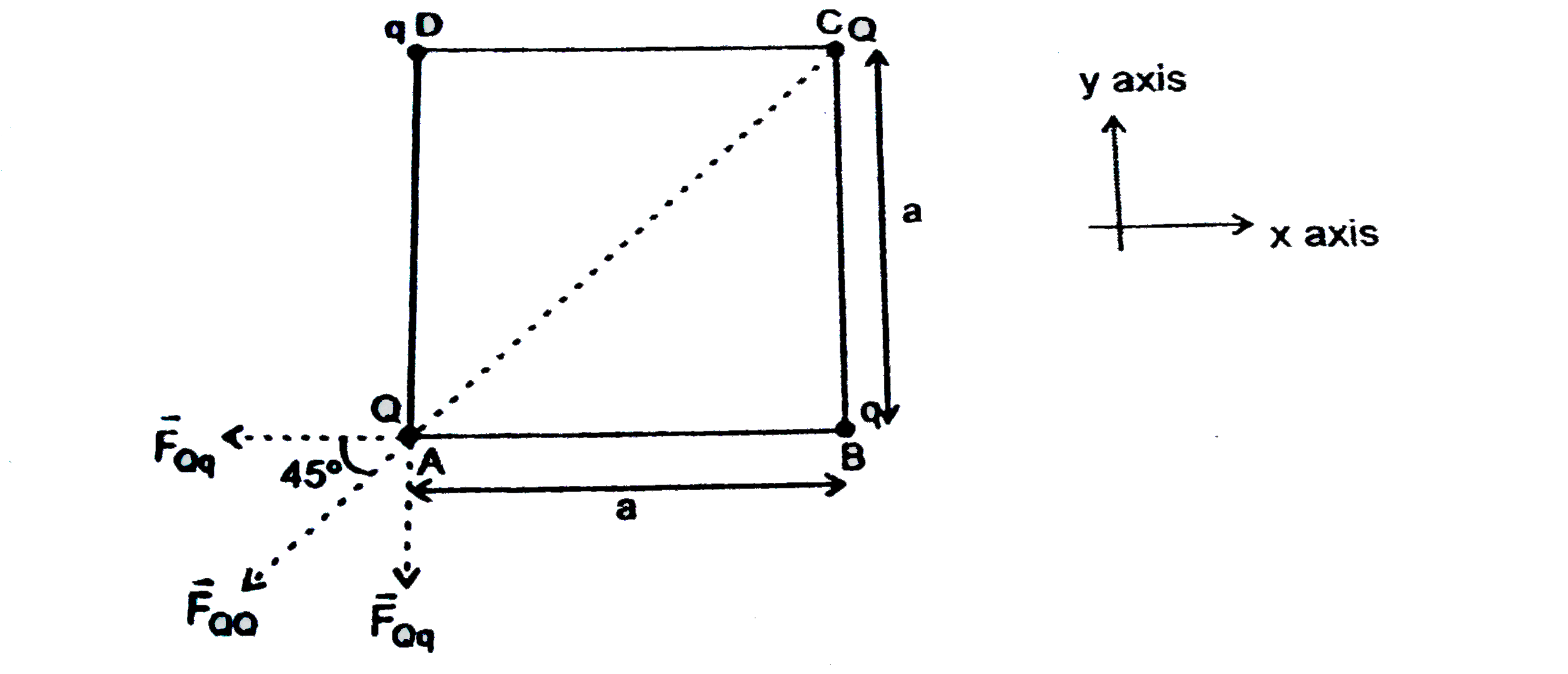
(a) Let on a square ABCD, charges are placed as shown

Now, forces on charge Q (at point A) due to other charge are `vec(F)_(Q Q), vec(D)_(Q q)` and `vec(F)_(Q q)` respectively as shown in figure.
`F_("net")` on `Q=vec(F)_(Q. Q)+vec(F)_(Qq)+vec(F)_(Qq)` (at point A)
But `F_("net")=0`
So, `SigmaF_(x)=0`
`SigmaF_(x)=-F_(Q Q) cos 45^(@)-F_(Q q)`
`implies(KQ^(2))/((sqrt(2)a)^(2)). 1/sqrt(2)+(KQq)/a^(2)=0 implies" "q=-Q/(2sqrt(2))`
(b) For resultant force on each charge o be zero :
From previous data, force on charge Q is zero when `q=-Q/(2sqrt(2))` If for this value of charge q, force on q is zero, then and only then the value of q exists for which the resultant force on each charge is zero.
Force on q :
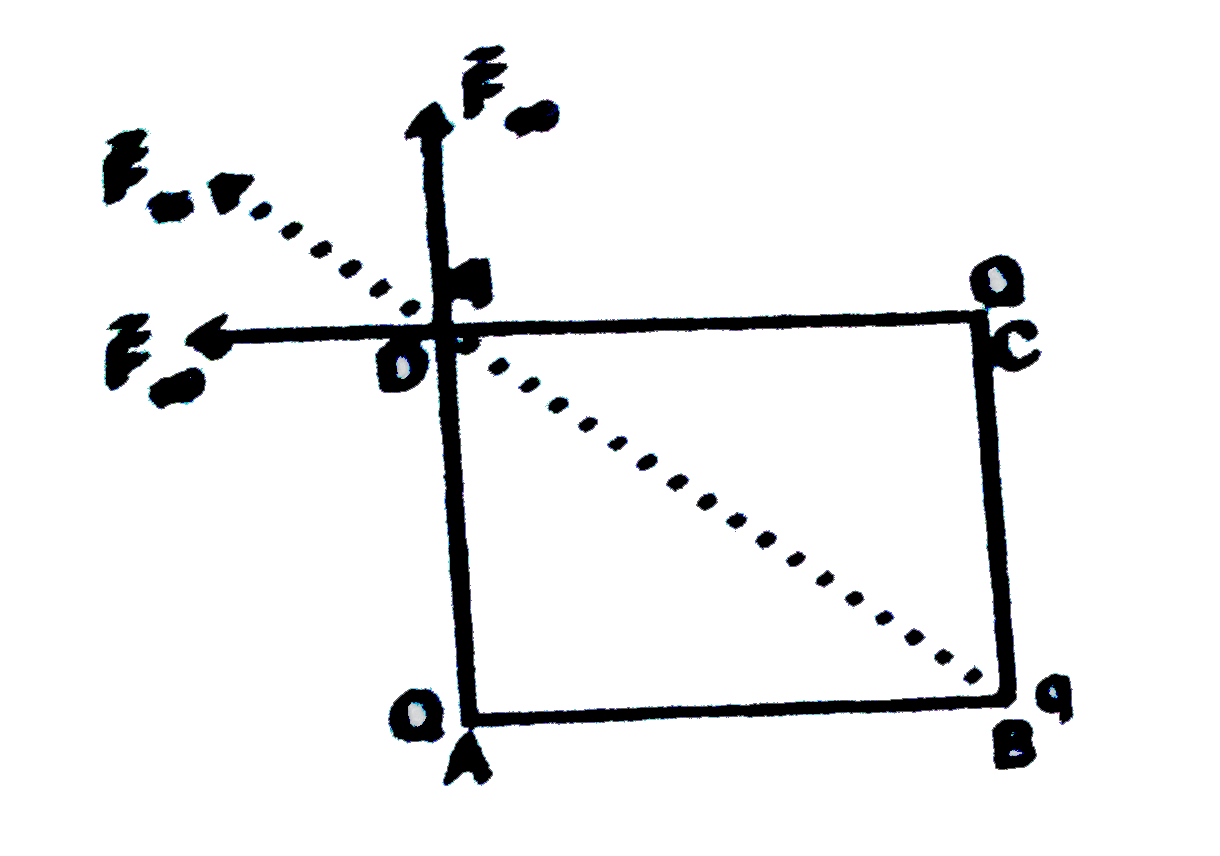
Forces on charge q (at point D) due to other three charges are `vec(F)_(q Q), vec(F)_(q q)` and `vec(F)_(q Q)` respectively as shown in figure.
Net force on charge q :
`vec("net")=vec(F)_(q q)+vec(F)_(q Q)+vec(F)_(q Q)` But `vec(F)_("net")=0`
So, `SigmaF_(x)=0`
`SigmaF_(x)=-(Kq^(2))/((sqrt(2)a)^(2)). 1/sqrt(2)-(KQq)/((a)^(2))" "implies" "q=2sqrt(2)-Q`
But from previous condition, `q=-Q/(2sqrt(2))`
So, no value of q makes the resultant force on each charge zero.
Promotional Banner

Topper's Solved these Questions

  • ELECTROSTATICS

    RESONANCE ENGLISH|Exercise Exercise-1 Section (A)|9 Videos
  • ELECTROSTATICS

    RESONANCE ENGLISH|Exercise Exercise-1 Section (B)|12 Videos
  • ELECTROSTATICS

    RESONANCE ENGLISH|Exercise HLP|40 Videos
  • ELECTROMAGNETIC INDUCTION

    RESONANCE ENGLISH|Exercise A.l.P|19 Videos
  • EXPERIMENTAL PHYSICS

    RESONANCE ENGLISH|Exercise PART -II|10 Videos

Similar Questions

Explore conceptually related problems

A charge Q is place at each of the opposite corners of a square. A charge q is placed at each of the other two corners. If the net electrical force on Q is zero, then Q//q equals:

Two equal point charges Q=+sqrt(2) mu C are placed at each of the two opposite corners of a square and equal point charges q at each of the other two corners. What must be the value of q so that the resultant force on Q is zero?

Four positive charges (2sqrt2-1)Q are arranged at the four corners of a square. Another charge q is placed at the centre of the square. Resulting force acting on each corner charge is zero if q is

A point charge Q is placed at the corner of a square of side a. Find the flux through the square.

Three charges each of value q are placed at the corners of an equilateral triangle. A fourth charge Q is placed at the center of the triangle. a. Find the net force on charge q. b. If Q = -q , will the charges at the corners move toward the center or fly away from it ? c. For what value of Q at O will the charges remain stationary ? d. In situation (c), how much work is done in removing the charges to infinity?

Four charges of +q, +q +q and +q are placed at the corners A, B, C and D of s square. The resultant force on the charge at D

A charge Q is placed at each corner of a cube of side a. The potential at the centre of the cube is

A charge Q is placed at the corner of a cube of edge length L. The electric flux linked to one of the faces not touching the charge Q is

Four charges equal to -Q are placed at the four corners of a square and a charge q is at its centre. If the system is in equilibrium the value of q is

Two equal charges q are placed at a distance of 2a and a third charge -2q is placed at the midpoint. The potential energy of the system is

RESONANCE ENGLISH-ELECTROSTATICS-Problems
  1. Two equal positive point charges 'Q' are fixed at points B (a, 0) and ...

    Text Solution

    |

  2. A particle of mass m and charge q is located midway between two fixed ...

    Text Solution

    |

  3. A charges Q is placed at each of the two opposite corners of a square....

    Text Solution

    |

  4. A large nonconducting sheet M is given a uniform charge density. Two u...

    Text Solution

    |

  5. Figure shows a uniformly charged sphere of radius R and total charge Q...

    Text Solution

    |

  6. Two concentric spherical shells of radius R(1) and R(2) (R(2) gt R(1))...

    Text Solution

    |

  7. A solid non conducting sphere of radius R and uniform volume density r...

    Text Solution

    |

  8. Three uniform spheres each having a mass M and radius a are kept in su...

    Text Solution

    |

  9. A uniform electric field of 20 N/C exists in the vertically downward d...

    Text Solution

    |

  10. An electric field of 20 N C ^(-1) exists along the x-axis in space. Ca...

    Text Solution

    |

  11. Some equipotential surfaces are shown in figure(29.E3) What can you sa...

    Text Solution

    |

  12. A point charge of charge -q and mass m is released with negligible spe...

    Text Solution

    |

  13. Four small point charges (each of equal magnitude q) are placed at fou...

    Text Solution

    |

  14. If V=x^(2)y+y^(2)z then find vec(E) at (x, y, z)

    Text Solution

    |

  15. Magnitude of electric field only on the x-coordinate as vec(E)=20/x^(2...

    Text Solution

    |

  16. If E=2r^(2) then find V(r)

    Text Solution

    |

  17. A charge Q is uniformly distributed over a rod of length l. Consider a...

    Text Solution

    |

  18. A charge Q is placed at the centre of a cube. Find the flux of the ele...

    Text Solution

    |

  19. An isolated conducting sphere of charge Q and radius R is grounded by ...

    Text Solution

    |

  20. An isolated conducting sheet of area A and carrying a charge Q is plac...

    Text Solution

    |